

Qantas Europe Flights Shift Via Singapore
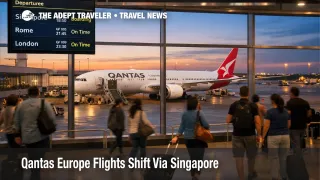
Qantas is adding Europe capacity in a way that gives some Australia bound travelers a more workable path around weakened Gulf connections, but the benefit is narrower than a simple "more flights to Europe" headline suggests. From mid April through mid July 2026, the airline says it will operate more Australia to Europe flying as demand rises while Dubai, Doha, and other Gulf transfer points remain disrupted or unevenly restored. The practical change is that Rome gets more nonstop capacity from Perth, while Paris is being reworked into a Sydney via Singapore service rather than staying a Perth nonstop. Travelers choosing between rebooking and waiting should read this as a useful rerouting option, not a broad fare relief story.
Qantas Europe Flights: What Changed
Qantas says its updated Europe schedule will roll out progressively from mid April and run until mid July. On the record, the airline says Perth to London Heathrow is operating via Singapore for a fuel stop, Paris flights will originate in Sydney and operate via Singapore instead of Perth, and the broader Europe adjustment is designed to add more flying between Australia and Europe. Reuters reported the Paris service rises to five return flights a week from three, Perth to Rome goes from four weekly returns to daily, and Perth to Singapore increases from seven to 10 weekly.
Schedule filings add the sharper timing. AeroRoutes shows Sydney, Perth, Rome Fiumicino ramping from three to four weekly to six weekly on May 22, 2026, then daily from June 20, 2026, through July 26, 2026. It also shows Sydney, Singapore, Paris Charles de Gaulle replacing the Sydney, Perth, Paris pattern from April 20, 2026, with four weekly flights, increasing to five weekly from May 19, 2026, through July 25, 2026.
That makes this a real network shift, not just extra seats. Rome gains frequency and resilience for travelers willing to route through Perth, while Paris gains capacity but loses the cleaner Perth nonstop structure that had differentiated it before. In an earlier Adept Traveler article, Gulf Airline Recovery Stays Too Uneven for Connections, the main warning was that bookable Gulf itineraries still lacked recovery depth. Qantas is now leaning into that weakness by building a Europe bridge through Singapore instead.
Who Benefits Most From the New Qantas Europe Capacity
The biggest winners are Australia based travelers who want to avoid a traditional one stop Europe itinerary through the Gulf, especially those starting in Sydney, New South Wales, Australia, or Perth, Western Australia, Australia, and those headed to Rome, Paris, or onward European rail connections from those gateways. Rome is the cleanest improvement because more weekly flying usually means better odds of getting a workable date, a less fragile schedule, and a better chance of same airline reaccommodation when something slips.
Paris is more mixed. Yes, the route gets more capacity, and Qantas says the shift to Sydney via Singapore allows an additional 60 passengers on each service. But Perth based travelers lose the nonstop outbound to Paris from mid April, which means the practical benefit moves toward Sydney originating passengers and travelers who value avoiding Gulf hubs more than they value nonstop simplicity.
The travelers least helped are bargain hunters hoping this will loosen the market broadly. ABC cited aviation analyst Justin Wastnage saying up to 30 percent of Australia to Europe capacity had been removed and that this Qantas move was unlikely to produce cheaper airfares in a constrained market. Reuters has separately reported that Asia Europe fares jumped earlier in March as travelers looked for ways around Middle Eastern airspace and disrupted hub flows.
In an earlier Adept Traveler article, Europe Middle East Flight Cuts Stay in Place for Summer, the pressure point was thinning nonstop capacity between Europe and the Middle East. This Qantas move shows where some of that displaced long haul demand is now going, Singapore and Australia based bridges rather than the older Gulf centered map.
What Travelers Should Do Before Booking
Travelers bound for Rome should treat the added Qantas flying as a real improvement in itinerary resilience, especially for trips from late May through late July. Daily service from June 20, 2026, materially improves flexibility compared with a four flight per week pattern. That matters most for fixed date trips, premium itineraries, and journeys with onward rail, cruise, or hotel commitments that are expensive to miss.
Paris travelers should slow down and check the operating pattern, not just the route name. The key tradeoff is straightforward. You gain more total seats and a Singapore based routing that avoids the most stressed Gulf hubs, but you may lose the nonstop Perth departure that made the old setup attractive. Rebook early if you are Perth based and the nonstop outbound was the reason you chose Qantas in the first place. Wait a bit longer only if your dates are flexible and a Singapore connection works as well as, or better than, a Gulf transfer.
Watch the next decision window closely. Qantas says affected customers are being offered alternative flights within 24 hours of the original departure or a refund, and it says it may make further adjustments depending on fuel security, fuel prices, and demand. That means this is not yet a settled summer map. Travelers booking Europe for late July and beyond should treat current availability as provisional until the airline shows what stays in place after the temporary adjustment window ends.
Why the Rerouting Map Is Shifting Away From Gulf Hubs
The mechanism is bigger than one airline. Reuters reported that the war linked disruption after the February 28, 2026 strikes on Iran hit major Middle East aviation flows, pushed Gulf airline activity far below normal, and left recovery uneven, with Emirates around three quarters of pre conflict capacity, Etihad and Air Arabia around half, flydubai around one third, and Qatar Airways around one fifth. That weakens the old transfer system even where airports are open and some flights are back on sale.
Qantas is responding to that weakness by moving aircraft and changing geometry. Reuters said the airline is redeploying some Boeing 787s from U.S. routes and shifting some domestic A330 flying onto international work. ABC separately reported that the move could mark a broader shift toward Perth and Darwin as more useful Australia based bridges into Europe if Gulf disruption stays stubborn.
The second order effect is that demand may get safer in routing terms without getting easier in price or inventory terms. Fewer travelers will want Dubai or Doha as their default bridge while the hubs remain thin, but that displaced demand has to go somewhere. Rome, Paris, Singapore, and connected short haul or rail markets become part of the pressure chain. For travelers, the main takeaway is blunt, Qantas has created a better workaround, not a cheap one.
Sources
- Travel updates, Qantas
- International flight network, Qantas
- Australia's Qantas boosts Europe flight as demand climbs due to Mideast war, Reuters, March 26, 2026
- Gulf airlines recover slowly as Iran conflict drags, Reuters, March 23, 2026
- Qantas ramps up services to Europe as travellers avoid Middle East stopovers, ABC News, March 26, 2026
- Qantas NS26 Intercontinental Network Changes, AeroRoutes, March 27, 2026