

Vietnam Flight Cuts Hit April Domestic Connections
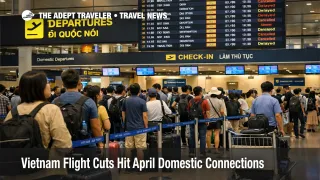
Vietnam flight cuts are now a published April planning problem, not just an energy market warning. Vietnam Airlines has already confirmed domestic route suspensions from April 1, and Reuters reported on March 27 that other Vietnamese carriers are also preparing cuts as fuel supply constraints tied to the Middle East conflict push airlines from contingency planning into schedule action. For travelers, the main exposure is not only a canceled domestic segment. It is the way thinner domestic lift can break multi city itineraries, same day international connections, and prepaid hotel sequencing across Vietnam.
Vietnam Flight Cuts: What Changed
What changed is that route trimming is now published at the airline level. Reuters reported on March 24 that Vietnam Airlines will suspend seven domestic routes and cancel 23 flights a week from April 1, including Hai Phong to Buon Ma Thuot, Cam Ranh, Phu Quoc, and Can Tho, plus Ho Chi Minh City to Van Don, Rach Gia, and Dien Bien. Reuters then reported on March 27 that the pressure is broader than one airline. Vietnam Airlines is also planning wider capacity reductions if fuel prices stay elevated, Vietjet Air plans to cut April capacity, Bamboo Airways aims to halve daily flights to about 17, and Sun PhuQuoc Airways says it can hold its current schedule only through the end of April for now.
The outlook is not yet a blanket shutdown. The Civil Aviation Authority of Vietnam said operations through mid April are expected to remain stable, and fuel suppliers have committed supply through that period. The problem is what comes after that buffer. The same CAAV update said fuel availability beyond mid April is uncertain, and airlines may be forced onto the spot market at much higher prices. That is why this story now sits in the meaningful disruption category for April travel inside Vietnam rather than in the minor friction bucket.
In an earlier Adept Traveler article, Vietnam Jet Fuel Warning Puts April Flights at Risk the risk was that schedule cuts might arrive. That threshold has now been crossed. In an earlier Adept Traveler article, Vietnam Flight Cuts Watch Expands Across Asia the bigger regional warning was that Vietnam looked like a lead indicator for wider Asia fuel stress. The new development is narrower and more useful for readers, actual published route and capacity pain.
Which Vietnam Itineraries Are Most Exposed
The most exposed travelers are not people staying in one gateway city for several days. The risk is higher for anyone using Vietnam's domestic network as a bridge between international arrival points, island destinations, smaller regional cities, and tight same day onward flights. Trips built around Ho Chi Minh City, Hanoi, Hai Phong, Phu Quoc, Dien Bien, Can Tho, or Van Don are more vulnerable because once domestic frequency drops, the remaining seats carry more of the network.
That matters most for travelers flying into Tan Son Nhat International Airport (SGN) or Noi Bai International Airport (HAN) and then continuing on separate tickets. A missed domestic feeder in a normal week can often be patched with a later same day option. A thinner April schedule makes that much less reliable. First order, a suspended route or reduced frequency removes flexibility. Second order, missed onward international links, forced extra hotel nights, tour reshuffles, and pricier last minute rebooking become more likely because fewer backup seats remain in the system.
International travelers should also watch for cost creep even where flights still operate. Reuters reported that Vietnamese airlines are preparing fuel surcharges on international routes from early April, and CAAV linked the cuts to rapidly rising Jet A 1 prices, with March averages projected around $190 to $200 per barrel and a March 24 reading of $234.34 per barrel. Vietnam has also suspended several fuel taxes through April 15 to stabilize the market, but that tax relief does not eliminate the physical supply problem.
What Travelers Should Do Now
Start by treating domestic flights inside Vietnam as the weakest link in any April itinerary. If your trip depends on a domestic connection to meet a long haul departure, cruise embarkation, or timed tour, give yourself an overnight buffer instead of a same day handoff where possible. That is especially true if you are traveling to or from one of the already named route pairs, or if your backup option would require another domestic hop.
The next decision point is ticket structure. If you have not booked yet, favor one ticket or one alliance protected itinerary over separate bookings, even if the fare is a little higher. If you are already booked on separate tickets, check whether your international segment can be moved to a later departure or whether a gateway hotel night is cheaper than absorbing a missed long haul leg. Travelers heading to Vietnam should also review Vietnam Entry Requirements For Tourists In 2026 so documentation does not become the second problem when flight options are already thinner.
Monitoring matters over the next several days. Watch for whether Vietnam Airlines publishes deeper domestic trims, whether Vietjet and Bamboo load more reductions into April schedules, and whether international fuel surcharges become active across more carriers. If your travel falls after mid April, pay closer attention than travelers departing in the first half of the month, because the official supply assurance currently runs only to mid April. For many April trips, the practical threshold is simple, rebook earlier if your plan depends on a same day domestic to international handoff with no slack.
Why More Schedule Pressure Could Follow
The mechanism is straightforward. Vietnam depends heavily on imported aviation fuel, and CAAV said most supply comes from China, Thailand, and Singapore, while only about 20 percent comes from domestic refineries. With Middle East conflict driving price spikes, physical premiums, insurance costs, and supply chain disruption, airlines face both cost pressure and a real sourcing problem. That is why the story moved from fuel inflation to schedule cuts.
What happens next depends on whether supply remains stable past mid April and whether carriers can keep buying fuel at workable prices. For now, the published route suspensions are concentrated in thinner domestic markets, which suggests airlines are trying to preserve politically and commercially important flying first. Reuters said Vietnam Airlines is prioritizing routes tied to national connectivity, trade, tourism, diplomacy, and domestic travel. That means trunk routes may hold up longer than leisure heavy or low volume links, but it also means secondary cities can lose flexibility fast.
Travelers should read this as a live network thinning story, not a one day headline. Vietnam flight cuts are already hitting domestic connectivity from April 1, international surcharges may arrive from early April, and the official stability window only clearly reaches mid April. If fuel availability improves, airlines could stop at limited trims. If it does not, Vietnam flight cuts could spread from named suspensions into a wider April capacity squeeze across both domestic and regional flying.
Sources
- Vietnam Airlines plans domestic route cuts due to jet fuel shortage, regulator says, Reuters
- Vietnamese airlines to cut flights due to fuel supply constraints, Reuters
- Vietnamese airlines adjust flight networks from April to optimise efficiency, VietnamPlus
- Giảm thuế đối với xăng, dầu từ 24 giờ ngày 26/3/2026, Civil Aviation Authority of Vietnam