

Washington ATC Outage Delays DCA, IAD, BWI Again
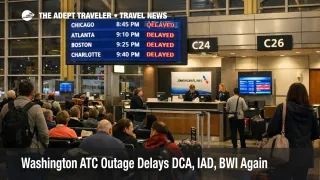
Washington ATC outage delays hit Ronald Reagan Washington National Airport (DCA), Washington Dulles International Airport (IAD), and Baltimore/Washington International Thurgood Marshall Airport (BWI) on March 27, 2026 after a strong odor forced the evacuation of the Potomac Consolidated Terminal RADAR Approach Control facility in Warrenton, Virginia and triggered a ground stop beginning at 6:40 p.m. EDT. Flights resumed about 90 minutes later, but delay carryover remained visible into Saturday, with FlightAware still showing average departure delays at DCA, BWI, and IAD. For travelers this weekend, the problem is not just one paused departure bank, it is the knock on effect on aircraft turns, crew timing, and short onward connections across the East Coast and Midwest.
Washington ATC Outage: What Changed
What changed on March 27 is that Washington area airport disruption came from a different failure point than the TSA staffing story. The FAA halted traffic after controllers evacuated Potomac TRACON, the regional radar approach facility that handles a large share of the Washington and surrounding airspace. Reuters reported that roughly 30 percent of incoming flights at BWI and DCA were delayed after the stop, with 13 percent delayed at Dulles, even after operations resumed. AP also reported that the disruption extended beyond the three main Washington airports to Charlottesville Albemarle Airport (CHO) and Richmond International Airport (RIC).
That makes this a real weekend planning issue, not a one line overnight operations note. DCA remains the sharpest pressure point, with FlightAware showing average departure delays of about 1 hour 20 minutes and average arrival delays of roughly 55 minutes to 1 hour as conditions improved, while BWI and IAD were still showing average departure delays of about 57 minutes and 36 minutes respectively when those airport pages were indexed.
In an earlier Adept Traveler article, Washington ATC Outage Delays DCA, IAD, BWI, RIC, the warning was that a March 13 Potomac TRACON failure could keep Washington area traffic fragile even after flights resumed. That warning now has a second real world test.
Which Travelers Face the Most Disruption
The most exposed travelers are people originating at DCA, connecting through DCA on short domestic banks, and passengers using Dulles or BWI for late arriving flights that roll into first wave Saturday departures. At origin airports, the first order risk is straightforward, an aircraft or crew that arrives late can break the next departure even if weather is fine and the airline itself has not changed the schedule. For connecting travelers, a 60 to 90 minute delay in Washington can spill into missed onward flights at hubs in Chicago, Atlanta, Charlotte, Dallas, or the Northeast corridor, where later reaccommodation space is already tighter on weekends.
This matters more for travelers on the last flight of the night, on protected but tight domestic to international connections, or on trips tied to cruises, tours, or events that do not tolerate a same day slip. It also matters for passengers who assumed Washington's current airport stress was only about security lines. In an earlier Adept Traveler article, U.S. Airport Delays Stay High After House Rejects TSA Fix, the main airport warning was checkpoint pressure. This outage adds a separate air traffic control fragility layer on top of that.
What Travelers Should Do Now
Travelers flying into or out of the Washington region on March 28 should treat schedule reliability as weaker than the posted timetable suggests. Check the inbound aircraft status before leaving for the airport, not just the scheduled departure time, because a ground stop ripple usually shows up first in late aircraft turns. If you are connecting, protect more time than usual at DCA in particular, where lingering average delays were still the highest among the three main airports after the stop lifted.
The next decision point is whether your itinerary can absorb one more broken link. Rebooking early makes sense if you are holding a sub 90 minute connection, the last flight to your destination, or a sequence involving cruise embarkation, a hotel deposit night, or a timed international departure. Waiting is more reasonable when you have multiple later flight options, no hard event at arrival, and a nonstop itinerary from Dulles or BWI rather than a tighter DCA bank. Travelers should also watch for airline waiver language, airport delay advisories, and continuing average departure delay data Saturday morning, because those are better recovery signals than the mere fact that the ground stop has ended.
Why the Washington System Still Looks Fragile
Potomac TRACON is a key regional facility, so when it is evacuated, the disruption spreads fast. A TRACON manages aircraft in the busy terminal airspace around major airports, sequencing arrivals and departures before handoff to tower or center controllers. When that function is interrupted, the system has to slow or stop traffic first, then rebuild flow in stages, which is why delays often outlast the formal ground stop. Reuters said controllers returned to work after the March 27 evacuation and emergency crews responded, but the measurable delay carryover remained.
The bigger concern is repetition. AP and Reuters both reported that this was the second odor related incident at the same facility in March. The March 13 event was traced to an overheating circuit board. For the March 27 event, the FAA publicly confirmed the strong odor and evacuation, while local reporting citing Fauquier County officials said the source was believed to be an overheated battery inside an IT cabinet. Until federal officials give a fuller explanation of the failure mode and remediation, travelers should read the March 27 Washington ATC outage as proof that the region's air traffic fragility remains operational, not historical.