

U.S. Airport Delays Stay High After House Rejects TSA Fix
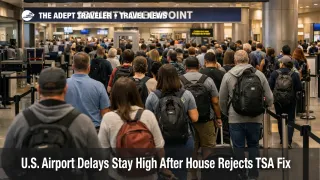
U.S. airport delays remained a live weekend problem on March 27, 2026, even after the Senate passed a bill to restore most Department of Homeland Security funding, including TSA. House Republicans rejected that Senate path and moved toward their own shorter funding bill instead, while President Donald Trump separately ordered DHS and OMB to pay TSA employees using funds tied to TSA operations. For travelers, that means the political headline moved, but the airport problem did not disappear. The immediate risk is still long checkpoint lines, uneven staffing, and slow recovery at major hubs where screening had already been strained for weeks.
U.S. Airport Delays: What Changed
What changed on March 27 is that Congress and the White House stopped moving on one clean track. The Senate unanimously passed a bill to restore funding for most of DHS, but House Speaker Mike Johnson said the House would not take up that measure and would instead pursue its own roughly 60 day stopgap. At nearly the same time, the White House issued a presidential memorandum directing DHS and OMB to use funds with a "reasonable and logical nexus" to TSA operations to provide the pay and benefits TSA employees would have received absent the shutdown.
That split matters operationally. A Senate breakthrough could have reopened a broader funding path. A White House pay order may help reduce the immediate financial pressure on TSA staff, but it does not instantly restore lost staffing, reopen every checkpoint, or rebuild morale after weeks of missed pay and elevated absences. Reuters, AP, and the White House all describe an airport system already under real stress, with long waits, elevated callouts, and hundreds of TSA officers gone since the lapse began.
In an earlier Adept Traveler article, U.S. TSA Shutdown Airport Delays Could Linger, the main warning was that a Senate vote alone would not fix checkpoint throughput. That is now the confirmed story, not just the caution case.
Which Travelers Face the Most U.S. Airport Delays
The most exposed travelers are people flying this weekend through airports already warning about extended screening times, especially large hubs with heavy banked departures and smaller airports with less staffing slack. Houston's airport system said on March 27 that wait times at George Bush Intercontinental Airport (IAH) could reach four hours or longer during peak periods this weekend, with TSA operating only in Terminals A and E and both TSA PreCheck and CLEAR unavailable there at that time. Hartsfield Jackson Atlanta International Airport (ATL) was still warning travelers to allow three hours to clear security during peak travel.
The traveler risk is not just a long line. First order, passengers can miss bag drop cutoffs, security cutoffs, or flights that are otherwise operating on time. Second order, a missed departure at a hub can trigger a much more expensive day, same day rebooking options shrink, connection banks roll past, and hotels or ground transportation become part of the problem. That is especially true where spring break demand is still heavy or where travelers are connecting onward to cruises, tours, or international departures that are harder to replace at short notice. Reuters and AP both describe the disruption as a staffing and throughput problem, not only a political one.
In an earlier Adept Traveler article, TSA Quits Push U.S. Airport Lines Higher Before March 27, the warning sign was that quits and absences were pushing screening reliability lower before the next missed paycheck. The White House memo may ease one pressure point, but travelers should not read it as proof that checkpoint performance will normalize immediately.
What Travelers Should Do Now
Travelers flying on March 27 through March 29 should treat airport processing time, not flight time, as the main pressure point. At Houston IAH, the airport itself said passengers should plan for wait times that may exceed four hours, reduce carry on items if possible, and consider rebooking if necessary. At ATL, the airport's standing advisory remained three hours to clear security during peak periods.
The next decision point is whether your airport is showing an advisory severe enough to break your planned buffer. Rebooking early makes sense if you are departing from a hub already warning of multi hour waits, if your airline's bag cutoff is tight, or if you are protecting a cruise embarkation, international connection, or event that cannot absorb a late arrival. Waiting may still be reasonable if your airport is not under an active advisory, you can arrive very early, and you are on a route with multiple same day fallback options.
What travelers should monitor next is not only Congress. Watch for airport level advisories, checkpoint reopening, the return of programs like PreCheck access where temporarily suspended, and signs that staffing is stabilizing in practice. A funding headline in Washington helps only when local throughput starts improving on the ground.
Why Recovery Is Still Uneven
The mechanism here is straightforward. Airport screening systems are labor intensive, and once staffing falls, recovery is not instant. Officers who quit do not come back because of one memo, checkpoint consolidation creates longer and less predictable queues, and airports have to route passengers through fewer screening points until staffing improves. Houston's current setup is a clear example, passengers from some terminals are being funneled to other screening locations because TSA staffing remains reduced.
What happens next is still uncertain because there are now two recovery tracks. One is the House and Senate fight over broader DHS funding. The other is whether TSA pay resumes quickly enough, and on firm enough footing, to reduce absences and stabilize operations before more spring travel peaks hit. If the House and Senate remain deadlocked, the pay order may keep the worst airport strain from deepening, but it does not solve the larger funding dispute. If pay begins quickly and airports start removing severe advisories, travelers will have the first real sign that checkpoint recovery is becoming operational rather than merely political.
Sources
- US House Republicans reject Senate deal to restore airport security funding
- The Latest: Trump signs executive order to pay TSA after funding bill collapses in Congress
- Paying Our Great Transportation Security Administration Officers and Employees
- Government shutdown impacts TSA, passengers
- Hartsfield Jackson Atlanta International Airport advisory page