

Azteca Reopening Exposes Mexico City Access Risk
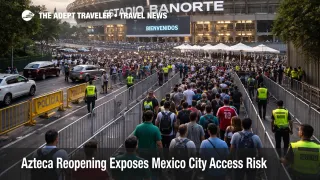
Azteca stadium access risk moved from a planning concern to a live operational warning on March 28, 2026, when Mexico City's reopened Estadio Banorte, formerly Estadio Azteca, served as a rehearsal for the June 11, 2026 World Cup opener and exposed friction at the venue itself. Reuters reported tight security, road closures, entry-point confusion, limited parking complaints, and a fatal fall from a box-seat area shortly before kickoff. For travelers planning opening-match trips or nearby stays, the practical takeaway is to treat stadium access, not just air travel into Mexico City, as a separate booking risk that now needs buffer time, flexible transport planning, and close monitoring of any post-event operational changes.
Azteca Stadium Access Risk, What Changed
What changed is that the venue has now gone through a live stress test, and the rehearsal showed multiple pressure points at once. The Mexico versus Portugal friendly was not just a football match. It was effectively a public trial run for fan circulation, security screening, road management, and arrival flow ahead of the opening fixture of the FIFA World Cup on June 11, 2026. Reuters reported that some attendees complained about confusion over which entry points to use and about reduced parking after renovations, while road closures and a large security operation lengthened the approach to the gates.
The fatal fall shortly before kickoff is a separate issue from the access problems, and travelers should keep those two tracks distinct. Authorities said the man fell from a box-seat area, and Reuters reported that the incident is being treated as an accident involving a spectator who was allegedly intoxicated and trying to move between levels. That does not by itself prove a stadium-wide crowd safety failure. It does, however, raise the chance of tighter circulation controls, more visible enforcement, or operational adjustments before June if investigators or organizers decide any access patterns need to change.
Which Travelers Face the Most Exposure
The most exposed travelers are not casual spring visitors to Mexico City, Mexico. They are World Cup fans planning the June opener, hospitality buyers using package products, travelers staying near the southern stadium zone, and anyone relying on private drivers or same-day transfers between hotels, the stadium, and Mexico City International Airport (MEX). These travelers are the ones most vulnerable to long walks from drop-off points, late gate changes, parking restrictions, police perimeters, and last-minute routing decisions around the stadium district.
The second-order problem is that stadium access friction multiplies quickly on event days. A gate mix-up is not just a gate mix-up when it hits a venue hosting the tournament opener. It can push travelers into the wrong queues, delay escorted transport, compress entry windows, and increase the odds of missing hospitality check-ins or timed pre-match access. Nearby hotel positioning also becomes more complicated. A property that looks close to the stadium on a map can still become operationally awkward if road controls, no-parking rules, or crowd-management zones force long detours on foot or by car. In an earlier Adept Traveler article, Mexico City Anti Tourism Protests Warn World Cup Fans noted that World Cup pressure in the capital was already showing up first in street-level friction rather than in any broad tourism shutdown.
What Travelers Should Do Now
The right move now is not to avoid Mexico City altogether. It is to stop assuming the opener will function like an ordinary big match. Travelers booking around June 11 should favor hotels with flexible cancellation terms, avoid schedules that depend on a perfectly timed private car arrival, and build enough slack to absorb a longer than expected final approach to the stadium. Anyone choosing lodging should think in terms of route resilience, not just distance from the venue.
There is also a clear decision threshold for when this becomes more serious. If organizers publish revised access maps, additional parking limits, new security layers, or stronger circulation controls after the March 28 test event, travelers should assume that arrival times will need to move earlier, not later. If those updates do not appear, the risk remains meaningful but more manageable, mainly as a buffer-planning problem rather than a reason to rebook the trip. For travelers already familiar with how Mexico City demonstrations can widen road delays beyond the original protest footprint, In an earlier Adept Traveler article, Mexico City CNTE Strike Hits Centro And Reforma showed how even localized street actions can distort transfer times across broader city corridors.
What Happens Next Before The World Cup Opener
The next phase is likely to be adjustment, not retreat. Reuters described the reopening as a rehearsal, which means organizers now have live evidence on where fans bunched up, how the security envelope functioned, and where access instructions were unclear. FIFA has already confirmed the stadium as the site of the opening match on June 11, 2026, so the operational incentive is to tighten procedures, not to gamble that the same issues will sort themselves out on the biggest match day the venue will face.
That is why the immediate watch list matters more than broad World Cup hype. Travelers should monitor whether venue operators publish new entry guidance, whether city authorities signal additional road restrictions for future event days, and whether the accident investigation leads to visible changes in box, suite, or circulation management. The reopening did not show a system in collapse. It showed a venue and district that are still learning how to handle the exact kind of pressure they will face in June. For opening-match travelers, that makes the stadium district a live planning variable, not just a pin on the map.