

Mexico City Stadium Rehearsal Raises Access Risk
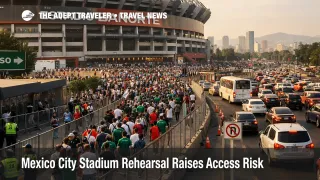
Travelers planning around Mexico City's World Cup opener now have a more concrete warning that stadium operations are not fully settled. Estadio Banorte, formerly Estadio Azteca, reopened on March 28 for a Mexico vs. Portugal friendly that served as a practical rehearsal before the June 11, 2026 opening match, but Reuters reported entry-point confusion, complaints about limited parking, nearby road pressure, and a fatal fall from a box-seat area shortly before kickoff. That shifts the issue from abstract construction anxiety to a live venue-operations signal. Travelers building match trips around tight transfers, private drivers, or short hotel stays should plan for wider buffers and avoid assuming current access rules will hold unchanged into June.
Mexico City Stadium Access Risk: What Changed
What changed is not only that the stadium reopened, but that the first large-scale test exposed multiple friction points at once. Reuters described the event as a rehearsal for the World Cup, with tight security, road closures, and some fan complaints over confusing entry points and limited parking after the renovation. A man also died after falling from a box-seat area, and authorities are investigating the circumstances. That separates into two different traveler questions. One is an active safety investigation inside the venue. The other is an operational warning that crowd flow, perimeter control, and arrival logistics may still be evolving at the very site set to host the tournament opener.
FIFA has already confirmed that Mexico City will host the first match of the 2026 World Cup on June 11. That makes this test event more important than an ordinary stadium reopening because the venue is not being judged only on fan experience. It is being judged on whether it can process large numbers of spectators, vehicles, staff, media, and security layers on a fixed tournament clock.
Which Travelers Face the Most Disruption
The most exposed travelers are not casual visitors to Mexico City in general. They are travelers building itineraries around the opening match, hospitality buyers, tour operators, families using private transfers, and anyone choosing a hotel specifically to cut same-day travel time to the stadium. Those travelers are more vulnerable because stadium friction does not stay at the turnstiles. It spills outward into rideshare pickup reliability, police diversions, curbside drop-off rules, and walking times from whatever access points remain open on event day.
This also fits a broader Mexico City pattern that Adept Traveler has already covered. In an earlier Adept Traveler article, Mexico City Anti Tourism Protests Warn World Cup Fans, the warning was that World Cup pressure could show up first through demonstrations, road slowdowns, and local access friction rather than a formal shutdown. In an earlier Adept Traveler article, Mexico City CNTE Strike Hits Centro And Reforma, the practical lesson was similar, central protests and police controls can quickly turn ordinary transfer planning into a timing problem. Saturday's stadium rehearsal adds a venue-specific layer to that same citywide risk picture.
What Travelers Should Do Before Booking Around The Opener
Travelers should treat June 11 planning as a high-buffer event, not a precision-timed city transfer. That means avoiding flight arrivals or departures on the same day as the match if attendance is non-negotiable, and avoiding hotel choices that look close on a map but depend on one road corridor, one driver route, or one narrow arrival window. A cheaper room farther away can be the better choice if it leaves room for a much earlier departure and a more flexible return.
The next decision point is how much uncertainty a traveler is willing to absorb before paying for nonrefundable match-adjacent logistics. Rebookable hotels, flexible car services, and ticketed experiences that do not stack tightly on match day are the safer play while organizers are still revealing how access will actually work under live conditions. If you are planning a premium or short-stay trip built around one match, it makes more sense to pay a bit more for flexibility than to assume the March 28 traffic and entry setup is the final version.
Travelers should also watch for specifics, not slogans. The useful signals will be official access maps, parking rules, shuttle or drop-off instructions, gate assignments, and any changes to surrounding road closures or crowd-management zones. Those details will tell you far more than general reassurance about readiness.
Why The Venue Test Matters For June Planning
A stadium test event matters because it shows how a venue behaves under pressure before the world is watching. The first-order effect here is straightforward, arrival and entry at the stadium may still be less predictable than travelers would want for a one-night, high-cost event. The second-order effect is broader, once road closures, protests, security perimeters, and crowd-flow controls overlap, nearby hotel positioning, airport transfer timing, and even post-match exit plans become harder to model cleanly. Reuters also reported that protesters staged a symbolic football game on a major highway the same weekend, underlining that surface-access pressure can sit outside the stadium and still affect event-day travel.
What happens next is likely to be a mix of investigation and operational adjustment. Authorities still need to establish the facts around the fatal fall, while organizers and venue operators will almost certainly review circulation, access control, and arrival logistics after the rehearsal. That does not mean the opening match is in doubt. It means the most important traveler variable is no longer whether the stadium will open, but how strict, slow, and changeable the approach to getting in and out may be by June 11.
Sources
- Fan Dies In Fall At Mexico City Stadium Reopening
- Fans Flock To Azteca Reopening, Brushing Off Tensions Ahead Of World Cup
- Mexican Protesters Turn Highway Into Football Pitch To Slam World Cup "Dispossession"
- World Cup 2026, Mexico City Stadium Hosts Opening Match
- World Cup 2026, Match Schedule, Fixtures And Stadiums