

SunExpress Turkey-Europe Surcharge Raises Gulf Trip Risk
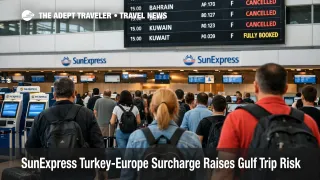
SunExpress Turkey Europe surcharge becomes a traveler planning issue on Tuesday, April 1, 2026, not because the airline is adding a large fee on its own, but because the charge lands while Gulf recovery is still uneven and some fallback routes remain suspended. Reuters reported SunExpress will add a temporary €10.00 (EUR), about $11.46 (USD), fuel surcharge per passenger on Turkey Europe routes for bookings made on or after April 1, for departures on or after May 1. At the same time, SunExpress still shows Dubai suspended through April 5, 2026, inclusive, and Reuters reported Bahrain remains canceled through April 30, 2026, while Turkish Airlines has kept most Middle East flights canceled until the end of March. For travelers, that means Turkey based rebuild options are getting more expensive just as the regional map is still incomplete.
SunExpress Turkey Europe Surcharge, What Changed
The key split is between booking date and travel date. The temporary SunExpress Turkey Europe surcharge applies only to bookings made on or after April 1, 2026, and only for departures on or after May 1, 2026. Travelers who already hold tickets are not looking at the same pricing trigger, and passengers flying in April on tickets issued before April 1 are not in the new surcharge window described by Reuters.
What makes this more than a normal fare adjustment is the network backdrop. SunExpress says Dubai flights are suspended through April 5, 2026, inclusive, and Reuters reported Bahrain is canceled through April 30, 2026. Reuters also reported Turkish Airlines has canceled most Middle East flights until the end of March. That means the added charge is arriving in a market where some travelers are already being pushed away from their original routing and into fewer workable replacement paths. In an earlier Adept Traveler article, Europe Middle East Flight Cuts Stay in Place for Summer, the focus was how long those suspension windows were surviving. The new development is that the same disruption is now showing up in the price of some replacement flying, too.
Which Travelers Face the Most Exposure
The most exposed passengers are travelers piecing together Europe to Turkey to Gulf trips on separate tickets, travelers using Antalya or Izmir as lower cost substitutes for larger hubs, and package travelers who expected Turkey to remain a relatively cheap buffer market while Gulf flying stayed patchy. A €10.00 surcharge on its own is manageable. The problem is that it can stack with higher last minute fares, replacement hotel nights, baggage rechecks, and weaker same day recovery when a suspended Gulf segment breaks the trip.
There is also a practical difference between destination types. A traveler flying only between Europe and Turkey may mainly feel the change as a pricing issue after April 1. A traveler continuing toward Dubai, Bahrain, or another Middle East point can face both price pressure and routing fragility at the same time. That is especially true where a trip depends on separate bookings, a one night stopover, or a protected event such as a cruise, tour departure, or nonrefundable hotel stay. In an earlier Adept Traveler article, Türkiye Extends Gulf Flight Halt Through March 9, the reporting showed how quickly Turkish gateway disruptions can spill beyond one city pair and into the wider bridge market between Europe and the Gulf. That same bridge logic still applies here.
What Travelers Should Do Before April 1
Travelers who are likely to keep a Europe Turkey itinerary and have not booked yet should pay attention to timing. If the flight you want is on SunExpress, and your departure is on or after May 1, 2026, booking before April 1 avoids the surcharge window described by Reuters. That does not make the broader trip risk free, but it does remove one confirmed cost increase.
For travelers rebuilding a disrupted Gulf trip, the better decision threshold is not the surcharge alone. Rebook early if a missed departure would break the rest of the itinerary, especially if you are protecting a cruise embarkation, a tour start, or a long haul onward connection. Waiting can still make sense if your dates are flexible, your original carrier is actively reaccommodating you, and you can absorb a forced overnight or a hub change. The tradeoff is simple, waiting may save money, but rebooking early can save the itinerary when the remaining network is thin. Reuters has separately reported that fuel driven fare pressure is spreading across multiple carriers, not just SunExpress, which weakens the case for assuming a cheap last minute rescue ticket will appear later.
Travelers should also stop treating Turkey as an automatically cheap fallback for Gulf disruption. It is still a useful bridge in some cases, but the cost gap is narrowing, and the route map is still unstable. Before moving, confirm whether the Gulf segment is actually operating, whether the replacement path is on one ticket or two, and whether you would need an extra hotel night if the onward leg fails. Those are the pressure points most likely to turn a modest surcharge into a much more expensive recovery.
Why the Price Shift Matters Beyond One Fee
The mechanism is straightforward. Middle East conflict has already tightened airspace, cut frequencies, and slowed recovery at several hubs. Even where airports are open, airlines have not restored normal operating depth. Reuters has reported that carriers are raising fares, adding fuel surcharges, and adjusting schedules as higher jet fuel costs and disrupted route structures spread through the market. SunExpress fits directly into that pattern.
The first order effect is obvious, some Europe Turkey trips booked from April 1 onward will cost more. The second order effect is more important for travelers, replacement itineraries become harder to rebuild cleanly when suspended Gulf sectors and higher feeder pricing collide. That can mean thinner package value, more hotel stopovers in Turkish gateways, and weaker missed connection recovery for Europe Turkey Gulf itineraries that used to work with less buffer. What happens next depends on two moving pieces, whether SunExpress or Turkish linked Gulf flying comes back on a firmer timetable after March and early April, and whether fuel pressure forces more carriers to pass costs through to travelers. Until that changes, Turkey remains usable in some cases, but less forgiving as a fallback market than it looked before the latest surcharge step.
Sources
- Price hikes, outlook cuts, What airlines are doing as fuel costs surge, Reuters
- Current travel updates, SunExpress
- Airlines cancel more flights as Middle East conflict escalates, Reuters
- Airlines begin to hike fares due to higher fuel prices, Reuters
- European airlines warn of higher fares, fuel shortages due to conflict, Reuters