

Türkiye Extends Gulf Flight Halt Through March 9
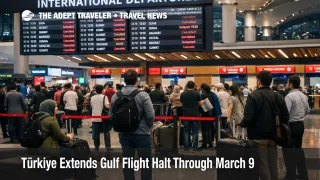
Türkiye has widened one of the region's most important outside network pullbacks, extending flight stoppages to Iran, Iraq, Syria, Lebanon, and Jordan through March 9, 2026, while separately halting flights to Qatar, Kuwait, Bahrain, and the United Arab Emirates on Friday, March 6, 2026. Turkish Transport Minister Abdulkadir Uraloğlu also said Turkish Airlines has removed Iran flights through March 12, 2026, and Pegasus has removed Iran flights through March 20, 2026. For travelers, that means Türkiye remains a weak bridge into and out of the Gulf through the weekend, even as some other evacuation and relief channels start to reopen elsewhere.
The practical change from earlier coverage is that this is no longer just a Gulf airport problem or a carrier by carrier advisory. Türkiye is a major connecting market for Europe, the Caucasus, and the Middle East, so when Turkish linked capacity stays out of the system, the disruption spreads well beyond Istanbul transfers. Travelers who were still treating Türkiye as a flexible fallback should now assume fewer seats, more fragile connection options, and a higher chance that the only workable continuation involves a land segment rather than a clean same day flight.
Türkiye Gulf Flight Halt: What Changed
The main traveler facing split is now clear. Flights from Türkiye to Iran, Iraq, Syria, Lebanon, and Jordan are suspended through March 9, 2026, while flights to Qatar, Kuwait, Bahrain, and the UAE were halted for Friday, March 6, 2026. On top of that broader network decision, Iran is on its own longer timeline, with Turkish Airlines keeping Iran flights out through March 12, 2026, and Pegasus through March 20, 2026. That matters because a traveler deciding whether to wait for a normal air restart should not treat all markets as if they are on the same recovery clock.
There is also a new operational clue in the Azerbaijan case. After rerouted Azerbaijan Airlines flights were diverted to Türkiye's Iğdır province, passengers were moved onward to Nakhchivan by land. That is a real example of overland substitution moving from theory into practice. It shows that some trips can still be salvaged, but only by turning an air itinerary into a mixed air and land movement with fresh border, transport, and timing risk.
Which Travelers Face the Highest Exposure
The most exposed travelers are those using Istanbul, or another Turkish departure point, as a bridge between Europe and the Gulf, the Levant, Iraq, or Iran. If your plan depended on Turkish capacity to reconnect you into Doha, Dubai, Abu Dhabi, Amman, Beirut, Baghdad, Erbil, or Tehran, your problem is no longer only whether one local airport reopens. Your bridge market itself has lost options. That reduces flexibility, especially for separate ticket itineraries and for travelers hoping to buy a last minute seat once they reach Türkiye.
The fit is somewhat better for travelers whose destination can still be reached through controlled relief channels outside Türkiye, including Oman based options already in use for some Qatar disrupted passengers. Adept's earlier coverage on Muscat Relief Flights Become Qatar Airways Exit Route and Dubai Restart, Emirates Runs 100 Plus Flights March 5 6 shows where some capacity has reappeared, but those channels are still narrow, controlled, and prone to bottlenecks.
Travelers considering a land continuation need to think like a border crosser, not like a normal connecting passenger. The immediate risk is not just whether a road transfer exists. The harder failure points are entry permission, visa status, passport validity, transit rules, border operating hours, local transport availability, and whether your onward ticket still works once you arrive on the other side. Turkish Airlines' own travel documents guidance underscores that document compliance remains the traveler's responsibility, even when the trip changes shape mid disruption.
What Travelers Should Do Now
Start by sorting your trip into one of three buckets. If your destination is in the March 6 Gulf halt group, treat Türkiye as unreliable for immediate onward movement today. If your destination is in the March 9 group, assume no short term restart before the weekend. If Iran is involved, use the longer Turkish Airlines and Pegasus dates, not the March 9 date, as your working planning horizon.
Rebook early if your trip has a hard deadline within the next 24 to 72 hours, especially if it includes a cruise embarkation, tour start, medical appointment, or a protected long haul connection that will be expensive to rebuild later. Waiting can still make sense when you are on a single protected ticket and your carrier is actively reaccommodating you, but it stops being the rational choice once your fallback depends on multiple carriers, separate tickets, or a same day airport purchase in a market where capacity is visibly tightening.
If you are considering an overland continuation, verify the documents first, then the transport. Confirm whether you can legally enter or transit the country you would cross into, check whether border posts are operating on your planned day and hour, and price the ground leg before you abandon your existing ticket. Overland moves can save a trip, but they also create a new point of failure, because a missed border or paperwork issue can strand you farther from stable commercial capacity than you were at the airport. For a broader look at how bottlenecks create outsized downstream damage in travel systems, see U.S. Air Traffic Control Privatization: Reality Check.
Why the Disruption Keeps Spreading Through Travel
Türkiye matters here because it is not a small peripheral market. Istanbul is one of the region's biggest connecting nodes, and Turkish carriers normally provide a large share of the seat supply that binds Europe, the Gulf, the Levant, Iraq, and Iran into one usable network. When that capacity stays out, the first order effect is obvious, fewer flights and fewer seats. The second order effect is what travelers actually feel next, higher pressure on remaining carriers, weaker reaccommodation odds, more aircraft and crews stuck out of position, and more hotel and transfer demand in substitute nodes like Muscat or Dubai whenever those channels partially reopen.
The land continuation example into Nakhchivan shows the next phase of this disruption. Once air corridors become too constrained, the system starts substituting border crossings, buses, and road transfers for what used to be a normal hub connection. That can preserve a trip, but it changes the risk model completely. The Türkiye Gulf flight halt is no longer only about canceled sectors, it is about whether your itinerary can survive being broken into separate legal, operational, and ground transport pieces. Travelers should plan around that reality now, not after they have already checked out of one hotel and started moving toward the wrong airport.