

U.S. Protest Weekend Can Still Snarl Downtown Travel
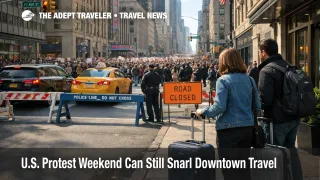
U.S. protest weekend travel became a practical downtown timing issue on March 28, 2026, as more than 3,200 "No Kings" rallies were held across all 50 states, with large demonstrations in New York, Dallas, Philadelphia, Washington, and St. Paul, Minnesota. For travelers, the main problem is not a national transport shutdown. It is localized street friction, police perimeters, and slower last mile movement around rally corridors, hotels, stations, and pickup zones in core districts. Reuters also reported that two thirds of the events were outside major cities, a sign that the disruption pattern is spreading beyond the usual downtown protest map into smaller and suburban communities.
U.S. Protest Weekend Travel: What Changed
What changed is scale, and where that scale is showing up. Reuters reported that this third nationwide mobilization was larger than earlier rounds in smaller communities, with nearly a 40 percent jump there from the movement's first major day of action last June. That matters operationally because a protest day concentrated in a handful of big downtowns is easier for travelers to route around. A protest day distributed across city centers, inner suburbs, and secondary communities turns ordinary same day assumptions about road access, rideshares, and bus arrivals into a weaker bet.
The largest visible trouble spots were still the major metros. Reuters said police estimated the New York crowd at tens of thousands stretching more than 10 blocks in midtown Manhattan. The same report described large rallies in Dallas, Philadelphia, and Washington, while AP said the flagship Minnesota event drew large crowds around the state capitol in St. Paul. In Philadelphia, the traveler impact was formal enough that the city published road closures and parking restrictions for the march and rally before the event.
Which Metro Areas Face the Most Friction
Travelers are most exposed where downtown hotel districts, civic rally sites, and surface transfer corridors overlap. Midtown Manhattan fits that pattern because very large crowds can slow crosstown movement even when subway service continues. Washington is similar around the National Mall and adjacent government core, where demonstrations can compress pedestrian space and make vehicle pickups less reliable. Dallas carries a higher unpredictability factor because Reuters reported clashes and arrests there, which can produce more abrupt police redirections than a purely static rally.
Philadelphia deserves extra attention because the closure pattern was explicit. The city said on March 24 that road closures and parking restrictions would be in place for the March 28 "No Kings 3" demonstration, and the Office of Emergency Management separately warned that public events would affect travel around Center City, the Benjamin Franklin Parkway, and parts of Fairmount Park. That is the kind of official city notice travelers should treat as a real routing constraint, not background noise.
The broader warning is outside the biggest cities. Reuters said about two thirds of the rallies were happening outside major urban cores. For travelers, that means suburban rail stations, hotel belts near county seats, regional coach stops, and airport runs that depend on passing through a town center can all be delayed even when the city on the booking looks secondary or normally low risk.
What Travelers Should Do Now
For Saturday plans that are still in motion, or for late arrivals into downtown districts, the cleanest move is to stop assuming curb to curb timing. Use rail for the last leg where possible, walk the final stretch if the route is straightforward, and build extra time before hotel check in, event entry, bus departure, or an airport run from the city center. Travelers with luggage heavy itineraries or prepaid timed reservations should be especially cautious around civic centers, capitol grounds, main squares, and ceremonial corridors.
The next decision point is whether a same day transfer depends on a car moving through the core of a protest city. Keep the booking if you have a wide buffer, direct rail fallback, or a hotel outside the rally footprint. Change the plan if you need a precise vehicle arrival into midtown Manhattan, central Philadelphia, the National Mall area, or downtown Dallas during peak dispersal periods. Waiting can save money. Reworking the surface segment early can save the itinerary.
Travelers should also check city emergency management feeds, local police traffic alerts, transit advisories, and venue messages before leaving. The most useful signal is not protest size alone. It is whether a city has posted formal closures, parking bans, or crowd control guidance, because that usually means rideshare routing, bus diversions, and last minute hotel access will become less predictable.
Why the Disruption Is Spreading Beyond Core Downtowns
The mechanism is simple. A very large rally in one downtown usually slows one obvious district. A day with thousands of actions across all 50 states changes the travel map by multiplying small choke points at once. First order, police presence, blocked lanes, curb restrictions, and denser pedestrian flows slow immediate access around rally sites. Second order, airport trips from downtown hotels, intercity coach departures, rail station arrivals, and even restaurant or attraction bookings become harder to time because surface transport loses reliability.
This also explains why the story is distinct from the airport security strain Adept has been covering. In an earlier Adept Traveler article, U.S. TSA Shutdown Airport Delays Could Linger the weak point was the checkpoint. Here, the weak point is the downtown approach to the rest of the itinerary. In another earlier Adept Traveler article, London Protest Ban Shifts March 15 Access Risk the same pattern showed up in a different city: transport still ran, but access inside the core became less dependable. That is the right frame for U.S. protest weekend travel as this movement spreads beyond the largest metros.
Sources
- Anti-Trump 'No Kings' rallies pop up in thousands of US cities, Reuters
- City Announces Road Closures, Parking Restrictions and Other Details for "No Kings 3" March and Rally, City of Philadelphia
- Office of Emergency Management Homepage, City of Philadelphia
- 'No Kings' rallies draw crowds across US, in Europe, AP News