

United Cuts 5% of Flights as Fuel Prices Surge
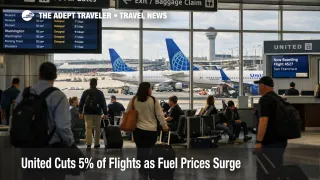
United flight cuts have moved from selective trimming to a broader network response, after United Airlines told staff on March 20, 2026, that it will remove about 5 percentage points from its planned 2026 capacity as fuel prices surge. For travelers, the shift matters most over the next two quarters, when fewer off peak frequencies and thinner schedule cushions can turn a manageable delay into a missed connection or forced overnight. The immediate takeaway is not that United is collapsing its network, it is that it is pulling weaker flying out of the system to protect margins while fares are already rising. Travelers with fixed dates, last flight of the day itineraries, or tight hub connections should start building more margin into spring and summer plans.
United Flight Cuts: What Changed
What changed on March 20 is the scale and clarity of the response. Reuters reported that Chief Executive Scott Kirby told staff United is preparing for oil to reach as high as $175 per barrel and remain above $100 through the end of 2027. In that scenario, he said United's annual fuel bill would rise by about $11 billion, which is more than twice the profit the airline earned in its best year. The carrier had already been trimming weaker flights, but the new plan goes further, pulling about 3 percentage points from off peak flying in the second and third quarters, about 1 percentage point from Chicago O'Hare International Airport (ORD), and leaving Tel Aviv and Dubai suspended, for a total reduction of about 5 percentage points from this year's planned capacity.
This is a more serious traveler signal than a generic warning about expensive oil. Reuters also reported that United expects to restore its full schedule in the fall, which suggests management still sees this as a near term capacity discipline move rather than a retreat from long term growth. At the same time, United is not pausing aircraft deliveries, and Kirby told employees the airline still expects to take about 120 aircraft this year.
Which Travelers Are Most Exposed
The biggest exposure sits with travelers who depend on schedule frequency, not just a single flight number. Midweek departures, Saturday flying, overnight sectors, and routes with weaker demand are the first places United is cutting, according to Reuters. That means travelers at smaller origins, passengers connecting over United hubs, and anyone relying on a late backup option face a less forgiving network in the second and third quarters.
Chicago is an especially important pressure point because United is also pulling capacity from O'Hare while the airport is already facing a separate summer scheduling squeeze. In an earlier Adept Traveler article, O'Hare Summer Flight Cuts Raise Booking Risk explained how a tighter O'Hare schedule can reduce connection flexibility and push travelers toward earlier departures, longer layovers, or alternate airports. That overlap matters because a United reduction layered onto an already constrained hub can spread disruption beyond Chicago into domestic to international connections, same day cruise joins, tours, and other trips with little room for recovery.
The fare side is moving at the same time. Reuters reported that fares booked over the past week had risen 15 to 20 percent, while the Associated Press reported jet fuel rose to $3.93 per gallon from $2.50 before the war began on February 28, 2026. In an earlier Adept Traveler article, U.S. Airfare Hikes Spread as Fuel Costs Double tracked how carriers were already testing fare increases before this larger United capacity move became public.
What Travelers Should Do Now
Travelers booked on United for April through summer should treat today's schedule as less resilient than it looked a week ago. The first move is to identify whether your trip depends on a thin part of the day, especially a late departure, a short hub connection, or a route that only operates once or twice daily. If it does, extra time now is worth more than hoping the schedule remains padded later.
The main decision threshold is whether a same day failure would materially damage the trip. If a missed connection would only be annoying, waiting may be reasonable because United says it still expects to restore the full schedule in the fall. If a missed flight would break a cruise embarkation, a wedding, a guided tour, or an international departure on a separate ticket, the safer move is to shift to an earlier flight, buy more connection time, or arrive the night before. Travelers using O'Hare should also compare pricing and timings at Chicago Midway International Airport (MDW) or other nearby hubs, because thinner ORD options can spill fare and reaccommodation pressure across the region.
Over the next 24 to 72 hours, watch for three signals. First, whether United updates booking displays or schedules on affected off peak routes. Second, whether other U.S. carriers deepen their own capacity response if fuel remains elevated. Third, whether fuel pressure broadens from a pricing problem into a wider network problem. In an earlier Adept Traveler article, Jet Fuel Price Shock Hits Global Travel Planning we covered how record physical jet fuel prices were already raising the odds of higher fares, fewer marginal flights, and weaker recovery when something else goes wrong.
Why United Is Cutting Now, and What Happens Next
The mechanism is straightforward. U.S. airlines generally do not hedge fuel the way some European and Asian carriers do, so a rapid fuel spike hits operating costs more directly. Reuters reported that United and its peers have been relying on fare increases and capacity discipline to recover part of that added expense. When demand is still strong, the logic is to cut flying that cannot absorb the higher fuel bill, protect pricing power on the flights that remain, and wait for either fuel prices or the geopolitical shock to ease.
What happens next depends on duration, not just the headline price of oil. If fuel stays elevated for weeks, United's move is likely to be read across the industry as a template rather than a one off adjustment. Reuters reported that Delta has also said it has flexibility to trim capacity if fuel prices remain high, and the Associated Press noted that executives across the large U.S. carriers are still seeing strong ticket sales despite the cost shock. That combination can keep fares firm while reducing fallback options for travelers. In practical terms, United flight cuts are not yet a network emergency, but they are a meaningful warning that the U.S. airline system is becoming more expensive and less forgiving at the margins.
Sources
- United Airlines to cut more flights as it eyes oil above $100 through 2027, Reuters
- Strong ticket sales help offset rising jet fuel prices, US airlines say, AP News
- United Airlines Reports Fourth Quarter and Full Year 2025 Results, United Airlines Investor Relations
- O'Hare Summer Flight Cuts Raise Booking Risk, Adept Traveler
- U.S. Airfare Hikes Spread as Fuel Costs Double, Adept Traveler
- Jet Fuel Price Shock Hits Global Travel Planning, Adept Traveler