

Loveholidays Extends Gulf Package Cancellations to May 10
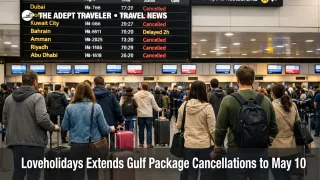
Loveholidays has pushed its Gulf package cancellations deeper into late spring, canceling holidays departing up to and including May 10, 2026, to the UAE, Kuwait, Bahrain, Qatar, Jordan, and Riyadh, including trips that connect through those points. That widens the decision window for travelers who thought the main risk sat in late March and early April. The change matters most for UK based package customers with school break, business, or shoulder season trips tied to Gulf hubs. Travelers with affected bookings should now treat this as a package organizer decision first, then check what separate airline rights or waivers may still apply underneath it.
Gulf Package Cancellations: What Changed
The operational change is clear. Loveholidays says it has decided to cancel all affected holidays departing up to and including May 10, 2026, to destinations currently on the U.K. Foreign, Commonwealth and Development Office list for all but essential travel, and it says this also covers holidays with a connecting flight via one of those points. The company says it has begun processing full refunds automatically and will contact affected customers directly within two days. That is a wider horizon than a short term disruption response, and it shifts late spring package travel into the same risk bucket as the more immediate Gulf cancellations seen earlier in the month.
That matters because airline recovery is still uneven. Reuters reported on March 30 that carriers continue to cancel or suspend flights across the region, with long dated cuts still in place on some city pairs. British Airways has extended cancellations to Amman, Bahrain, and Dubai through May 31, while Lufthansa Group has longer suspensions on several Middle East points, and Pegasus, Malaysia Airlines, Singapore Airlines, and others still have active interruptions or partial network changes. Reuters also reported the same day that airlines globally are now using both fare increases and capacity cuts to cope with the fuel shock, which makes replacement options less abundant even when a route is technically still operating.
Which Travelers Now Face Earlier Decisions
The most exposed travelers are not just people flying nonstop to the Gulf. They also include passengers on dynamic or flight inclusive packages that rely on Gulf connection banks to reach somewhere else, because Loveholidays says the cancellation policy also covers packages with a connecting flight through the affected points. That widens the impact from destination risk to network risk. A traveler headed to the UAE for a resort stay and a traveler transiting Doha, Qatar, or Riyadh, Saudi Arabia, as part of a wider itinerary can both now land inside the same cancellation horizon.
Package travelers should also separate their protections correctly. If the organizer cancels the package, ABTA says the customer is entitled to get their money back, though not compensation when the cancellation stems from unavoidable and extraordinary events outside the company's control. If the underlying flight is canceled, the airline still owes the usual air passenger rights on the flight itself, including rerouting or a refund, and potentially care while waiting, but the package organizer remains responsible for the holiday as a whole. The U.K. government's air passenger guide says travelers with a package should tell the organizer about flight disruption immediately, because the organizer has to manage the rest of the booking, not just the air segment.
This is where late spring decisions get trickier than the earlier wave of March departures. A standalone airline customer might choose to wait for a waiver, hold for a reroute, or cancel only the flight. A package customer has to weigh the full holiday, hotel, transfer, and timing value together. In an earlier Adept Traveler article, Global Airfare Hikes Spread as Fuel Squeeze Widens, the pricing side of the fuel shock was already becoming visible. The new development is that packaging risk is now stretching farther into the calendar than many travelers expected.
What Travelers Should Do Now
If Loveholidays has already canceled your departure, the practical move is to wait for the organizer's confirmation, then compare the refund path against any rebooking offer using the full trip cost, not just the airfare. Check whether the substitute trip preserves your original travel dates, room category, transfer arrangements, and onward timing. If the replacement holiday shifts the practical value of the trip too far, a refund is usually the cleaner outcome than trying to rebuild the itinerary piecemeal.
If your departure falls after May 10, the decision is harder. Waiting may preserve flexibility if operator guidance improves, but waiting also risks landing in a market with fewer seats and more expensive substitutes if airline cuts widen further. Reuters reported that carriers are already trimming capacity as fuel prices stay elevated, which means a traveler who waits too long may face worse replacement pricing across Southern Europe, the Mediterranean, or other substitute warm weather markets. Rebook early if the trip is date critical, school break locked, or tied to nonrefundable events. Wait longer only if your dates are flexible and the operator has not yet moved your booking into a cancellation or major change window.
Travelers should also keep receipts and preserve every operator and airline notice. If a flight cancellation or reroute triggers meals, hotels, or ground transport, the airline may still owe reimbursement for reasonable costs under passenger rights rules, while the package organizer may owe broader remedies if the holiday can no longer be delivered as booked. That split is easy to mishandle if you accept airline options without telling the package company first. The government guide is explicit on that point.
Why the Risk Is Reaching Later Departures
The mechanism is bigger than one tour operator. Gulf package travel depends on three moving parts staying aligned, destination viability, hub connectivity, and replacement economics. Right now all three are unstable. Airspace disruption and security risk have already forced airlines into suspensions and longer detours, while the fuel shock has pushed carriers to raise fares and cut weaker capacity. When tour operators look at that combination, they do not need every airline to stop flying in order to cancel a package. They only need enough doubt around transport reliability, recoverability, or trip value to decide the package is no longer workable at scale.
That also explains why late spring travelers should not read a single airline schedule update as proof that package risk has passed. A network can be partly flying and still be too thin, too expensive, or too fragile for package operators to stand behind it confidently. In an earlier Adept Traveler article, Dubai Phantom Flights Raise Gulf Transit Risk, Gulf hub reliability was already becoming a separate planning problem from outright cancellations. The next thing to watch is whether Loveholidays, or rival organizers, move the cutoff beyond May 10, 2026, or begin steering customers harder into substitute destinations instead of waiting for Gulf normalization.
Sources
- Conflict in the Middle East, loveholidays FAQs & Travel Information
- Airlines Cancel More Flights as Middle East Conflict Escalates, Reuters
- Airlines Face Fare Dilemma as Fuel Spike Threatens Travel Demand, Reuters
- Guidance to Passengers Facing Disruption in the Middle East and Cyprus, UK Civil Aviation Authority
- Air Passenger Travel Guide, GOV.UK
- What Happens if My Holiday Has Been Cancelled by the Travel Company Due to Unavoidable and Extraordinary Events, ABTA
- My Flight's Been Cancelled, What Are My Rights, ABTA