

JFK Terminal 6 Adds TAP for Easier 2026 Connections
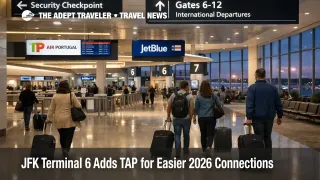
JFK Terminal 6 TAP move is now a real 2026 planning signal, not just another tenant announcement. JFK Millennium Partners and TAP Air Portugal said on March 30, 2026, that TAP will shift to the new terminal as part of Terminal 6's phase one opening later this year, while TAP's current JFK operation continues normally until the move. For travelers using the Lisbon route, or building one stop itineraries through New York, the practical upside is a more concentrated terminal layout on JFK's north side, where Terminal 6 is designed to connect with JetBlue's Terminal 5 and keep walks from security to gates under five minutes on average.
JFK Terminal 6 TAP Move Reshapes 2026 Connections
What changed is not the TAP schedule itself. TAP still operates daily nonstop JFK to Lisbon and says operations will continue normally until the planned move later in 2026. The real change is where that flight will sit inside JFK's rebuilt terminal map. TAP will join JetBlue, Air Canada, ANA, Avianca, Lufthansa, SWISS, and other long haul and international carriers in Terminal 6's first phase, which the developer says opens with six gates in 2026 and expands to a 10 gate terminal by 2028, with nine gates sized for widebody aircraft.
That matters because terminal geography often shapes a trip as much as the airfare does. If an airline sits in a more coherent transfer zone, passengers usually get shorter connection walks, cleaner bag drop and security flow, and fewer last minute terminal changes that turn a comfortable layover into a stressful one. Terminal 6 is being marketed as a digital first facility with biometric bag drop, new customs and border control facilities, airline lounges, a ground transportation center, and a less than five minute average walk from security to gates. Even allowing for first month startup friction, that is a meaningful operational improvement over JFK's fragmented reputation.
Who Benefits Most From the New T6 Layout
The clearest winners are New York origin travelers flying TAP nonstop to Lisbon, and Lisbon bound passengers arriving on JetBlue feed from U.S. cities that do not have their own Portugal nonstop. Because Terminal 6 is being built to connect seamlessly with Terminal 5, the move should make TAP more useful for travelers who piece together a JetBlue plus TAP itinerary, whether on a codeshare, a partner booking, or a self managed trip with enough buffer.
A second beneficiary group is premium and alliance oriented travelers. TAP is a Star Alliance member, and Terminal 6 is already shaping up as a meaningful Star presence at JFK alongside Air Canada, ANA, Avianca, Lufthansa, and SWISS. In an earlier Adept Traveler article, JFK lounges 2026 preview, alliances add capacity mapped how Terminal 6 was already developing into a stronger premium and alliance space, especially once new lounges and wider terminal capacity come online. TAP's addition does not turn T6 into a pure Star terminal, but it does make the terminal more useful for travelers who care about lounge access, partnership logic, and keeping long haul connections in one part of the airport.
There is also a market timing angle. In an earlier Adept Traveler article, U.S. Europe Summer Flights Slip Further for July, the warning was that softer transatlantic demand could eventually become a schedule story, not just a fare story. TAP's move does not change 2026 summer demand on its own, but it does show that airports and airlines are still investing in better terminal clustering and product design around Europe flying, even as carriers remain alert to booking softness on some U.S. Europe lanes.
What Travelers Should Do Before the 2026 Move
For 2026 bookings, the immediate move is simple. Do not assume your TAP flight will depart from the same JFK terminal later this year. If you are booking fall or winter travel, especially on a multi airline itinerary touching JetBlue or another Terminal 6 carrier, watch your confirmation and terminal assignment closely as the opening window gets closer. This is the kind of airport change that usually improves the experience after launch, but can create short term confusion during the first operating weeks.
If your trip depends on a tight New York connection, build in extra buffer until the move is live and operating patterns settle. The right threshold is not panic, it is margin. A protected same ticket connection is safer than a self transfer. A 90 minute plan that looks fine on paper can still get squeezed by construction era wayfinding changes, baggage timing, or first phase gate concentration. The benefit of T6 is that it should eventually simplify those transfers, but travelers should give the terminal time to prove that in real operation.
For fare shoppers, keep comparing JFK against Newark as well. TAP's own booking pages still show New York area demand split between JFK and Newark options, which means terminal improvements at JFK do not eliminate the usual tradeoff between airport access, fare, and schedule convenience. If your trip begins in Manhattan, Brooklyn, Long Island, or Queens, the improved north side setup at JFK may become more attractive. If your trip starts in New Jersey, Newark can still win on ground time even if JFK's airside experience gets better.
Why TAP's Move Matters Beyond One Route
The bigger story is that JFK's rebuild is becoming operationally legible. Terminal 6 is part of the Port Authority's broader $19 billion airport transformation, and TAP's decision adds another piece to a terminal map that is increasingly organized by terminal quality, partner fit, and north side versus south side logic, not just by whichever legacy facility an airline happened to inherit years ago. That is the kind of structural change that can reduce connection friction for years once the construction phase ends.
What happens next is straightforward. Terminal 6 phase one opens in 2026, TAP moves later in 2026, and the full terminal is expected to complete by 2028. The next traveler decision point is not whether to rebook today. It is whether to treat JFK terminal assignment as a live part of the booking decision for late 2026 and beyond. If T6 opens close to plan and performs the way the developer is promising, TAP's Lisbon flight becomes more attractive not because the aircraft changes, but because the ground experience at one of America's most complex airports should get easier.