

Greece Ferry Departures Halt at Athens Ports April 2
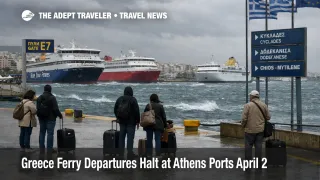
Greece ferry departures from the Athens area ports were disrupted again on April 2, 2026, after strong winds up to force 9 kept major sailings tied up at Piraeus, Rafina, and Lavrio and suspended Saronic hydrofoil services until further notice. Travelers trying to reach islands from the Greek capital are the main group exposed, especially anyone linking a flight, cruise, hotel check in, or tour booking to a same day ferry leg. The immediate problem is not just a missed sailing, it is the way a weather stop at the port layer quickly spills into hotel, airport, and onward island timing. Travelers with departures or arrivals tied to Thursday morning should treat published timetables as provisional and confirm operator status before heading to the port.
Greece Ferry Departures: What Changed on April 2
Authorities halted all early ferry departures from Piraeus on Thursday morning, April 2, and indicated services might be reviewed after 9:00 a.m. if conditions improved. At the same time, ferries remained tied up at Rafina and Lavrio, while in the Saronic Gulf only conventional ferries were allowed to operate and hydrofoil services were suspended until further notice. eKathimerini reported winds reaching as high as 9 Beaufort, while Reuters separately described force 9 conditions tied to the storm system Erminio affecting parts of Greece.
That matters because these three Attica ports do different jobs in the island network. Piraeus is the main volume gateway for many island routes, while Rafina and Lavrio are important alternatives for Cyclades patterns and for travelers trying to avoid a longer cross Athens transfer. When all three are constrained at once, the usual workaround, switching from one Athens area port to another, becomes much less reliable. In an earlier Adept Traveler article, Greece Ferry Sailing Bans at Athens Ports, the same pattern showed how quickly a wind event can turn into rolling rebooks, hotel changes, and missed same day flight connections.
Which Travelers Face the Most Disruption
The highest exposure sits with travelers who treated April 2 as a transfer day rather than a buffer day. That includes passengers landing at Athens International Airport Eleftherios Venizelos (ATH) and continuing straight to a ferry, island hoppers with back to back sailings, and anyone using a ferry arrival to make a timed hotel check in, cruise embarkation, or prepaid excursion. When departures are suspended at the source, the damage is not limited to the first missed vessel. Capacity can compress into the next operating bank, and the first sailing that resumes may still be oversubscribed or restricted by vessel type, route exposure, and sea state.
Saronic travelers face a slightly different problem. The fact that conventional ferries were allowed while hydrofoils were suspended means the route map did not disappear completely, but the faster vessel class that many day trippers and short stay travelers rely on was removed. That tends to stretch journey times and undermine tight same day plans even when a route is not fully canceled. Travelers headed beyond the Saronic Gulf face a broader network issue, because Piraeus, Rafina, and Lavrio feed many island chains where there is little practical same day substitution once the maritime leg fails.
What Travelers Should Do Now
Start with the immovable parts of the trip. If you have a flight, cruise embarkation, or nonrefundable island stay tied to Thursday, protect that booking first, then treat the ferry as the variable. Do not leave for Piraeus, Rafina, or Lavrio on the basis of the published timetable alone. Wait for a confirmed operator update on your exact sailing, because a general review after 9:00 a.m. does not mean every route or vessel class restarts at once.
The next decision point is whether the sailing you need is essential today, or whether preserving the wider itinerary matters more than holding the original ferry ticket. If the ferry leg is feeding a same day airport departure or a high cost island booking, reworking the itinerary around an Athens overnight or a flight substitution to an island with air service is often the safer move. If the trip is flexible and your lodging is protected, waiting for the next confirmed sailing may still be reasonable, but travelers should expect crowding, rolling delays, and weaker seat availability as passengers from canceled departures spill forward.
For travelers not yet in motion, the most useful threshold is simple. If your operator has not posted a confirmed departure window, do not begin the airport to port transfer. That avoids burning money on taxis, private transfers, and port area waiting time while the weather decision is still unresolved. Anyone likely to miss an island arrival should also notify lodging and transfer providers early, because once large numbers of passengers are pushed into later departures, hotel no show rules and paid transfer timing become the next layer of cost. This is the kind of disruption where acting earlier usually preserves more options than waiting for full normal operations to return.
Why the Port Shutdown Spreads Beyond the Ferry Terminal
The mechanism here is straightforward. Passenger ferries in Greece are a core transport layer, not a niche add on, and weather restrictions at the Athens ports break more than a single departure. They disrupt the timing ladder that connects Athens airport arrivals, urban ground transfers, ferry check in cutoffs, island hotel arrivals, and onward inter island movements. Once one layer slips, later bookings do not automatically absorb the delay. That is why a wind event at the port can become an airport problem, a lodging problem, and a tour problem within hours.
The outlook is still conditional. eKathimerini reported that authorities in Piraeus were looking at a possible post 9:00 a.m. restart if conditions improved, but Reuters and Greek media described a wider storm event, including severe weather impacts elsewhere in Greece, which argues for uneven recovery rather than a clean all clear. Travelers should therefore watch for route by route and vessel by vessel updates, not a single national restart signal. Even after a port restriction lifts, the backlog can behave like a traffic jam, with slower vessel classes, full sailings, and altered island arrival patterns continuing after the worst wind has passed.