

Ryanair Europe Fuel Warning Raises Summer Flight Risk
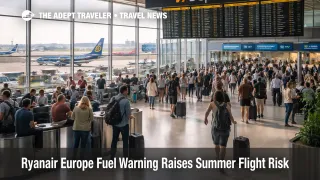
Europe summer flight risk just moved from a broad energy concern into a traveler planning problem after Ryanair's chief executive said on April 1, 2026 that a Middle East conflict lasting through April could trigger jet fuel shortages in Europe from June and force carriers to consider summer cancellations. The warning matters most for travelers booking peak season trips now, especially in the UK and on thinner leisure routes where one canceled frequency can break the whole itinerary. The immediate issue is not that summer schedules have already been cut. It is that airlines are now putting a specific summer decision window on the table while fuel replacement flows remain tight. Travelers booking for June through August should lean toward itineraries with multiple daily alternatives, longer connection buffers, and change terms that do not punish early rebooking.
Europe Summer Flight Risk: What Changed
What changed is the level of specificity. Reuters reported on April 1 that Ryanair is not talking only about higher fuel prices, it is talking about the possibility that airlines may have to start considering cancellations if jet fuel supply is at risk in June, July, or August. Michael O'Leary also said the UK is the most vulnerable European market because of its refining and supply links, including reliance on Kuwaiti fuel. That turns a vague summer cost story into a schedule resilience story, because once fuel availability becomes the constraint, airlines usually protect their strongest routes first and leave travelers on marginal frequencies with fewer recovery options.
The warning also lands in a market that is already under strain. Reuters reported on April 1 that U.S. fuel exports hit a record in March as Europe and Asia tried to replace disrupted Middle East supply, with clean product exports to Europe rising 27% to 414,000 barrels per day. On April 2, Reuters also reported that the roughly 500,000 barrels per day of jet fuel normally moving through the Strait of Hormuz is far larger than what the U.S. exported on average last year, which means replacement barrels exist, but not at a scale that makes Europe comfortable.
Which Travelers Face the Most Exposure
The most exposed travelers are not necessarily the latest bookers. They are the passengers whose trips depend on limited frequency, a single same day connection, or airports where one canceled departure removes most of the recovery path. UK-origin trips deserve extra attention because Ryanair singled out the UK as Europe's most vulnerable fuel market, and Reuters reported that the International Air Transport Association estimates roughly 25% to 30% of Europe's jet fuel demand originates in the Gulf. That does not mean every UK or Europe flight is suddenly at equal risk. It means the markets with the least slack are the ones to watch first if supply tightens into the summer bank.
Leisure-heavy routes are also more exposed than core trunk routes. Airlines tend to preserve the flights that protect network feed, large bases, and business-critical corridors. Thin island links, secondary city pairs, and off-peak departures can become the first place where a modest fuel constraint turns into a real cancellation. In an earlier Adept Traveler article, IEA Air Travel Warning Signals Jet Fuel Stress, the pressure was already showing up as a broader traveler behavior and policy story. In another, Europe Fuel Shock Threatens Summer Airfares, the cost side of the same squeeze had already started coming into view.
What Travelers Should Do Now
Travelers booking June through August should prioritize schedule depth over a small fare difference. A cheaper itinerary loses value fast if it sits on a once-daily route or a short connection with no backup. The safer move is to choose flights with multiple same day alternatives, avoid the last departure of the day when possible, and pay attention to whether a ticket allows changes or credits without a heavy penalty. On monopoly or leisure-heavy routes, locking in the most flexible fare you can justify now is more defensible than waiting for a formal airline warning.
The next decision point depends on trip type. If the trip is date-critical, such as a cruise embarkation, wedding, major event, or onward long-haul connection, earlier booking with more flexibility is the lower-risk path. If the trip is discretionary and the route has dense competition, waiting can still make sense, but only if you are willing to reroute through another airport or shift dates. Travelers should also be realistic about recovery this summer. In an earlier Adept Traveler insight, FAA Delays on Boeing 737 MAX 10 Hit Airline Capacity, the broader seat-supply problem was already visible. A fuel squeeze layered onto an already tight aircraft market would leave airlines with even less slack to absorb disruptions.
Why The Warning Matters Beyond Ryanair
The bigger point is that this is no longer only a fares story. Europe's airlines have already warned that higher fuel costs can push up ticket prices as hedges roll off, but Ryanair's latest message adds a stronger operational threshold, supply itself may become the problem if the conflict keeps disrupting flows through April. Reuters also reported that the International Energy Agency expects Middle East oil disruptions to rise in April and begin to hit Europe's economy more directly, which fits the timing Ryanair is flagging for summer schedules. What happens next depends on whether April brings de-escalation or a longer squeeze. If the conflict eases, this may remain mostly a fare and margin problem. If not, summer cancellations could move from contingency talk into carrier-by-carrier schedule action.
For travelers, that means watching for three signals over the next few weeks, airline commentary about fuel availability rather than just price, cuts on thin routes or weaker dayparts, and rising preference for flexible summer bookings. The first visible damage may not be a broad Europe-wide cancellation wave. It may be smaller schedule trims that make rebooking harder and raise the cost of staying on the same trip plan. That is the real Europe summer flight risk now.
Sources
- Ryanair will consider cancelling flights if jet fuel supply disrupted in June, CEO says, Reuters
- US fuel exports hit record in March as Asia, Europe sought to replace Middle East supplies, Reuters
- Trump says US has plenty of jet fuel for Europe, market disagrees, Reuters
- Middle East Conflict Exposes Jet Fuel Supply Vulnerabilities, IATA
- Middle East oil supply disruptions rise in April, will hit Europe, IEA chief says, Reuters