

Greece Storm Disrupts Ferries, Crete Flights
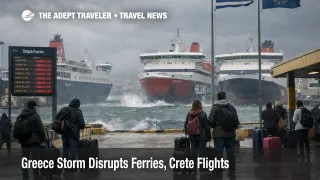
Greece storm ferry disruptions spread from a weather warning into a real transport problem on April 2, as departures were canceled or restricted at the Athens area ports and flights on Crete were disrupted by strong winds and Saharan dust. The main exposure sits with travelers linking Athens to the islands, especially anyone trying to combine a same day flight, ferry, cruise, or hotel check in. By Friday, April 3, conditions were starting to improve at Piraeus, but Rafina and Lavrio remained less reliable, which means the system was stabilizing unevenly rather than snapping fully back to normal. Travelers with tight transfer chains should rebuild plans around delay risk, not published timetables alone.
Greece Storm Ferry Disruptions: What Changed
On Thursday morning, April 2, authorities canceled all early departures from the Port of Piraeus, while ferries were also tied up at Rafina and Lavrio. In the Saronic Gulf, conventional ferries were still allowed in some cases, but hydrofoils were suspended, which matters because those faster vessels are what many short stay and day trip travelers rely on to keep same day plans intact. Other links were hit as well, including sailings from Volos to the Sporades and the Kavala to Prinos route, widening the disruption beyond the Athens ports. Reuters also reported that flights on Crete were disrupted as strong winds and dust reduced visibility.
By Friday, April 3, the picture had improved only in part. Reporting indicated departures from Piraeus were expected to resume gradually after 9:00 a.m., but Rafina and Lavrio still had no departures at that stage. That distinction matters operationally. Piraeus handles the biggest share of Athens area ferry volume, so any restart there helps, but it does not fully solve transfer problems for travelers whose routes, tickets, or ground transport plans were built around Rafina or Lavrio.
Which Travelers Face the Highest Risk
The highest risk group is anyone treating Athens as a clean same day handoff point. That includes passengers landing at Athens International Airport Eleftherios Venizelos (ATH) and heading straight to a port, island hoppers moving between ferry bookings without an overnight buffer, and cruise travelers who planned to use a ferry leg to reach or leave a port city on schedule. When Piraeus, Rafina, and Lavrio are all constrained at once, the usual workaround, switching ports, becomes much weaker because all three gateways serve different island patterns and ground transfer times.
Crete travelers face a different but related problem. Flight disruption from wind and dust does not always produce the same clean cancellation pattern as a ferry sailing ban. Instead, it can show up as diversions, rolling delays, missed onward connections, and airport transfer uncertainty around Heraklion and Chania. The dust also cuts visibility and can worsen air quality, which adds friction for travelers with respiratory sensitivity even when a flight still operates.
In an earlier Adept Traveler article, Greece Ferry Departures Halt at Athens Ports April 2, the disruption was already moving beyond the dock into hotel timing and airport connections. In an earlier Adept Traveler article, Greek Ferry Cancellations Hit Island Hops Again, the same pattern showed how quickly repeated wind events can turn island hopping into a buffer problem, not just a ticket problem. Related cruise exposure remains relevant too, especially for pre and post sailing stays around Athens, as outlined in Celestyal Cancels April 2026 Greece Cruises.
What Travelers Should Do Now
Start with the least flexible part of the itinerary. If you have a flight out, a cruise embarkation, or a nonrefundable island stay, protect that first and treat the ferry segment as the variable. For Friday and the next operating window, travelers should verify the exact vessel and departure port with the operator before leaving Athens, because a partial restart at Piraeus does not mean every route, vessel class, or substitute port is working normally.
The next decision point is whether preserving the day matters more than preserving the original booking. Rebook early if a missed ferry would break a same day flight, cruise, or expensive lodging chain. Wait only if you have protected accommodation, flexible onward timing, and a route that can absorb spillover demand once sailings restart. For Crete, travelers should also check inbound aircraft status before heading to the airport, because low visibility and dust related disruption can leave a flight technically operating but running badly off schedule.
Over the next 24 to 72 hours, watch two signals. First, whether Rafina and Lavrio return to service, because that will tell you whether the Athens area ferry network is truly normalizing or just partially reopening through Piraeus. Second, whether winds and dust ease enough on Crete for cleaner airport operations. A broad improvement in forecasts into the weekend points to lower risk, but travelers should still expect backlog pressure, especially where canceled passengers roll into the first restored departures.
Why the Disruption Spread Across Ferries and Flights
This was not just one bad port morning. Storm Erminio combined gale force winds, rough seas, heavy rain, and Saharan dust, which hit separate layers of the travel system at the same time. Ferries fail first when sea state and port conditions make departures unsafe. Flights do not fail for the same reason, but wind and dust can degrade visibility, slow turnarounds, and force diversions. When both layers are under pressure together, Greece loses one of its most common recovery tools, shifting travelers between air and sea when one side breaks.
The second order effects are what make this more serious than a simple weather delay. Same day island transfers become unreliable, hotel check in windows tighten, rental car pickups slide, cruise pre and post stays get compressed, and travelers are forced into last minute overnight decisions in Athens or on the islands. Even as weather improves, the first restored departures often carry backlog from canceled sailings, so operational recovery usually lags behind the weather itself. That is why Friday looked better than Thursday, but not fully clean yet.
Sources
- Storm batters Greece, killing one, flooding homes and disrupting travel
- Stormy weather keeps ferries tied up at port
- Ferry services suspended across the Aegean amid strong winds
- Greece: Strong winds up to 9 Beaufort keep ships docked
- Greek island of Crete is cloaked by Saharan dust storm, turning its blue skies blood red
- Forecast for METAREA-3 (E)
- Γενική πρόγνωση καιρού Ελλάδος (2 ημερών)