

Flight Delays and Airport Impacts: April 5
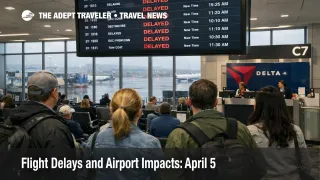
April 5 flight delays are turning into a New York first problem with San Francisco already running under a live traffic management program and additional risk spreading into the Mid Atlantic, Charlotte, and Orlando later today. The Federal Aviation Administration's command center says LaGuardia Airport is under an active ground stop tied to low visibility and diversions, while San Francisco International Airport (SFO) is already posting average destination delays of 28 minutes and the broader plan points to possible additional programs this afternoon. Travelers connecting in the New York region, crossing the East Coast bank, or depending on same day arrivals in San Francisco should protect buffer early.
April 5 Flight Delays: What Changed
What changed on Sunday, April 5, 2026 is that the FAA's live operations plan has already moved beyond a simple weather watch. The command center says the LaGuardia ground stop was extended because of low runway visual range and the number of diversions, with diversion recovery issued for LaGuardia, Newark Liberty International Airport (EWR), and satellite airports. At the same time, the FAA listed active programs at Houston George Bush Intercontinental Airport (IAH) and San Francisco, then flagged Philadelphia International Airport (PHL) after 1100 a.m. ET, Washington area airports after noon ET, JFK and LaGuardia after 100 p.m. ET, Charlotte Douglas International Airport (CLT) after 100 p.m. ET, Boston Logan International Airport (BOS) after 200 p.m. ET, and Orlando International Airport (MCO) after 3:00 p.m. ET as possible or probable program points.
The weather footprint is broad enough to matter operationally. The FAA identified low ceilings, low visibility, and rain in Boston, the New York and Philadelphia approach structure, and parts of the Washington corridor, with thunderstorms affecting Charlotte and Central Florida, isolated storms in South Florida, rain and snow around Minneapolis, low ceilings in Southern California, and wind in Las Vegas. That does not guarantee major disruption everywhere, but it does mean the network has several separate drag points rather than one isolated airport problem.
Which Airports and Itineraries Are Most Exposed
The highest exposure is still the New York system. LaGuardia's real time FAA status page shows a traffic management program in effect because of weather and low ceilings, with departures also vulnerable because arriving traffic is being managed first. JFK and Newark were still posting only minor general delays when checked, but the command center had already activated a New York metro hotline for weather issues across the region, and that usually signals a coordinated effort to prevent the metro complex from slipping further behind.
San Francisco is the other clear pressure point. SFO's FAA status page shows arriving traffic under a live management program with delays averaging 28 minutes, and the command center separately marked SFO for a probable ground stop or delay program later in the day. That risk is more important than the raw delay number suggests, because SFO is also operating with runway and taxiway construction that the FAA says continues through November 15, 2026. In an earlier Adept Traveler article, Flight Delays and Airport Impacts: April 3, the same airport already stood out as a fragile node even on a lighter delay day.
The next tier of exposure is itineraries that depend on afternoon and evening turns through PHL, Washington Dulles International Airport (IAD), Baltimore Washington International Thurgood Marshall Airport (BWI), Ronald Reagan Washington National Airport (DCA), CLT, BOS, and MCO. The FAA has not confirmed full disruption at all of those airports yet, but once route controls and ground programs stack from New York through Washington and down into the Southeast, short connections become much weaker bets. First order, flights depart or arrive late. Second order, inbound aircraft, crew rotations, and onward connections start slipping even before your own airport posts a dramatic advisory.
What Travelers Should Do Now
Treat April 5 as a protect the itinerary day, not a wait and see day, if you are touching New York or San Francisco. Check the inbound aircraft for your flight, not only the posted departure time, because that usually reveals the next delay before the public board catches up. If you are flying into a hard arrival commitment, a cruise embarkation, a long drive after landing, or a separate ticket connection, add margin now rather than assuming a current delay of 15 minutes or less will stay that small.
The rebook versus wait decision is mostly about connection risk. If your trip runs through LaGuardia, JFK, Newark, or SFO and depends on a short layover or same day event, earlier flights, alternate airports, or a longer layover are the safer play. If you are traveling later through Philadelphia, Washington, Charlotte, Boston, or Orlando, the better move may be to keep the ticket but stop building tight downstream assumptions around it until the afternoon picture is clearer. Travelers who want more structural context on why these FAA controls ripple so widely can read U.S. Air Traffic Control Privatization: Reality Check.
The main things to monitor over the next several hours are simple. Watch whether the possible programs at PHL, the Washington airports, JFK, CLT, BOS, and MCO shift from planned to active, and watch whether your airline starts swapping aircraft or stretching turn times. The FAA's airport status pages and your airline app together will usually tell you more than a static departure board.
Why the Network Can Worsen Fast This Afternoon
The mechanism is not just local rain or low clouds over one airport. The FAA plan shows en route constraints from New York and Washington through the Southeast and Gulf, with thunderstorms affecting multiple control centers, route closures possible over the Atlantic and Gulf, and traffic management tools such as capping, tunneling, escape routes, and swaps ready to be used as the day develops. In plain language, that means aircraft are not only fighting local airport conditions, they are also competing for fewer workable paths through busy airspace.
Two background factors make that more sensitive today. The FAA says the national system is carrying high snowbird volume, and it also notes added traffic tied to Masters tournament arrivals through April 14. Neither item alone causes a disruption day, but both reduce slack in a network that is already handling weather, diversions, and construction limits at several major airports. That is why a day that begins with mostly minor posted delays can still become a harder connection and recovery problem by late afternoon. In earlier Adept Traveler coverage, Flight Delays and Airport Impacts: April 2 showed the same pattern, an early localized choke point can spread once demand, weather, and hub dependency start reinforcing each other.
Sources
- Current Operations Plan Advisory, ATCSCC ADVZY 037, April 5, 2026
- La Guardia Airport Real time Status, FAA
- Newark International Airport Real time Status, FAA
- John F Kennedy International Airport Real time Status, FAA
- San Francisco International Airport Real time Status, FAA
- FAA Daily Air Traffic Report
- The Most Recent ATCSCC Advisory, NY Metro Hotline FYI, April 5, 2026