

Flight Delays and Airport Impacts: April 3
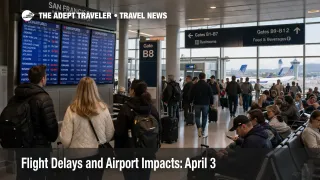
April 3 flight delays are starting as a lower intensity national risk day, but the Federal Aviation Administration is already pointing to a few places where the picture could tighten fast. The FAA's daily report says low clouds may affect Boston Logan International Airport (BOS), the New York airports, Philadelphia International Airport (PHL), and the Washington area, while thunderstorms could disrupt Orlando International Airport (MCO), Tampa International Airport (TPA), Detroit Metropolitan Wayne County Airport (DTW), Indianapolis International Airport (IND), and Memphis International Airport (MEM), with snow in Salt Lake City International Airport (SLC) and wind in Las Vegas. Live airport pages still show only minor delays at many of those hubs, which means the main risk for travelers is not a systemwide breakdown this morning, but a later loss of recovery room if the FAA's planned programs switch on. Travelers with tight same day connections, fixed arrival commitments, or late day transcontinental turns should build margin before the network gets less forgiving.
April 3 Flight Delays: What Changed
What changed on Friday, April 3, 2026 is that the FAA's command center is not reporting major active terminal programs yet, but it is clearly signaling where the day could worsen. The operations plan says no national initiatives are anticipated this morning because of low demand, yet it also marks a San Francisco International Airport (SFO) ground stop or delay program as probable after 300 p.m. Zulu, a Denver International Airport (DEN) ground stop or delay program as probable until 800 p.m. Zulu, a Boston program as possible after 6:00 p.m. Zulu, and a LaGuardia Airport (LGA) program as possible through midnight Zulu. It also warns of minor holding around LaGuardia and Teterboro during survey work, and short departure stops or holding at Ronald Reagan Washington National Airport (DCA) because of multiple flyovers.
That makes April 3 different from a day where airports are already deep in live delays. The live FAA airport pages for BOS, JFK, MCO, SFO, DEN, LGA, and IAD were still showing only gate hold, taxi, or airborne delays of 15 minutes or less when checked. For travelers, that means there is still room to protect the itinerary early, but the agency's own plan shows where that room could shrink first.
Which Airports Carry the Most April 3 Flight Delay Risk
The clearest watchpoint is San Francisco. The FAA has already marked SFO for a probable ground stop or delay program later today, and that sits on top of the airport's longer running arrival constraint tied to runway and taxiway construction through November 15, 2026. In an earlier Adept Traveler article, SFO Landing Restrictions Cut Arrivals Through October 2, the deeper issue was that SFO is already operating with less arrival flexibility than normal. A weather driven slowdown on top of that lower margin setup can spill outward quickly into missed Bay Area pickups, shorter recovery windows, and weaker transpacific or West Coast connection reliability.
Denver is the other major pressure point. The FAA plan calls a DEN ground stop or delay program probable through 8:00 p.m. Zulu, and it separately notes Runway 07/25 remains closed through July 2, 2026. Even though DEN was still posting only minor delays when checked, Denver matters because it is both a large origin and a major connecting hub. When a Denver program activates, the first order effect is slower arrivals and departures. The second order effect is compressed bank structure, later aircraft turns, and weaker same day recovery across domestic itineraries that depend on Denver as a mid trip handoff.
The Northeast is more conditional, but still exposed. The FAA daily report flagged low clouds in Boston, New York, Philadelphia, and the Washington area, while the operations plan pointed to low ceilings and visibility in the New York approach system and possible later programs at BOS and LGA. Reagan National has a separate flyover constraint today, with FAA advisories warning of arrival delays and airborne holding of up to 20 minutes during specific windows. Travelers connecting through New York or Washington are not looking at a full collapse this morning, but they are looking at a day where a normal looking departure board can hide a weaker margin later in the cycle.
What Travelers Should Do Before the Afternoon Tightens
The immediate move is to protect short connections first, not just flights that already look late. If you are flying through SFO, DEN, LGA, BOS, or DCA later today, check the inbound aircraft before heading to the airport, and give yourself more buffer around parking, rideshare, bag drop, and security than the current airport board might seem to require. On a day like this, the published delay often shows up after the network has already begun to lose slack.
The next decision point is whether your itinerary needs certainty more than schedule convenience. For SFO and Denver, earlier departures, longer layovers, or alternate airports can make sense if the trip depends on a hard arrival time. For New York and Washington area trips, the better tradeoff may be to keep the booking but avoid assuming a short same day connection will hold if clouds, holding, or route controls start to stack. Travelers who want a one day earlier comparison can read Flight Delays and Airport Impacts: April 2. Travelers who want broader system context can read U.S. Air Traffic Control Privatization: Reality Check.
Over the next several hours, monitor whether the FAA's planned terminal programs at SFO, DEN, BOS, and LGA actually go active, and whether the Washington flyover windows create longer than forecast holding into DCA. Also watch Florida bound and Southeast routings, because the FAA plan shows multiple en route thunderstorm constraints and active traffic management flows from the Northeast and Midwest into Florida. That structure can widen the problem without every airport posting headline delay numbers at once.
Why the System Still Looks Fragile
April 3 is a good example of how U.S. delay days often develop. The daily report shows the weather footprint, but the operations plan shows how that footprint turns into practical travel risk through terminal constraints, route closures, and planned management programs. On this day, the FAA is balancing low clouds in the Northeast, thunderstorms across multiple control regions, snow in Salt Lake City, wind in Las Vegas, flyover constraints in Washington, and a high snowbird traffic backdrop in the national system. That does not guarantee a bad day everywhere. It does mean several separate friction points can interact if one or two hubs lose efficiency first.
That is also why today's seriousness is meaningful disruption risk, not yet a national breakdown. The live airport picture remained relatively restrained when checked, but the FAA's own plan already identifies the places where minor delays can become something more consequential. In practical terms, travelers still have time to defend the itinerary on April 3, but the safest assumption is that San Francisco and Denver are the first places where a manageable morning can turn into a much less forgiving afternoon.
Sources
- FAA Daily Air Traffic Report, April 3, 2026
- FAA Current Operations Plan Advisory, April 3, 2026
- FAA Most Recent Advisory, DCA Airport Arrival Delays, April 3, 2026
- General Edward Lawrence Logan International Airport (BOS) Real-time Status, FAA
- John F Kennedy International Airport (JFK) Real-time Status, FAA
- Orlando International Airport (MCO) Real-time Status, FAA
- San Francisco International Airport (SFO) Real-time Status, FAA
- Denver International Airport (DEN) Real-time Status, FAA
- La Guardia Airport (LGA) Real-time Status, FAA
- Washington Dulles International Airport (IAD) Real-time Status, FAA
- Flight Delays and Airport Impacts: April 2
- SFO Landing Restrictions Cut Arrivals Through October 2
- U.S. Air Traffic Control Privatization: Reality Check