

Korean Air April Fuel Surcharge Jumps
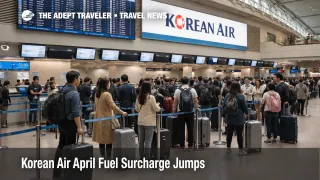
Korean Air fuel surcharge pressure moved from a market warning to a live booking cost problem on April 1, 2026, when the carrier entered emergency management mode for April and pushed much higher fuel charges onto international tickets from South Korea. The change matters most for long haul travelers booking from Incheon International Airport (ICN) to North America and Europe, where the surcharge jump is large enough to change the math on family trips, multi city itineraries, and last minute repairs. The immediate problem is not a published systemwide schedule cut at Korean Air. It is a faster rise in trip cost, combined with a clear sign that weak routes across Asia could face closer scrutiny if fuel stays elevated through April.
Korean Air Fuel Surcharge: What Changed
Reuters reported on March 31 that Korean Air would shift into emergency management mode for April because Middle East driven oil prices had pushed expected April fuel costs to about 450 U.S. cents per gallon, versus 220 cents in its business plan. Reuters also reported that fuel surcharges on Incheon long haul routes including New York, Chicago, London, and Paris were rising by more than 200 percent.
Local South Korean reporting fills in the passenger facing numbers. Korea JoongAng Daily reported that Korean Air's one way surcharge on its longest haul routes rose from KRW 99,900 to KRW 303,000, while most European routes including London and Paris rose from KRW 79,500 to KRW 276,000. Aju Press separately reported that Korean Air's April international fuel surcharge now ranges from KRW 42,000 to KRW 303,000 per one way ticket depending on route, and that round trip passengers on the longest routes could face KRW 606,000 in fuel surcharges alone.
That makes this more than a balance sheet story. A surcharge increase of that size can leave the schedule intact while still making the trip materially harder to book, harder to reprice, and harder to salvage if a traveler needs to change airports, dates, or connections after the original purchase.
Which Travelers Face the Most Pressure
The most exposed travelers are passengers originating in South Korea on long haul leisure or family trips, especially to North America and Europe, where the surcharge jump is largest. Travelers booking separate tickets are also exposed, because a missed feeder or voluntary rebooking can force them back into a market where the surcharge has already reset higher. Corporate travelers with fixed meeting dates may absorb the increase, but leisure travelers shopping by total trip price are more likely to delay, downgrade, or reroute.
There is also a second layer of risk beyond Korean Air itself. Reuters reported that Asiana Airlines and T'way Air have already adopted emergency measures under the same fuel stress. Korea JoongAng Daily reported that Asiana raised its New York surcharge sharply as well, and that several lower cost South Korean carriers have already started trimming or suspending routes.
For Adept Traveler readers, that means the booking problem can spread even if one airline still operates the flight. In an earlier Adept Traveler article, Hong Kong Cathay Fuel Surcharge Hike Raises April Fares, we covered another Asia hub carrier using surcharge action rather than immediate broad cuts. In Jet Fuel Shortage Risk Spreads Beyond Asia, the wider signal was already visible across pricing, supply, and network resilience.
What Travelers Should Do Before Booking
Travelers with fixed April, May, or early summer dates should stop treating the current fare as stable. On Korean Air, the issue is not only whether the base fare rises again, but whether the Korean Air fuel surcharge table resets even higher for May if jet fuel stays elevated through the March 16 to April 15 pricing window used in South Korea's monthly system. Aju Press reported that the benchmark had already moved above the highest surcharge threshold by March 31, which means another increase is possible if the average stays high enough.
The practical threshold is simple. Rebook or lock in now if the trip depends on one long haul nonstop, one alliance, or a thin onward connection that would be expensive to rebuild later. Wait only if the trip is discretionary, the traveler can absorb a large repricing, and there are genuine substitute routings through other hubs. Travelers building Asia Europe or Asia North America itineraries should price a backup on the same day they price the primary trip. If the fallback is already substantially worse, the market is tightening.
Over the next two to four weeks, watch for three signals. First, whether Korean Air's May surcharge table resets higher. Second, whether other Asian carriers move from surcharge action to route reviews or selective cuts. Third, whether alliance alternatives stop offering meaningful fare relief, which would show that fuel stress is spreading from one airline response into a broader regional pricing pattern.
Why This Could Spread Beyond Korean Air
The mechanism is straightforward. Fuel is a major airline operating cost, and South Korea's surcharge system passes part of that cost through in monthly resets based on jet fuel benchmarks and exchange rates. When fuel rises quickly, the first order effect is a higher surcharge or higher fare. The second order effect is tighter network decision making, weaker demand on marginal long haul routes, and less room for travelers to repair a broken itinerary cheaply.
There is already evidence that this is not a Korean Air only pattern. Cathay Pacific published higher fuel surcharge levels from April 1, 2026, on many long haul markets, including increases from USD 149.20 to USD 200.00 in most non Hong Kong purchase markets. Korean Air Cargo also published a first party notice on March 17 saying the Middle East conflict had put operating costs under significant pressure and that an urgent surcharge adjustment would take effect on April 1, with a shift toward more frequent updates in some regions.
That does not prove a wave of immediate passenger cuts across Asia. It does show a widening pattern in which carriers are trying to protect margins first through surcharge and pricing action, while leaving schedule reductions as the next lever if fuel stays high or demand weakens. For travelers, the next real decision point is not whether one headline sounds dramatic. It is whether the Korean Air fuel surcharge becomes the first of several monthly resets that make long haul Asia trips steadily harder to price and rebuild.
Sources
- Korean Air to shift to emergency mode in April amid rising oil prices from Iran war, Reuters
- Passengers rush to buy plane tickets before April's steep fuel surcharges kick in, Korea JoongAng Daily
- Flying for South Koreans is now a luxury as fuel surcharge triples, Aju Press
- Fuel surcharge updates, Cathay Pacific
- [Notice] Revision of FSC Scheme due to Middle East conflict, Korean Air Cargo