

Saudi Arabia Airports Open, but Flights Stay Fragile
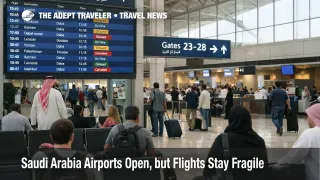
Saudi Arabia airport restrictions remain the practical issue on April 5, 2026, even though King Khalid International Airport (RUH), King Abdulaziz International Airport (JED), and King Fahd International Airport (DMM) are still open. Official U.S. and U.K. guidance now lines up on the same operational point: Saudi departures are still possible, but travelers should not mistake an open airport for a stable trip. The main risk is not terminal closure, it is a volatile operating environment in which air traffic restrictions, route suspensions, and short notice delays can break a transfer or exit plan after the ticket is already booked.
Saudi Arabia Airport Restrictions: What Changed
What changed this week is the framing. The U.S. Embassy in Riyadh said on March 31 that Saudi airspace remains open, but with frequent air traffic restrictions tied to continued missile and drone threats, and that Riyadh, Jeddah, and Dammam airports remain open and operational. The same alert told travelers to check status directly with their airline because delays and cancellations remain possible. On the U.K. side, the FCDO updated its Saudi Arabia advice to say Iran continues striking civilian infrastructure across the region, including airports, and that travel within or out of Saudi Arabia is at the traveler's own risk.
That makes this an operational reliability story, not an airport closure story. A traveler using Saudi Arabia as a fallback exit from the wider Gulf can still move, but the margin for error is thinner than a published schedule suggests. Same day onward flights, overnight connections, and multi carrier itineraries are the most exposed because one short disruption at the Saudi segment can spill into a wider rebooking problem.
Which Travelers Face the Most Risk
The travelers with the highest exposure are people using Saudi Arabia as a transfer or escape valve rather than as a simple origin and destination trip. That includes passengers connecting onward to Europe, North America, or Asia through Riyadh, Jeddah, or Dammam, business travelers trying to leave on tight schedules, and anyone relying on a Gulf hub connection after a canceled segment elsewhere in the region. The first order problem is delay or cancellation on the Saudi leg. The second order problem is that the missed onward segment may not fail until the next airport, after hotel, visa, and baggage decisions have already become more expensive.
Carrier behavior shows why airport status alone is not enough. Flynas says flights to and from several regional destinations, including Abu Dhabi, Dubai, Sharjah, Doha, Bahrain, Kuwait, Iraq, and Syria, remain suspended through April 15, 2026. Lufthansa Group separately says Riyadh and Dammam flights remain suspended through October 24, 2026, alongside a wider list of Middle East destinations. In practice, Saudi Arabia is open, but parts of the network around it are still uneven, which narrows reroute options if the original plan breaks.
This is also not a one airport problem. Dammam's airport site currently tells passengers to check flight status and contact airlines before heading to the airport, while Riyadh and Jeddah both provide live flight status tools and current departures information through their airport platforms. That is a strong signal that local operators expect travelers to verify actively, not passively show up and assume normal operations.
What Travelers Should Do Now
Travelers who still need to use Saudi Arabia should treat it as workable only when the plan has slack built into it. That means avoiding short same day self connections, confirming every segment directly with the operating airline, and checking both the carrier and the airport departure tools before leaving for the terminal. A ticketed booking is no longer enough proof that the itinerary will operate cleanly from curb to gate.
The main decision threshold is whether Saudi Arabia is your best available path, or merely the least bad path. If you already hold a confirmed nonstop or a single ticket through Saudi Arabia on a carrier that is still operating normally, the route can still work. If your plan depends on separate tickets, a late night arrival feeding a morning long haul departure, or a backup connection through one of the still disrupted Gulf markets, the risk climbs fast. That is the point where rebooking earlier, paying more for a cleaner itinerary, or adding an overnight buffer becomes the smarter move.
Over the next 24 to 72 hours, the signals that matter most are new carrier suspension extensions, fresh embassy or FCDO wording about regional strikes, and any airport specific guidance that shifts from status checking to stronger movement limits. Travelers should also keep onward visa rules, hotel flexibility, and medication access in mind before committing to Saudi as an exit route, because a disrupted departure can quickly become a documentation and lodging problem, not just a flight problem. In an earlier Adept Traveler article, Saudi Arabia Flights Still Run, but Risk Is Higher covered the earlier phase of this exposure. In an earlier Adept Traveler article, U.S. Gulf Travel Advisories Tighten as Risks Spread tracked how that risk widened across the region.
Why Saudi Flights Remain Fragile
The mechanism is straightforward. Saudi airports can stay open while the wider system around them stays unstable. Air traffic restrictions can slow departures without closing terminals. Missile and drone threats can force operational changes even when runways remain available. At the same time, airline level suspensions remove recovery capacity from the network, so a traveler who misses one connection may find fewer same day alternatives than a normal timetable would suggest.
What happens next depends less on whether Saudi airports remain technically open, and more on whether regional volatility keeps forcing airspace management and carrier caution. For now, the most accurate traveler reading is this: Saudi Arabia remains usable, but not dependable in the way a stable hub normally is. Travelers can still get through Riyadh, Jeddah, and Dammam, but only by treating verification, buffers, and fallback planning as part of the trip, not as optional extras.
Sources
- Security Alert: Saudi Arabia, Update 1, March 31, 2026
- Saudi Arabia Travel Advice, GOV.UK
- Travel Advisory: Flight Updates Due to Airspace Closures, flynas
- Current Travel Information, Lufthansa
- King Fahd International Airport Flight Alert
- King Khalid International Airport Departures and Arrivals
- King Abdulaziz International Airport Departure Information