

Saudi Arabia Flights Still Run, but Risk Is Higher
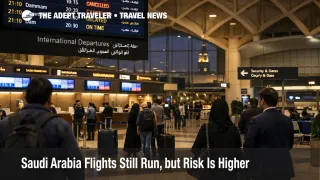
Saudi Arabia flight risk is no longer a simple open or closed question. As of March 21, 2026, the U.S. State Department still says commercial flights from Saudi Arabia are operating, but have been significantly disrupted, while also warning that the U.S. government has limited ability to provide emergency services because of safety risks. Separate U.S. Mission security messaging says Americans should depart via commercial flights if they can do so safely, and that Riyadh, Jeddah, and Dammam airports remain open but face possible delays and cancellations. For travelers, that shifts the decision from "can I fly" to "can my full itinerary survive another disruption."
Saudi Arabia Flight Risk: What Changed
What changed is the operating posture around a still functioning market. The March 13, 2026 State Department advisory kept Saudi Arabia at Level 3, Reconsider Travel, but updated the summary to emphasize Iranian drone and missile targeting risk, armed conflict, and the fact that flights remain available only inside a significantly disrupted system. It also states that on March 8, 2026, the United States ordered non-emergency government personnel and eligible family members to leave Saudi Arabia due to safety risks.
That matters because open airports are not the same thing as stable operations. The U.S. Mission said on March 20, 2026 that Saudi airspace remains open with frequent air traffic restrictions to address continued missile and drone threats, and that Riyadh, Jeddah, and Dammam remain operational. At the same time, routine U.S. consular services were suspended for the Eid closure window, adding more friction for travelers who might need passport, visa, or other consular help while conditions stay unstable. In an earlier Adept Traveler article, Saudi Arabia Travel Advisory Hardens Risk tracked the advisory hardening, and Saudi Consular Suspension Cuts Eid Travel Options documented the sharper consular squeeze.
Which Saudi Itineraries Are Most at Risk
The most exposed travelers are not necessarily those flying into Saudi Arabia for a long stay. The higher risk group includes short business trips, pilgrim or family itineraries with fixed dates, and connecting journeys that rely on one Saudi airport plus a second onward segment. When flights are technically operating but vulnerable to delay, cancellation, or airspace restriction, tight connections and same-day meeting plans become the weakest part of the trip.
Riyadh and Dammam also look weaker for some European connections than a simple airport status check would suggest. KLM says flights to and from King Khalid International Airport (RUH) and King Fahd International Airport (DMM) are suspended through May 17, 2026, which shows that parts of the Saudi market remain open overall while specific international links stay cut for weeks. In an earlier Adept Traveler article, KLM Dubai, Riyadh, Dammam Suspensions Extend to May 17 showed how that route-level damage changes rebooking options.
The risk is even higher for travelers who would struggle if something goes wrong on the ground. That includes anyone with a passport close to expiration, anyone facing visa or overstay issues, anyone depending on embassy help, and anyone planning a road workaround tied to another Gulf airport. First order, the airport may still function. Second order, the trip can still fail if airspace restrictions move, a carrier trims service again, border logic changes, or the traveler needs emergency help that is harder to obtain quickly.
What Travelers Should Do Now
Travelers already ticketed into or out of Saudi Arabia should treat the next 24 to 72 hours as an active risk-management window, not a routine predeparture period. Confirm that every flight in the chain is still operating, check whether your carrier has a waiver or refund path, and avoid assuming an airport that is open now will remain low friction by the time you reach check in. If your trip depends on a short layover, a fixed event, or a same-day domestic connection after arrival, the safer call is to add more buffer or rebook earlier.
The main decision threshold is whether the trip can absorb one serious break without turning into a larger financial or logistical problem. A traveler with flexible dates, strong insurance, extra hotel budget, and no consular or visa issues may still decide to go. A traveler who needs schedule certainty, rapid onward movement, or fast access to emergency documentation should be much more cautious. That is where Saudi Arabia flight risk becomes too high to ignore, even though planes are still moving.
Anyone who still travels should keep printed and digital copies of passports, visas, tickets, and hotel bookings, monitor airline apps directly, and avoid plans that depend on improvising at the airport. The U.S. Mission's current message is not "normal operations with delays." It is effectively "depart if safe, verify everything, and do not count on a smooth operating environment."
Why Saudi Travel Remains Fragile
The mechanism is broader than one airport or one airline. Saudi operations now sit inside a regional airspace and security problem that can change faster than a published timetable. The State Department ties the current risk to ongoing threats of Iranian drone and missile attacks after hostilities that began on February 28, 2026. The FAA still maintains active security notices for the Persian Gulf and Gulf of Oman region, which means airlines and flight planners are operating with an elevated risk framework even when Saudi airports themselves remain open.
That is why this remains a mixed but operationally degraded market, not a routine destination. What happens next depends less on whether Saudi Arabia can keep airports open today, and more on whether the wider Gulf security picture stabilizes enough for airlines, embassies, and route planners to restore predictability. Until that happens, Saudi Arabia flight risk stays elevated for trips that need reliability, fast recovery options, and normal emergency support.
Sources
- Saudi Arabia Travel Advisory, U.S. Department of State
- Consular Information for Americans in the Middle East, U.S. Department of State
- Security Alert: Saudi Arabia, Update 1, OSAC
- Prohibitions, Restrictions and Notices, Federal Aviation Administration
- Saudi Arabia Travel Advisory Hardens Risk, Adept Traveler
- Saudi Consular Suspension Cuts Eid Travel Options, Adept Traveler
- KLM Dubai, Riyadh, Dammam Suspensions Extend to May 17, Adept Traveler