

Storm Dave Compounds UK Easter Flights, Ferries
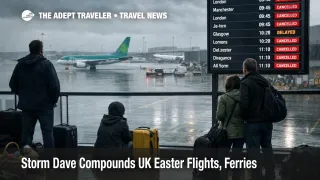
Storm Dave has turned UK Easter travel into a stacked network problem, not a single weather delay. By April 5, 2026, the Met Office had already escalated part of northern Britain to an amber wind warning, CalMac had warned that the storm would challenge Easter sailings, and live reporting showed flight cancellations at Dublin Airport plus wider rail and ferry disruption across Scotland, Northern Ireland, and Wales. For travelers, the practical shift is that planned Easter rail engineering work was already thinning recovery options before the weather hit. If your trip depends on a same day airport to rail or rail to ferry handoff, the safer move is now to simplify the journey rather than try to preserve every segment.
Storm Dave UK Easter Travel Disruption: What Changed
The most useful distinction is timing. In an earlier Adept Traveler article, UK Easter Airport Rail Works Tighten Access, the pressure point was planned engineering work around the holiday weekend. Since then, Storm Dave has added live wind and weather disruption on top of that weaker holiday timetable. The Met Office said the amber warning covered northern England, southern Scotland, and northwest Wales from 700 p.m. on April 4 to 300 a.m. on April 5, with gusts of 60 to 70 mph and broader yellow wind and snow warnings across Scotland and Northern Ireland.
That weather translated into operating limits across multiple modes. Dublin Airport canceled flights during the storm window, while ScotRail's severe weather rules explain why strong wind quickly becomes a timetable problem, trains face speed restrictions at 70 mph forecasts, and services in affected areas must be suspended at 90 mph. On ferries, CalMac told Easter travelers that Storm Dave would challenge the network, and Irish Ferries canceled at least one April 4 Pembroke to Rosslare sailing because of adverse weather. This is why a traveler may see one leg still running while the itinerary as a whole is already failing.
Which Travelers Face the Most Disruption
The highest risk group is not every Easter traveler equally. It is people who built tight intermodal chains into a holiday weekend, especially Scotland and Irish Sea itineraries that already had less slack because of rail works from Friday, April 3 through Monday, April 6. National Rail said major Easter engineering affects long distance movement between Preston and Glasgow Central or Edinburgh, while separate airport guidance already showed altered airport rail access over the same bank holiday window. When weather then forces slower rail running or ferry cuts, replacement capacity is thin, and late recovery can break well beyond the original warning zone.
Island and west coast Scotland trips are especially exposed because some ferry corridors were already fragile before the storm weekend. CalMac said it had experienced significant disruption heading into Easter, warned that not all routes were equally affected, and highlighted pressure on Arran, Mull, Islay, and Skye related services, with some routes operating with limited space, single vessel service, or charter arrangements. A traveler trying to salvage a missed rail arrival into one of those sailings may discover that the next available option is no longer the same day, and sometimes not even the same port approach.
What Travelers Should Do Now
Treat airport to rail to ferry combinations as the first plans to cut, not the last plans to defend. If you are traveling on April 5 or early April 6 and your booking depends on landing, clearing the airport, catching a train, and then making a booked sailing, you should price the cost of splitting the trip with an overnight stop or moving to a later departure now. The strongest case for immediate change is any itinerary involving western or northern Scotland, Northern Ireland sea crossings, or Welsh and Irish Sea ferry links where one missed segment can cascade into a full day loss.
Rail travelers should assume weather can outlast the official warning in practical terms. ScotRail notes that once high winds settle, routes still have to be checked for debris before regular service resumes. That means the operational risk window is often longer than the headline warning window. Ferry travelers should watch operator specific status pages rather than regional weather alone, because route level vessel limits, berth conditions, and backlog management decide what restarts first. Flight travelers moving through Dublin Airport should check airline status directly and avoid assuming that a departure board showing "delayed" still leaves enough time for a same day onward surface connection.
A comparable multi layer weather pattern appeared earlier this year in Storm Chandra UK Travel Disruption for Flights and Ferries, but this Easter case is less forgiving because holiday engineering works were already reducing fallback capacity. For travelers, the decision threshold is simple. If your trip still relies on one clean handoff between modes, or on the last reasonable sailing or train of the day, you are no longer managing normal delay risk. You are managing itinerary failure risk.
Why the Disruption Spreads Beyond the Warning Map
Storm Dave is not equally severe everywhere, but the transport system does not need uniform damage to produce broad traveler consequences. The mechanism is straightforward. A wind warning slows or suspends part of the rail network, ferry operators trim or cancel exposed crossings, airports lose some arrivals or departures, and the holiday weekend removes spare trains, spare berths, spare hotel rooms, and easy same day rebooking. That is why Scotland, Northern Ireland, and Irish Sea routes can remain the main trouble spots even when southern England is dealing more with planned rail works than direct storm effects.
What happens next depends less on whether the worst gusts have passed, and more on how quickly each operator clears backlog. The Met Office said warnings would ease as the system moved away, but live reporting on April 5 still pointed to residual restrictions, power issues, bridge controls, and emergency rail speed limits after the peak wind period. In practical terms, that argues for monitoring operator updates into April 6, not just watching the weather map turn quieter. Travelers with hotel check ins, tours, or car pickups tied to late April 5 arrivals should contact suppliers before the missed arrival becomes a no show problem.
Sources
- Amber wind warning issued as Storm Dave crosses the UK, Met Office
- Customer Update, Easter travel information, April 2026, Caledonian MacBrayne
- Easter Bank Holiday Travel Summary, National Rail
- Travel to and from the airport by train on bank holidays, National Rail
- Winter train travel, ScotRail
- Rosslare / Pembroke sailing updates, Irish Ferries
- Storm Dave, thousands of homes in Wales and Northern Ireland left without power, The Guardian