

Channel EES Checks Stay Uneven at UK-France Crossings
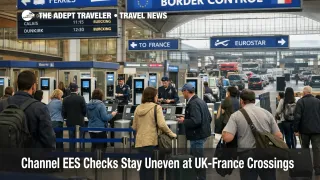
Channel EES border checks are becoming a sharper trip planning issue because the legal switch to full EU Entry/Exit System operation on April 10, 2026 does not guarantee that every UK-France crossing will feel the same on day one. The European Commission and related EU guidance are clear that EES replaces manual passport stamping at participating external borders from April 10, after a six month phased rollout. But operator guidance on the Channel is still uneven, with DFDS warning that traveler experience may vary by location and time, and that full application is not expected before mid-April in its own customer messaging. For travelers, that turns a border rule change into a corridor-specific reliability problem, especially for Easter and spring trips with fixed ferry departures, rail check-in cutoffs, coach staging, or onward same-day connections.
In an earlier Adept Traveler article, EU Entry Exit System Goes Fully Live on April 10, the focus was the hard EES deadline itself. The new risk on April 6 is narrower and more operational, the UK-France corridor is entering full EES with different operators still describing different handling patterns, which raises the odds of inconsistent pre-departure processing rather than one uniform border experience.
Channel EES Border Checks: What Changed
As of April 10, 2026, EES is supposed to be fully operational at all participating external border crossing points, ending the old reliance on manual passport stamps for eligible short-stay non-EU travelers. The system records passport data, a facial image, and fingerprints, then logs entries and exits electronically. UK government travel advice for France says travelers entering through the Port of Dover, Eurotunnel at Folkestone, or Eurostar at London St Pancras International may have EES registration taken before they leave the UK, which is a crucial detail for Channel travelers because the border friction shows up before boarding, not after arrival in France.
That pre-departure placement changes the failure point. Instead of a problem confined to arrival immigration halls in continental Europe, the pressure can build earlier at terminal approaches, vehicle staging areas, check-in lanes, security flows, and rail boarding windows on the UK side. First order, some passengers will simply take longer to clear controls on their first EES registration. Second order, a few extra minutes per traveler can spread into missed ferry loadings, longer rail queue compression at St Pancras, and missed onward bookings in Calais, Paris, Lille, or Brussels when travelers planned the crossing as if the old border rhythm still applied.
Which UK-France Crossings Face the Most Friction
Dover remains the clearest ferry pressure point because operators are openly telling travelers that processing may not be uniform. DFDS says EES is being introduced on a rolling basis and that experience may vary by location or time, while its UK-France boarding guidance says Dover-France check-in typically closes 60 minutes before departure and in high season customers should allow 120 minutes before check-in closes to pass all controls. P&O Ferries says Dover-Calais EES checks take place before departure in Dover and advises passengers to allow extra time because the scheme can take longer than usual. That combination points to the main Dover risk, not a single dramatic shutdown, but a corridor where vehicle and passenger throughput can fluctuate by sailing and time of day.
Folkestone is a different kind of risk because LeShuttle concentrates large volumes into a controlled terminal flow. LeShuttle says EES applies to non-EU nationals on short stays and that fingerprints and a facial image are scanned in addition to normal passport checks. UK guidance again matters here, because if registration is required for a France-bound crossing from Folkestone, it happens before leaving the UK. That means the weak point is less about onboard travel time and more about whether terminal processing still moves cleanly enough for the booked departure window.
London St Pancras International is operationally different again. Eurostar says EES procedures are being introduced gradually and tells passengers to arrive at the station at the time shown on their ticket, with that timing already designed to cover pre-departure checks including border control. Premium travelers departing London may also be invited to use a pre-registration kiosk opposite the priority ticket gates. That suggests St Pancras is better structured than some ferry flows for controlled processing, but it does not remove the core risk, uneven biometric handling can still crowd the pre-boarding sequence and punish travelers who treat old arrival habits as good enough.
What Travelers Should Do Before Same-Day Departure
Travelers using ferries from Dover should watch for operator emails, app alerts, and terminal advisories on the day of travel, not just the night before. On this corridor, the practical question is whether your sailing still has enough slack to absorb slower border enrollment. If you are taking a ferry as part of a longer same-day chain, especially a rail transfer, a timed tour, or a late hotel arrival window, the safer move is to build more pre-departure buffer than you used before EES.
LeShuttle and Eurostar travelers should treat ticketed departure as the end of the process, not the start of terminal time. With Eurostar in particular, the company is explicitly telling travelers to follow the arrival time on the ticket because that already accounts for border checks. The wrong move now is cutting it fine on the assumption that station or terminal routines have not materially changed. If the trip depends on a same-day onward connection in France or Belgium, a looser buffer is worth more than a theoretically faster crossing.
The next decision point is simple. If operator guidance tightens, if Easter volumes build, or if same-day terminal updates start warning of slower processing, travelers should prioritize preserving the crossing over preserving a tight onward schedule. The Channel EES border checks issue is not that every passenger will face a severe delay. It is that inconsistent handling at Dover, Folkestone, ferry terminals, and St Pancras can break an itinerary unevenly, which makes fixed, low-margin plans the weakest ones.
Why The Channel Is Still Uneven After April 10
The mechanism is straightforward. EES has one legal endpoint, full operation from April 10, 2026, but the UK-France corridor still depends on separate operators, separate terminal layouts, different passenger mixes, and border controls that are often performed before departure from the UK. DFDS customer guidance still pointing to mid-April variability does not override the EU deadline, but it does show that practical implementation on the corridor may feel messy even when the law says the rollout phase is over.
That mismatch is why this story matters more for Channel travelers than for many airport arrivals. Airports can sometimes spread border pressure across larger arrival halls and later stages of a trip. Channel crossings compress border control into a pre-departure funnel with hard boarding cutoffs, fixed sailing or train slots, and a high share of travelers who are driving or carrying their own onward timing risk. In an earlier Adept Traveler article, Europe EES Border Queue Risk Hardens Before April 10., the warning was that EES queues were becoming a broader Easter issue. On April 6, the more precise reading is that Channel EES border checks can stay uneven even after the official go-live date, so travelers should monitor the specific crossing they are using, not the headline rule alone.
Sources
- Entry/Exit System, European Commission
- Entry/Exit System FAQ, Travel to Europe, European Union
- France Travel Advice, Entry Requirements, GOV.UK
- Border Regulations Updates, DFDS
- Check-In and Boarding on UK-France Routes, DFDS
- EES Travel Rules for Europe, P&O Ferries
- Check Travel Requirements Between the UK and EU, Eurostar
- Entry/Exit System (EES), LeShuttle