

Gulf Flight Risk Review Lands April 10
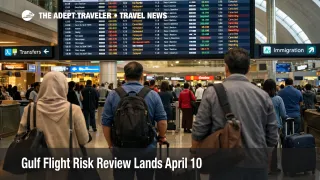
Travelers booked through Gulf hubs in mid April now have a clearer decision date. The Gulf flight risk review comes into focus on April 10, 2026, because the European Union Aviation Safety Agency, EASA, says its active conflict zone bulletin for the Middle East and Persian Gulf remains valid until that date unless reviewed earlier. The practical issue is not that flights automatically resume or automatically stop on April 10. It is that the review date can influence whether some airlines keep current suspensions, extend them again, or leave schedules technically on sale while still flying around a wider risk map.
Gulf Flight Risk Review: What Changes on April 10
EASA's bulletin is an active conflict zone information bulletin, not a blanket legal closure of Gulf airspace for every airline worldwide. But it is still a real operational trigger because it applies to EASA operators and to third country operators flying to, from, and within the European Union under EASA authorization. The current bulletin was revised on March 27, 2026, and that revision extended validity to April 10 without changing the underlying risk picture.
The bulletin's coverage is broader than many passengers realize. EASA lists affected airspace in Bahrain, Iran, Iraq, Israel, Jordan, Kuwait, Lebanon, Oman, Qatar, the United Arab Emirates, and Saudi Arabia. Its recommendation is that operators should not fly in that affected airspace at any altitude, with a limited exception for parts of southern Saudi Arabia and Oman above FL320 along a defined corridor. EASA says the risk comes from ongoing military intervention, retaliatory attacks, all altitude capable air defense systems, cruise and ballistic missiles, interceptions, and the chance of spillover, misidentification, or failure in interception procedures.
That matters to passengers even if their airport is open. A carrier can keep serving a destination only if it is satisfied with the airport situation, the route into and out of that airport, crew duty implications, fuel planning, alternate airport options, insurance, and its own risk tolerance. So the April 10 review is less about a headline reopening and more about whether airline planning assumptions loosen, stay frozen, or harden further.
Which Travelers and Itineraries Are Most Exposed
The most exposed travelers are not only people flying to the Gulf itself. The harder problem hits anyone using Dubai, Doha, Abu Dhabi, Riyadh, Dammam, or Amman as a bridge between Europe, Asia, Africa, or North America. First order, a nonstop or one stop itinerary can disappear when a carrier suspends a city. Second order, the rest of the trip can weaken because remaining routings may require longer detours, thinner schedules, extra hotel nights, or separate tickets that break protection if one leg slips.
Recent airline notices show why mid April travelers should not assume the market is stabilizing yet. KLM says flights to and from Tel Aviv, Dubai, Riyadh, and Dammam are suspended through May 17, 2026, and says it is also not flying through Iran, Iraq, and Israel, or over several countries in the Gulf region. Lufthansa Group says Dubai and Tel Aviv are suspended through May 31, 2026, while several other Middle East destinations remain suspended through October 24, 2026, depending on airline and city. Philippine Airlines says Dubai and Doha are suspended through May 31, 2026, with Riyadh suspended through April 9, 2026.
In an earlier Adept Traveler article, KLM Middle East Suspensions Run Through May 17 tracked how one European hub carrier pushed its disruption window deeper into spring. Another earlier Adept Traveler article, Lufthansa Middle East Cuts Deepen Summer Booking Risk, showed that some suspension windows now run far beyond the immediate conflict week. That is why April 10 matters even if nothing dramatic happens that day. It sits between active airline pullbacks and a regulatory bulletin that still frames part of the risk discussion.
What Travelers Should Do Before the April 10 Review
Travelers departing before or just after April 10 should treat the current schedule as provisional unless their airline has already published a hard operating plan. The immediate move is to check the carrier's own alert page, not just the booking screen, and to look for destination specific waivers, refund rules, and rebooking deadlines. A flight can remain in reservation systems while the risk environment still points toward cancellation, rerouting, or later schedule changes.
The main decision threshold is trip rigidity. If the journey depends on a cruise embarkation, wedding, conference, fixed tour, or onward long haul connection, waiting for a last minute clarification may cost more than rebooking early. If the trip is flexible and the airline has a broad waiver, it can make sense to watch the April 10 review and the first round of airline updates that follows. Travelers using Gulf hubs as connectors should be especially skeptical of short same day connections, because even when flights operate, route changes and congested reaccommodation can erase the margin that made the itinerary work in the first place.
The most useful signals on April 10 and the following 24 to 72 hours will be changes to airline advisory pages, whether suspension end dates move again, whether carriers restore any specific city pair rather than issue vague language about monitoring, and whether European airlines begin to treat southern Oman or Saudi routings differently under the existing corridor exception. No single press release will settle the whole market. Travelers need to watch the airline operating decision, not just the regulator's timestamp.
Why the EASA Bulletin Still Moves Airline Decisions
The bigger mechanism is that conflict zone bulletins help set the risk envelope for carriers that must make route, crew, fuel, insurance, and contingency decisions under uncertainty. EASA says it will keep monitoring whether risk for European operators increases or decreases as the threat picture evolves. That means April 10 is best understood as a decision node inside an ongoing process, not as a promised reopening date.
Passengers should also keep the second order effects in view. When multiple carriers suspend service into Gulf and nearby markets at the same time, capacity tightens on the surviving operators, reroutes lengthen block times, and backup options get more expensive. Reuters has also reported wider strain from the conflict on airspace access and fuel logistics, which adds another layer of fragility even where airports themselves remain open. For travelers, the real takeaway is simple, mid April plans that rely on Gulf hubs still need active monitoring, and April 10 is the next serious checkpoint.
Sources
- Airspace of the Middle East and Persian Gulf, EASA
- Receive Disruption Updates During Your Journey, KLM
- TWP2603/TWP2604/TWP2606: Lufthansa Group Airlines Adjust the Flight Offer to and from the Middle East, Lufthansa Group
- PAL Middle East Flights Advisory, Philippine Airlines
- Airlines Cancel More Flights as Middle East Conflict Escalates, Reuters
- Asian Airlines Trim Schedules and Carry Extra Fuel as Supplies Tighten, Reuters