

Lufthansa Middle East Cuts Deepen Summer Booking Risk
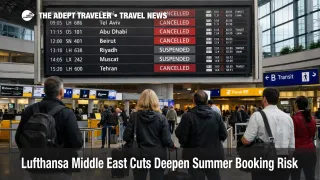
Lufthansa Middle East suspensions widened again on April 2, 2026, and the practical change for travelers is no longer just disruption, but duration. Lufthansa Group now shows a split network freeze, with Dubai and Tel Aviv suspended through May 31, while Abu Dhabi, Amman, Beirut, Dammam, Riyadh, Erbil, Muscat, and Tehran are suspended through October 24 across Lufthansa, SWISS, Austrian Airlines, Brussels Airlines, ITA Airways, and Edelweiss. Eurowings keeps Tel Aviv, Beirut, and Erbil in an April 30 bucket, but pushes Dubai, Abu Dhabi, and Amman out to October 24. For spring and summer travelers, that makes waiting for a quick European network rebuild a weaker bet, and it pushes more trips toward reduced Gulf hubs, different alliance choices, or extra hotel nights in connection cities.
Lufthansa Middle East Suspensions, What Changed
The largest new pressure point is breadth inside one airline family. Lufthansa Group's current disruption notice says all group airlines are suspended to the region through April 30, 2026, while several destinations remain offline longer for operational reasons. The long dated bucket is the real booking shock, Dubai and Tel Aviv through May 31, then Abu Dhabi, Amman, Beirut, Dammam, Riyadh, Erbil, Muscat, and Tehran through October 24. Reuters reported the same pattern on April 2, confirming that the pullback now spans the group's mainline, premium leisure, and lower cost brands rather than a single carrier or one city pair.
That matters differently by market. Tel Aviv and Dubai remain major long haul demand points, but the October 24 dates are more consequential for summer planning because they remove much of the core northern summer selling window on several Gulf and Levant routes. Eurowings adds another layer for price sensitive and leisure travelers, keeping Tel Aviv, Beirut, and Erbil suspended through April 30, while Dubai, Abu Dhabi, and Amman stay suspended through October 24. In an earlier Adept Traveler article, Europe Middle East Flight Cuts Stretch to October captured the earlier version of this pullback. The new step is that the same long horizon now looks more entrenched, not less.
Which Travelers Lose the Most Flexibility
The most exposed travelers are those who built Europe to Middle East trips around Lufthansa Group hubs such as Frankfurt, Munich, Zurich, Vienna, Brussels, Rome, and Milan, especially when they expected a protected one ticket itinerary on Star Alliance or a Lufthansa Group brand. First order, some nonstop options disappear. Second order, one stop options through familiar European hubs also thin out when the same group pulls back across multiple brands at once. That weakens the usual rebooking ladder and can force travelers into overnight connections, mixed ticket itineraries, or a different alliance entirely.
Israel bound travelers face an even narrower field because the Lufthansa cuts land on top of other long dated suspensions. In an earlier Adept Traveler article, Delta Tel Aviv Pause Now Runs Through September 5 showed that Delta has already pushed its Tel Aviv restart well into late summer. That means Lufthansa Group's May 31 Tel Aviv stop is not an isolated cut, it is part of a thinner Israel market where fewer network airlines are carrying the recovery load.
Travelers still heading to the Gulf have more usable options than Levant travelers, but they are not getting a normal market either. Qatar Airways says it is rebuilding toward more than 120 destinations by mid May, Emirates says it is operating a reduced flight schedule, and Etihad says it is serving around 80 destinations from Abu Dhabi under a phased resumption. Those are workable alternatives, but they shift the tradeoff. Travelers may preserve the trip through Doha, Dubai, or Abu Dhabi, yet still face schedule changes, longer elapsed travel times, or less forgiving onward connections than a normal summer booking would imply.
What Travelers Should Do Before Booking or Rebooking
If your Lufthansa Group itinerary now touches a destination suspended through May 31 or October 24, the safer assumption is that the carrier does not expect a near term restoration on that route. Rebooking early makes more sense when your trip has fixed dates, a cruise embarkation, a tour join, a business meeting, or a same day onward leg. Waiting makes more sense only when you are fully protected on one ticket, can absorb a date shift, and are willing to trade certainty for the chance that the airline later opens a better reroute. Lufthansa Group says affected customers can rebook once free of charge or request a refund on canceled flights.
The next decision threshold is hub choice. If your original Europe to Middle East path depended on Lufthansa Group metal, compare a same airline rebooking against a Gulf hub rebuild option, not against a fantasy of the old network coming back next week. In an earlier Adept Traveler article, Qatar Doha Flights Expand, but Connections Stay Fragile the key point was that Doha had become usable in slices, not normal again. That logic still applies across the region. Book only confirmed segments, avoid short self transfers, and add a buffer night when the trip fails if one connection slips.
Travelers should also watch fare logic, not just flight status. As group carriers pull back together, the remaining operators gain pricing power on the city pairs still moving, especially where reduced Gulf hubs are carrying displaced transfer traffic. Reuters has also reported that European aviation officials see safety risk rising as open corridors become more concentrated, with EASA renewing its advisory to avoid airspace over Iran, Israel, and parts of the Gulf until April 10. That does not guarantee more cancellations on its own, but it does explain why airlines are keeping longer buffers in place and why normal competitive capacity may take longer to return.
Why the Pullback Is Lasting Longer, and What Happens Next
The mechanism is not just carrier caution. Reuters reported that the conflict has squeezed available air corridors, forcing traffic into tighter routes over areas such as Azerbaijan and Central Asia, and EASA's chief warned that concentrated traffic in less usual routes can create safety risk. When that happens, airlines are not just choosing whether demand exists. They are balancing airspace access, routing reliability, crew legality, aircraft utilization, fuel burn, and whether a route can operate predictably enough to sell with confidence.
That is why the Lufthansa Group split dates matter. April 30 still reads like a rolling disruption window. May 31 signals a route family that is not expected back quickly. October 24 is different again, it points to timetable level removal from much of the summer season. Travelers should read those longer dates as a network planning signal, not just a temporary waiver window. The most likely near term pattern is selective restoration on the safer, higher value markets first, while longer affected routes keep pushing travelers toward Gulf carriers that are rebuilding under reduced or phased schedules.
Sources
- TWP2603/TWP2604/TWP2606: Lufthansa Group airlines adjust the flight offer to and from the Middle East
- Information on flights to the Middle East, Eurowings
- Airlines cancel more flights as Middle East conflict escalates, Reuters
- European aviation body eyes safety risks as conflict squeezes flight corridors, Reuters
- Travel Alerts, Qatar Airways
- Travel Updates, Emirates
- Etihad Airways operates a comprehensive flight schedule this April
- Flight Status Tracker, Etihad Airways