

Italy April 10 Airport Strikes Threaten Midday Flights
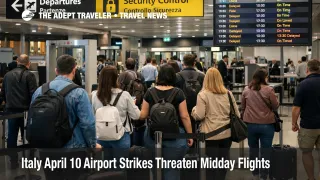
Italy's April 10 aviation disruption risk is now concrete, not theoretical. Italy's official transport strike board shows a cluster of four hour walkouts from 100 p.m. to 500 p.m. local time involving ENAV staff nationally, Techno Sky nationally, ENAV units tied to Rome and Milan, ENAV staff at Naples airport, and ADR Security staff at Rome's two main airports. For travelers, that points to a concentrated midday risk window rather than a full day shutdown, but it lands just as Easter demand starts to thicken across Italy itineraries. The practical move is to treat midday flights, tight connections, and same day cruise or rail handoffs as exposed now, especially in Rome.
Italy April 10 Airport Strikes: What Changed
The April 10 cluster matters because several layers of the flight system are being hit at once. Italy's strike board lists national four hour actions for ENAV personnel and for Techno Sky personnel, plus separate four hour actions affecting ENAV's Rome ACC, ENAV's Milan ACC, ENAV staff at Milan Malpensa Airport, ENAV staff at Naples airport, and ADR Security staff at Rome Fiumicino "Leonardo da Vinci" Airport (FCO) and Rome Ciampino "G.B. Pastine" Airport (CIA). On paper these are separate notices. Operationally they stack into the same 100 p.m. to 500 p.m. local window.
That does not mean every flight in Italy will cancel. ENAC says protected service bands still apply during air transport strikes, with flights required to operate from 700 a.m. to 1000 a.m. and again from 600 p.m. to 900 p.m. local time. That protection makes early morning and early evening departures safer bets than midday services, but it does not fully remove knock on delays once aircraft, crews, gates, and passenger flows fall out of sequence in the afternoon.
In an earlier Adept Traveler article, Italy March 18 Flight Strikes Hit Malpensa, easyJet showed how even a defined four hour Italy aviation stoppage can spill beyond the posted window once airport operations start catching up again.
Which Travelers Face the Most Disruption
Travelers transiting Italy around midday are the clearest exposure group, especially those using Rome, Milan, or Naples on separate tickets or on connections under about three hours. Rome is the sharper pressure point because the April 10 notices do not only touch air navigation functions, they also include ADR Security staff at Fiumicino and Ciampino, which raises the risk that the bottleneck shifts from the runway side to the passenger screening side. ADR says security at Fiumicino is staffed by ADR Security personnel, and that screening times can vary throughout the day.
Cruise passengers are also exposed. A flight that lands late into Rome or Naples can still break the day even if the ship sails hours later, because the lost slack usually shows up in baggage delivery, airport exit time, road transfer timing, and check in cutoff pressure at the port. The same logic applies to travelers connecting onward to high speed rail, regional rail, or fixed private tours. A four hour strike window often becomes a six to 10 hour itinerary problem once missed timings begin to compound. For broader planning logic on Europe's rolling labor calendar, Europe Transport Strike Dates 2026 for Flights and Trains remains useful context.
What Travelers Should Do Now
For departures on Friday, April 10, the safest move is to avoid the 100 p.m. to 500 p.m. local band if a no fee change or schedule adjustment is available. If you are already booked in that window, check whether your carrier retimes you into one of ENAC's protected service bands, and do not assume an "on time" listing the night before will hold through the day. Rome departures deserve extra caution because a security layer is also involved there.
For connections, the decision threshold is simple. Keep the itinerary if your arrival lands in Italy before late morning or your onward departure is after the protected evening band begins. Rework it if the plan depends on a midday connection through Rome, Milan, or Naples, or if a missed onward segment would trigger a cruise miss, a nonrefundable hotel loss, or a same day international misconnect. Waiting may save money, but rebooking early may save the trip.
For airport timing, leave earlier than usual for Fiumicino and Ciampino, travel with cabin baggage if possible, and monitor airline alerts rather than airport rumor. ENAC's protected flights reduce the odds of a total breakdown, but they do not protect every itinerary equally. The travelers most likely to regret waiting are those with checked bags, same day port transfers, wedding or event travel, and multi segment Italy days built with little slack.
Why the Disruption Can Spread Beyond Four Hours
The mechanism is straightforward. ENAV manages air traffic control services across Italian airspace, including tower, approach, and area control phases that govern takeoff, landing, routing, and spacing. Techno Sky, part of the ENAV group, manages and maintains the hardware and software platforms that support those air navigation services, including area control centres, airports, radar, telecommunications, weather systems, and navigational aids. When both operational staff and mission critical technical support are affected in the same time band, the risk is not just fewer takeoffs and landings in that window, but slower recovery afterward.
That is why April 10 is a meaningful watch date even with guaranteed service rules still in place. First order, some midday flights may cancel or depart late. Second order, aircraft rotations can slip, inbound delays can hit later departures that were not supposed to be strike affected, and demand for backup rail, airport hotels, and private transfers can rise quickly in Rome and other major gateways. In an earlier Adept Traveler article, Italy easyJet Strike To Disrupt Flights Jan 31 Afternoon showed how Italy's protected bands can help some travelers, but still leave the midday bank vulnerable when the disruption is concentrated rather than all day.
The next useful signal is whether airlines start publishing waivers, protected flight lists, or schedule trims several days ahead of April 10. If they do, that will tell travelers which carriers see this as a manageable staffing issue and which see it as a real network risk. Until then, the right read is not panic, but respect for a tight four hour strike cluster touching Italy's air navigation chain and Rome airport security at the same time.