

Manila Protest Risk Slows April Airport Transfers
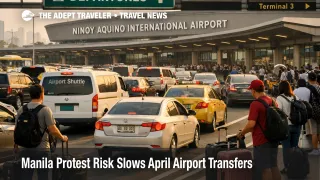
Travelers using Manila, Philippines, as a gateway this April should treat cross city timing as fragile again. The U.K. government now warns that large scale demonstrations are expected over the coming weeks in Metro Manila and elsewhere in the Philippines, and says they may lead to travel disruption, extra journey time, and a need to monitor local media. That shifts the problem away from a one off strike window and back toward a broader city movement risk that can hit airport runs, hotel transfers, and same day onward travel even when flights themselves are still operating. At the same time, the Philippines Bureau of Immigration says Holy Week demand is pushing daily departing international passengers toward 45,000 across the country's major airports, which means a late airport arrival can compound into a much larger miss once curbside traffic, check in, and immigration queues stack together.
Manila Airport Transfer Delays: What Changed
What changed is the wording and the time horizon. The FCDO is no longer just describing a general unrest environment. It now says large scale demonstrations are expected over the coming weeks in Metro Manila and elsewhere in the Philippines, warns that demonstrations may disrupt travel, and tells travelers to allow extra time for journeys. That is a practical planning signal for April itineraries, especially for anyone relying on road transport to or from Ninoy Aquino International Airport (MNL).
The immediate consequence is not that Manila's airport stops functioning. The more likely first order problem is slower and less predictable ground access on protest days or on days when police traffic control expands around rally areas. The second order problem is that a delayed road trip arrives at an airport already under seasonal pressure. The Bureau of Immigration said on April 1 that it had placed personnel on full force for the Holy Week exodus and estimated daily departing international passengers could reach 45,000 across the country's major airports, while separately reminding travelers to arrive at least three hours before scheduled flights.
Which Travelers Face the Most Disruption
The most exposed travelers are the ones with a fixed hour on the far side of Metro Manila. That includes international passengers departing from Ninoy Aquino International Airport (MNL), domestic travelers making same day onward connections after arriving from abroad, cruise or ferry passengers trying to reach a terminal from a Manila hotel, and business travelers crossing the city for a meeting before an evening flight. These trips break more easily because they depend on road timing first, not just airline timing.
Travelers staying in or moving through Manila Bay, Ermita, Malate, Makati, Ortigas, Quezon City, and other districts linked by core Metro Manila arteries should think in terms of corridor risk, not simple distance. Demonstrations do not need to occur at the airport to disrupt an airport run. They only need to trigger rolling congestion, security perimeters, or reroutes along the roads that feed hotels, business districts, and terminal approaches. In an earlier Adept Traveler article, Philippines Protest Warning Hits Manila Trip Timing explained how that shift turns a political alert into a transfer timing problem. In another earlier Adept Traveler article, Philippines Holy Week Immigration Queues Build documented how terminal processing pressure is already narrowing the margin for late arrivals.
What Travelers Should Do Now
For Manila airport runs in April, the safest default is to stop planning around normal city timing. On any day with announced demonstrations, visible police diversions, or heavier security near government or central rally areas, travelers should add at least 60 to 90 minutes beyond their usual Metro Manila airport plan. For international departures, the Bureau of Immigration's three hour recommendation should be treated as a floor, not a target, especially if the trip begins across town, involves checked bags, or includes family members who slow curb to gate movement.
The threshold for changing plans is straightforward. If your itinerary depends on a same day cross city transfer before an international departure, or on arriving from abroad and continuing by bus, ferry, or domestic flight on a thin buffer, rebuild the day before the street situation forces the decision. Travelers with only one night in Manila should lean toward airport area hotels or at least confirm that their driver or hotel can use expressway based approaches rather than relying on a single surface corridor. If your meeting, tour, or transfer can move, move it. Waiting for visible gridlock is too late.
What to monitor is also clear. Check local media, city traffic advisories, airport alerts, and your airline's notifications before committing to a same day cross city move. The watch window is not only the hour before departure. It starts when the first advisories or road control notices appear. Travelers should also verify their terminal before leaving, because Manila airport processing remains busy and mistakes at the curbside stage are costlier when both road time and immigration time are under pressure.
Why The Risk Persists Through April
The mechanism is simple. Metro Manila is road dependent, dense, and low on slack. Even a peaceful demonstration can alter trip times if authorities close turns, meter traffic, or reroute vehicles around a crowd. That does not require a citywide shutdown. It only requires enough friction on key corridors to make timing unreliable. The airport's operator describes NAIA as accessible via major expressways and public roadways, which underlines the core vulnerability, the airport is still only as reliable as the surface network feeding it.
There is some infrastructure relief, but not enough to cancel the risk. NAIA's operator said a new westbound NAIA Expressway off ramp to Terminal 3 opened on March 26 and could cut travel time by about 15 to 25 minutes for some motorists coming from the Skyway. That helps certain trips, but it does not remove the wider problem for travelers starting from hotels, offices, or districts that still need to reach the expressway in the first place, or for passengers using other terminals. In practice, April's Manila risk is not an airport closure story. It is a reliability story. Travelers who build slack, reduce same day dependencies, and watch local movement signals before crossing the city should be able to manage it. Travelers who assume normal traffic and normal processing are more likely to lose the day.