

Delta Bag Fee Hike Extends U.S. Airline Cost Shift
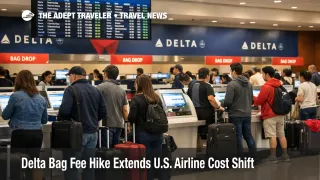
Delta's new checked bag pricing turns a competitor move into a broader U.S. airline cost shift. For tickets purchased on or after April 8, 2026, Delta now charges $45 for a first standard checked bag and $55 for a second on domestic flights and select short haul international routes, while long haul international bag fees stay unchanged. For travelers, that raises the real price of trips that looked manageable on fare alone, especially for family travel, longer stays, and itineraries that do not work with carry on only. The immediate move now is to reprice the whole trip, not just the seat.
Delta Bag Fee Hike: What Changed
Delta's current baggage page now shows the new standard domestic pricing at $45 for the first checked bag and $55 for the second, and its previous fee page confirms that tickets bought before April 8, 2026, were still priced at $35 and $45 on affected U.S. and selected regional routes. Reuters also reported that Delta is lifting the fee for a third checked bag to $200, and that the higher pricing applies on domestic and select short haul international routes only.
That makes Delta the latest major U.S. carrier to move baggage pricing higher after recent changes by JetBlue and United. JetBlue had already raised checked bag charges on U.S. and Caribbean relevant traffic, and United moved its first and second checked bag fees to $45 and $55 on flights within the United States, Mexico, Canada, and Latin America. In an earlier Adept Traveler article, JetBlue Bag Fee Increase Hits U.S. and Caribbean Trips, the warning was that baggage costs were starting to reshape the true trip price, not just the fare comparison. Delta's move confirms that was not a one airline outlier.
Which Travelers Will Feel the Higher Bag Costs First
The most exposed travelers are the ones who cannot realistically dodge a checked bag. That includes families, cruise passengers, business travelers mixing work gear with personal travel, and travelers on longer domestic or Caribbean style trips where carry on only is not practical. The same fare can still look competitive in search results, but the trip total changes fast once one or two checked bags are added each way.
The timing matters too. Delta's previous fee page shows the April 8, 2026 ticket purchase threshold, which means travelers holding older tickets on covered routes may be under earlier baggage terms, while new bookings face the higher rates. That shifts the pressure point from airport day surprise to booking day math. Travelers comparing Delta with United now face very similar standard bag pricing, while JetBlue still uses a more variable peak and off peak structure that can rise further depending on timing and when the bag is prepaid.
What Travelers Should Do Before Booking
Travelers booking now should price the full itinerary with bags included before choosing a carrier. A flight that looks cheaper at first glance may stop being the better deal once one or two checked bags are added, especially on roundtrips. That is now a basic comparison step, not an optional extra, because U.S. carriers are increasingly using ancillary fees to recover cost pressure without relying only on the headline airfare.
The main decision threshold is simple. If you already know you will check a bag, compare the all in cost at booking against airlines, fare bundles, loyalty status benefits, or co branded cards that reduce or remove baggage fees. If you can travel with carry on only, the Delta bag fee hike may not change your airline choice much. If your trip involves family gear, cruise embarkation, conference materials, or a longer stay, assume baggage now plays a bigger role in the real price than many fare searches suggest. Checked bag benefits tied to Delta premium fares, frequent flyer status, and co branded cards remain unchanged.
Travelers should also keep watching the broader price stack, not just baggage. In an earlier Adept Traveler article, U.S. Airfares Rise as Fuel Shock Tightens Summer Trips, the problem was already spreading from seat prices into thinner schedule resilience. Bag fee hikes add another layer. First order, the trip costs more. Second order, travelers may also face fewer cheap backup options if airlines keep responding to fuel stress with both higher fees and tighter capacity.
Why Airlines Are Using Fees, and What Happens Next
The mechanism is straightforward. Reuters reported that airlines are trying to offset sharply higher jet fuel costs linked to disruption around the Strait of Hormuz, and AP reported that average jet fuel prices at major U.S. hubs had climbed to about $4.88 per gallon from about $2.50 before the conflict. Fuel is one of the biggest airline cost items, and ancillary charges are one of the fastest tools carriers have to pass some of that pressure through to travelers without rewriting every fare in the market at once.
What happens next depends on how long fuel pressure lasts. Delta's refinery position gives it some buffer, according to Reuters, but not full insulation from crude price spikes. The more important traveler signal is that multiple U.S. airlines have now shown a willingness to raise bag fees in a short window. That does not prove every carrier will follow immediately, but it does make baggage, seat selection, and other add on charges a more important part of summer booking strategy than they were a few weeks ago. Travelers should expect airlines to keep testing optional fee revenue if fuel stays elevated into late spring.
Sources
- Baggage Policy and Fees, Delta Air Lines
- Previous Checked Baggage Fees, Delta Air Lines
- Delta Air, Southwest Airlines hike checked baggage fees as jet fuel prices soar, Reuters
- JetBlue raises baggage fees as the Iran war drives up fuel prices, AP News
- United Airlines raises bag fees amid rising fuel costs and introduces tiered premium fares, AP News