

Flight Delays and Airport Impacts: April 8
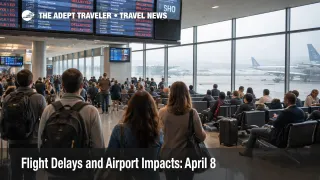
April 8 flight delays are starting as a San Francisco first problem with a wider afternoon risk map building behind it. The Federal Aviation Administration said low ceilings are constraining San Francisco International Airport (SFO), and the agency moved from a possible program to a proposed ground delay program with average arrival delays of 32 minutes and a maximum of 65 minutes for flights arriving between 1100 a.m. and 459 p.m. CDT on Wednesday, April 8, 2026. At the same time, the FAA's operations plan is flagging possible later ground stops for Miami International Airport (MIA), Fort Lauderdale Hollywood International Airport (FLL), and Palm Beach International Airport (PBI), while wind is in play around Boston Logan International Airport (BOS), the New York area, Philadelphia, and Washington. Travelers with short same day connections, fixed arrival commitments, or late day Florida plans should protect margin early.
April 8 Flight Delays: What Changed
What changed on April 8, 2026 is that the FAA's system picture has moved beyond broad forecast language at San Francisco. The command center's operations plan said a San Francisco ground stop or delay program was possible after 1500 Zulu, and the FAA's most recent advisory then proposed a formal ground delay program at SFO with an arrival rate of 36 and delays assigned to flights from all contiguous U.S. departure points, plus selected Canadian departures. The live SFO status page now shows a traffic management program in effect and destination specific delays averaging 29 minutes.
The rest of the national picture still looks more conditional than collapsed. Boston Logan, Newark Liberty International Airport (EWR), John F. Kennedy International Airport (JFK), Chicago O'Hare International Airport (ORD), and Miami were all still showing only gate hold, taxi, or airborne delays of 15 minutes or less when checked. That matters because today's problem is less about every major hub running late at once, and more about whether one or two constrained airports begin to eat into the network's recovery room before the afternoon bank.
Which Travelers Face the Most Disruption
The most exposed travelers are passengers connecting through San Francisco, people departing on aircraft that first need to arrive from San Francisco, and travelers heading to or from South Florida later today. SFO is already operating under a longer running runway and taxiway construction program through November 15, 2026, so weather or ceiling related restrictions stack on top of a system that already has less arrival flexibility than normal. In an earlier Adept Traveler article, SFO Landing Restrictions Cut Arrivals Through October 2, the deeper issue was the airport's narrower operating margin. April 8 adds live flow control on top of that.
Florida is the other major watchpoint, even though the live airport pages are not showing headline delays yet. The FAA plan says thunderstorms are affecting central and south Florida, route structure is being evaluated because convective activity off the coast is moving west into East Coast flows, and ground stops are possible after 1800 Zulu at MIA, FLL, and PBI. The same plan also shows route controls and escape route planning possible for Orlando International Airport (MCO) and Tampa International Airport (TPA), plus Atlantic route closures that can slow flows before a local airport board looks especially bad. For travelers, that means a normal looking departure board at noon can still turn into a weaker evening operation if Florida arrivals begin to compress.
The Northeast is a secondary risk zone rather than the lead story. Wind is listed as a terminal constraint for Boston, the New York approach system, Philadelphia, and Potomac area traffic, while a runway closure remains in effect at JFK until April 9, 2026 at 8:00 a.m. EDT. That does not mean widespread severe delay is already underway. It does mean the system has less room to absorb a second problem if San Francisco and Florida both tighten later in the day.
What Travelers Should Do Now
If you are flying through San Francisco today, treat the trip as delay prone even if your airline app still looks clean. Check the inbound aircraft, not only your own departure time, because that is often the earliest sign that the schedule is slipping. If your day depends on a short layover, an airport transfer, cruise embarkation, or a timed meeting, extra buffer is worth more than schedule convenience once a formal or proposed ground delay program appears.
For South Florida trips, the better decision threshold is time of day. Earlier arrivals are safer than late afternoon or evening arrivals if you have a choice, because the FAA's current plan places the potential Florida ground stop window after 1800 Zulu, which is 1:00 p.m. CDT. Travelers connecting into Miami, Fort Lauderdale, Palm Beach, Orlando, or Tampa should avoid assuming a tight same day handoff will hold if convective routing and traffic management measures start to stack.
For travelers outside the main hotspots, the move is not panic rebooking. It is protecting brittle itineraries first. Waiting usually makes sense for nonstops with flexible arrival times and multiple later backup options. Rebooking earlier or adding layover time makes more sense when one delay would break the rest of the day. Travelers who want broader system context can read U.S. Air Traffic Control Privatization: Reality Check.
Why Today's Risk Can Spread Fast
The FAA's April 8 plan shows the classic structure of a U.S. delay day that can widen without looking dramatic everywhere at once. San Francisco has low ceilings and a live flow control problem. Boston, New York, Philadelphia, and Washington are carrying wind constraints. Florida is sitting under thunderstorm risk with route controls under evaluation. En route constraints are also active across several air route traffic control centers, including closures on New York area routes and thunderstorm impacts affecting ZNY, ZMA, ZLC, ZDV, and ZAB.
That mechanism matters because the first order effect is not always a cancellation. It is often a departure held at origin, a slower arrival stream, or a reroute that burns schedule slack. The second order effect is later aircraft turns, weaker connection reliability, tighter crew timing, and thinner same day recovery across airports that still look mostly normal on their public status pages. April 8 is not yet reading as a full national breakdown. It is reading as a day where San Francisco is already under pressure, Florida could join later, and the Northeast has enough background friction to make the system less forgiving if those first two stress points deepen.
The next decision point is the afternoon update cycle. If the FAA confirms or expands the San Francisco program, or if Florida ground stops activate, the practical risk rises from manageable friction to wider connection trouble, especially for West Coast to East Coast and East Coast to Florida itineraries. Travelers should watch airline alerts, the FAA airport status pages for destination specific delays, and whether ground stop language replaces today's still conditional wording in Florida.
Sources
- FAA Current Operations Plan Advisory, April 8, 2026
- FAA Most Recent Advisory, SFO Proposed Ground Delay Program, April 8, 2026
- San Francisco International Airport (SFO) Real-time Status, FAA
- Miami International Airport (MIA) Real-time Status, FAA
- General Edward Lawrence Logan International Airport (BOS) Real-time Status, FAA
- Newark International Airport (EWR) Real-time Status, FAA
- John F Kennedy International Airport (JFK) Real-time Status, FAA
- Chicago OHare International Airport (ORD) Real-time Status, FAA
- SFO Landing Restrictions Cut Arrivals Through October 2
- U.S. Air Traffic Control Privatization: Reality Check