

Kuwait Exit Routes Tighten as Border Rules Shift
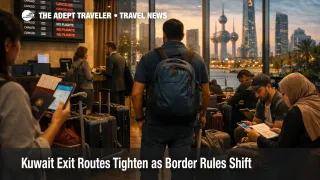
Kuwait exit routes became a harder traveler decision on April 8, 2026, because the problem is no longer just canceled flights. Australia's Smartraveller now says Kuwait's airspace is closed, commercial flights are not operating, and Kuwait International Airport plus all land borders are closed, while entry is limited to foreign nationals holding valid Kuwaiti residency permits unless special approval is granted. At the same time, Canada's current advisory still says two land crossings to Saudi Arabia, Al Khafji and Ar Ruqi, are open if travelers judge the trip safe and meet Saudi entry rules. That mismatch means travelers should not assume any border plan is usable until it is confirmed the same day.
In an earlier Adept Traveler article, Kuwait Airport Fuel Fire Puts Gulf Connections at Risk, the pressure point was damaged air travel and same day onward risk. Now the decision has shifted further toward route triage, document readiness, and whether a viable exit corridor still exists at all. In an earlier Adept Traveler article, Kuwait Embassy Shutdown Raises Trip Exit Risk, the operational question was already exit planning. April 8 narrows that further.
Kuwait Exit Routes: What Changed
The clearest confirmed change is that normal commercial air departure is still unavailable. Smartraveller says Kuwait's airspace is closed and commercial flights are not operating, and Reuters reported on March 25 that Jazeera Airways had already shifted operations into Saudi Arabia because Kuwait's airspace remained shut with no reopening timeline announced.
What changed on April 8 is the framing around borders and entry. Smartraveller now says Kuwait International Airport and all land borders are closed, and that only foreign nationals with a valid Kuwaiti residency permit may enter, with non residents needing both a visa and prior embassy coordination before travel proceeds. Canada's advisory, however, still says overland departure to Saudi Arabia may be possible through Al Khafji and Ar Ruqi if the traveler can move safely and satisfies Saudi entry requirements. For travelers, that means the official picture is fluid enough that yesterday's workaround may fail at the checkpoint.
Which Travelers Face the Hardest Kuwait Decision
The highest exposure sits with short stay visitors, business travelers without Kuwaiti residency, and anyone whose hotel, employer, or airline has not already arranged a controlled exit path. They face a simple problem, they cannot rely on outbound commercial flights, and they may not be able to pivot cleanly into Kuwait again later if they leave without the right status.
Travelers trying to enter Kuwait face an even narrower gate. Smartraveller says foreign nationals holding valid Kuwaiti residency permits may still be permitted entry, but non residents need a visa, advance embassy contact, and confirmation from the Ministry of Foreign Affairs before travel should proceed. That is not a normal visitor flow. It is a controlled permission process.
Travelers who may still have a route out by land are dealing with a document problem as much as a transport problem. Canada says anyone attempting the Saudi crossings needs valid travel documents and must already meet Saudi entry requirements before heading to the border. Smartraveller adds that Kuwaiti authorities may block departure for unpaid debts or fines, and that children traveling without a male guardian may need a signed approval letter from their father before leaving Kuwait.
What Travelers Should Do Now
Do not head for Kuwait International Airport (KWI) expecting a normal departure. The cleaner move is to confirm, in this order, whether your nationality, residency status, visa position, and intended receiving country make an overland exit legally possible before you commit to ground transport. If any one of those pieces is unclear, the border run can turn into a wasted trip or a stranded stop in a high risk corridor.
If you are already in Kuwait and want to leave, the strongest same day preparation step is document consolidation. Keep passports, visas, residency cards, hotel records, proof of onward eligibility, and emergency contact numbers physically accessible, not packed away. U.S. and Australian advisories both stress keeping travel documents current and having an emergency departure plan that does not depend on government rescue.
Treat land exit as conditional, not guaranteed. A traveler with confirmed Saudi eligibility and live border verification has a different risk profile from a traveler who is only assuming the crossing is open because it worked last week. There is no equally clear civilian sea exit path in the official advisories reviewed here, so sea should not be treated as a practical fallback unless a carrier, embassy, or local authority gives a direct, current instruction for your case.
Why the Exit Picture Is Getting Harder
The mechanism is straightforward. Air closure removes the normal mass departure channel, then every remaining option becomes constrained by border policy, visa rules, and road movement risk. Reuters reported that Jazeera had been using Saudi hubs such as Al Qaisumah and Dammam to keep some passenger movement alive after Kuwait closed its airspace, but any strategy built on Saudi transfer points becomes weaker if border access tightens or guidance diverges across governments.
The second order effects are now bigger than the first order flight cancellation. Once exits narrow, hotel nights extend, ground transfer timing matters more, queues can build at any functioning checkpoint, and travelers without the right paperwork can lose time they cannot easily buy back. Smartraveller also says the regional conflict is likely to escalate further, while Canada warns the security situation could deteriorate without notice. That means the next decision point is not when flights resume, it is whether the currently rumored or partially open land path is still usable when you reach it.
Sources
- Kuwait Travel Advice & Safety, Smartraveller
- Travel Advice and Advisories for Kuwait, Government of Canada
- Kuwait International Travel Information, U.S. Department of State
- Jazeera Airways taps Saudi hubs as Kuwait airspace remains shut, Reuters, March 25, 2026
- Kuwait Airport Fuel Fire Puts Gulf Connections at Risk, Adept Traveler
- Kuwait Embassy Shutdown Raises Trip Exit Risk, Adept Traveler