

Kuwait Airport Fuel Fire Puts Gulf Connections at Risk
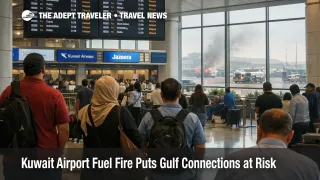
Kuwait airport fuel fire risk became more immediate on April 1, 2026, after an Iranian drone strike hit fuel tanks at Kuwait International Airport (KWI) and caused a large fire with no reported casualties. Kuwait has not, so far, been reported as a full airport shutdown on the scale of some earlier Gulf disruptions, but the strike moves the problem from broad regional threat into named airport infrastructure. For travelers, that changes the decision from general caution to active operational monitoring, especially for same day connections, short layovers, and trips that still depend on Kuwait as a functioning hub.
Kuwait Airport Fuel Fire: What Changed
The immediate change is that Kuwait International Airport was directly hit at its fueling layer, not just pressured by nearby conflict or wider airspace instability. Reuters, citing Kuwait state media, said the strike hit fuel tanks and sparked a major fire. Separate coverage tied to Kuwaiti official statements says flights were briefly affected, but airport operations continued. That does not make the situation normal. It means travelers are dealing with an airport that may still be moving aircraft while carrying fresh fuel infrastructure damage and a live security risk.
This comes only days after Reuters reported significant radar system damage at Kuwait International Airport from earlier drone attacks on March 28. The pattern matters. A one off fire can sometimes be absorbed. Repeated hits against different operational systems narrow recovery slack, raise the chance of rolling delays, and make each new incident harder to isolate from the wider disruption picture.
Which Kuwait Itineraries Are Most at Risk
The most exposed travelers are those connecting through Kuwait on tight schedules, especially passengers continuing onward to South Asia, the Gulf, Türkiye, or Europe on carriers with established Kuwait presence. Kuwait International Airport's airline listings and check in zone assignments show the airport normally handles a broad mix that includes Kuwait Airways, Jazeera Airways, Qatar Airways, Turkish Airlines, British Airways, KLM, Emirates, flydubai, Saudia, and others. When fuel handling is disrupted even briefly, the first order effect is often departure delay or aircraft rotation disorder. The second order effect is missed onward segments, forced overnights, and hotel night leakage across the rest of the itinerary.
The bigger issue is that Kuwait is not operating inside a stable regional backup system. Oman Air still lists Kuwait among destinations with cancellations through April 15 under its booking flexibility notice, and Akasa Air has separately said its Kuwait flights are suspended until April 5. That means some of the fallback options travelers might normally use in the Gulf are already thinner than usual. Even if Kuwait itself keeps operating, the margin for recovery is smaller because nearby substitute capacity is already constrained.
What Travelers Should Do Now
Travelers booked to depart from, arrive into, or connect through Kuwait on April 1 or April 2 should treat this as a live day of operation check, not a routine airport run. Kuwait Airways' flight status page tells passengers to contact the airline or airport for the latest updates, and Kuwait airport's own flight status tools remain active. That is the right first move before leaving for the airport, especially if the itinerary depends on checked baggage, a short connection, or one remaining daily frequency.
The practical threshold is simple. Wait and monitor if your Kuwait segment is nonstop, your onward plans are flexible, and the airline still shows your flight operating. Start rerouting the same day if the trip depends on a short Kuwait connection, the fare is on separate tickets, the itinerary ends with a cruise embarkation, event, or fixed hotel arrival, or your carrier has not published clear reaccommodation guidance. In that setup, one fuel related hold can break the whole day. Travelers already in Kuwait should also avoid assuming that "airport open" means "schedule reliable."
How the Disruption Could Spread Next
What happens next depends on whether the damage stays confined to one fueling area or forces a wider operational reset. Airports can sometimes keep flying with partial fueling workarounds, but doing so under repeated attack risk is a very different problem from ordinary irregular operations. The key signals to watch over the next 24 to 72 hours are extended departure delays, airline waivers, diversions, and any sign that carriers begin steering passengers through Saudi Arabian alternatives instead of normal Kuwait service.
In an earlier Adept Traveler article, U.S. Gulf Travel Advisories Tighten as Risks Spread, the broader warning was that Kuwait had already moved into a higher risk planning category. In an earlier Adept Traveler article, Kuwait Embassy Shutdown Raises Trip Exit Risk, the pressure point was exit planning. The April 1 strike sharpens both. It also fits the wider fuel exposure described in Travel Fuel Risk Is Becoming a Refinery Fit Problem, where airport and airline disruption can spread beyond the first visible incident. For travelers, Kuwait is now less a normal Gulf transfer point and more a hub that needs positive confirmation before every leg.
Sources
- Kuwait says Iran drone attack sets airport fuel tanks ablaze, no casualties
- Drone Strikes Hit Kuwait Airport Fuel Tanks, Bahrain Facility
- Iran hits Kuwait airport and a tanker off Qatar while strikes batter Tehran
- Kuwait international airport suffers significant radar system damage after drone attacks
- Kuwait International Airport, Airline Directory
- Kuwait International Airport, Check-in Zones
- Kuwait International Airport, Flight Status
- Kuwait Airways Flight Status
- Oman Air Booking Flexibility Notice
- Akasa Air issues travel advisory, suspends flights to Doha, Riyadh and Kuwait till April 5
- Middle East flight updates: International airlines extend cancellations and delays