

U.S. Airport Customs Threat Makes Gateway Choice Risk
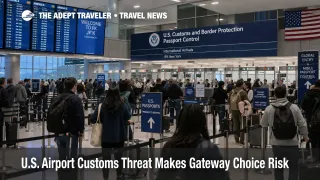
The U.S. airport customs threat moved from abstract politics into travel planning on April 7, 2026, when Reuters reported that Homeland Security Secretary Markwayne Mullin said customs processing could be halted at major airports in sanctuary cities. No order has been issued, and Mullin said no final decision had been made, but the operational consequence would be severe if the administration ever followed through. Travelers booking inbound U.S. trips for summer 2026 should stop treating gateway choice as neutral and avoid nonrefundable plans that only work through a single exposed airport.
U.S. Airport Customs Threat: What Changed
What changed is not airport operations on the ground today, it is the level of policy risk attached to specific U.S. arrival points. Reuters reported that Mullin raised the possibility of pulling Customs and Border Protection staff from airports in sanctuary jurisdictions, naming a pressure tactic that could effectively shut international arrivals processing at affected hubs. He also said no final decision had been made, which leaves travelers in an awkward planning zone, a live threat without an implementation order, timeline, or airport list.
That distinction matters. This is not yet a closure story. There is no published DHS or CBP order saying that international processing has been suspended at any airport, and CBP is simultaneously publishing World Cup 2026 travel guidance for inbound visitors. The rational read for travelers is that the immediate risk is uncertainty, not a current halt, but uncertainty is enough to break tight gateway dependent itineraries when flights, hotels, tours, and domestic connections are booked around one arrival point.
Which Gateways and Travelers Are Most Exposed
The airports most clearly in the frame are the large international hubs in cities Reuters identified as sanctuary jurisdictions, including John F. Kennedy International Airport (JFK), Los Angeles International Airport (LAX), Chicago O'Hare International Airport (ORD), and San Francisco International Airport (SFO). New York, Los Angeles, and the San Francisco Bay Area also matter for the 2026 FIFA World Cup, because FIFA lists those markets among the U.S. host cities, which raises the stakes for inbound fans, sponsors, media teams, and multi city tournament itineraries.
The most exposed travelers are international visitors whose trip only works through one gateway, especially anyone planning a same day domestic connection, a cruise embarkation, a conference, or a fixed event start. Group travel is especially brittle here. Airlines can rebook one passenger more easily than a family, tour group, or corporate delegation moving together. In an earlier Adept Traveler article, U.S. World Cup Travel Costs Rise as Fan Anxiety Grows, the planning problem was already shifting toward higher friction and weaker traveler confidence. This new customs threat adds another reason not to lock a complex U.S. itinerary around a single politically exposed arrival airport.
There is also a second order exposure for travelers who are not flying into the named cities themselves. If even the threat of a policy change pushes travelers, airlines, or planners toward alternate gateways, pressure can spill into other hubs through higher fares, weaker seat availability, and more fragile domestic connection banks. That is how a policy threat in one set of cities becomes a broader U.S. itinerary risk even before any order takes effect.
What Travelers Should Do Before Booking
For now, travelers should design U.S. arrivals with flexibility instead of assuming the cheapest or most obvious gateway will remain the safest choice. The cleanest move is to avoid nonrefundable hotels, tours, or onward domestic flights that depend on one exposed airport until there is either a formal policy order or a clear retreat from the threat. If you must book now, favor tickets with change flexibility and avoid the last domestic connection of the day after landing in the United States.
Where practical, inbound travelers should also look at airports outside the most clearly exposed city set, or at foreign airports with U.S. preclearance. CBP says it has preclearance operations at 16 locations in six countries, which lets eligible U.S. bound passengers complete inspection before departure rather than after landing in the United States. That will not solve every itinerary, but it can reduce dependence on a specific U.S. arrivals hall if gateway politics worsen.
Travelers arriving at standard U.S. gateways should keep Mobile Passport Control in play where eligible. CBP says MPC is available at 53 ports of entry, including preclearance locations, and it remains one of the few practical tools travelers can use to reduce arrival friction. In an earlier Adept Traveler article, Global Entry Paused, Plan Longer U.S. Passport Lines, the main warning was that border processing assumptions can fail faster than travelers can rework the rest of the trip. The same logic applies here, even though this story is still at the threat stage rather than the implementation stage.
Why This Matters Before Any Order Exists
The mechanism is straightforward. International arrivals at major U.S. airports depend on CBP officers to inspect and admit travelers. If that staffing is withdrawn from a gateway, international flights cannot simply operate as normal and let passengers sort it out later. The airport loses its basic ability to function as a normal international entry point, which is why even an unexecuted threat can change booking behavior months in advance.
What happens next is likely to fall into one of three paths. The administration could drop the idea, it could keep using the threat as leverage without issuing an order, or it could try to act and trigger immediate legal and commercial pushback. Reuters has already reported that federal courts blocked earlier Trump administration efforts to punish sanctuary jurisdictions through funding cuts, which suggests any airport customs move would likely face rapid litigation too. For travelers, though, the legal uncertainty does not remove the planning risk. It extends it.
That is why the right posture now is conservative, not panicked. No airport has lost customs processing as of April 12, 2026. But the U.S. airport customs threat is now a real booking variable for international arrivals, especially on summer trips and World Cup linked itineraries. Until the threat is clearly withdrawn or formally resolved, travelers should book flexible gateways, keep border buffers large, and avoid plans that fail if one politically exposed arrival airport stops being usable.
Sources
- DHS says US could stop processing international travelers at some airports in 'sanctuary cities'
- Host Countries and Cities
- CBP Welcomes You to FIFA World Cup 2026TM
- Prepare For Travel, FIFATM World Cup 2026
- Preclearance | U.S. Customs and Border Protection
- CBP and PHL Airport launch Enhanced Passenger Processing for U.S. travelers
- US judge blocks Trump from withholding funds from 16 'sanctuary' cities, counties
- Trump cannot use new executive order to skirt 'sanctuary' cities ruling, judge says