

Alaska Bag Fee Hike Widens U.S. Airline Cost Shift
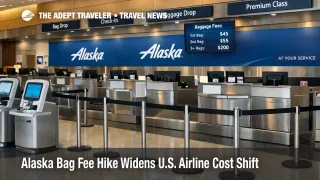
Alaska bag fee hike is no longer a small outlier in airline pricing. For tickets booked on or after April 10, 2026, Alaska Airlines raised first and second checked bag fees on North American Alaska and Hawaiian flights to $45 and $55, lifted the third bag fee to $200, and removed its former $5 online or mobile prepay discount. That puts Alaska Air Group in line with the broader U.S. carrier move to recover higher costs through baggage charges rather than relying only on higher base fares. Travelers who compare tickets by headline fare first should now treat checked bags as part of the booking decision from the start.
Alaska Bag Fee Hike: What Changed
Alaska said on April 9, 2026 that the new pricing applies to travel on North American Alaska Airlines and Hawaiian Airlines flights ticketed on or after April 10, 2026. The first checked bag rose from $40 to $45, the second from $45 to $55, and the third and higher bags from $150 to $200. The carrier also ended the $5 advance prepay discount that had applied on online and mobile bookings made at least four hours before departure. Alaska attributed the change to ongoing fuel price volatility and an uncertain global environment.
This matters beyond one airline group because the fee structure now looks much closer to what other major U.S. carriers have already rolled out in recent days. Reuters reported that JetBlue started the latest round of bag fee increases, followed by United, Delta, Southwest, American, and now Alaska. In practical terms, the U.S. market has moved from scattered baggage changes to a broader repricing pattern, with airlines pushing more of the real trip cost into ancillary charges. In an earlier Adept Traveler article, U.S. Bag Fees Rise Again as Basic Economy Splits, Adept mapped how quickly that shift was widening.
Which Travelers Will Feel the Increase First
The travelers most exposed are the ones who cannot realistically avoid checking luggage. That includes business travelers on multi day trips, travelers carrying presentation materials or work gear, cruise passengers, families, mixed work and leisure travelers, destination event travelers, and anyone combining multiple climates in one trip. A roundtrip traveler who checks one bag each way on Alaska or Hawaiian North America flying now pays $90 instead of $80, while two checked bags now cost $110 instead of $90. That is not catastrophic on its own, but it is enough to erase part of a fare advantage when several airlines look close on the booking screen.
The pain does not land evenly. Alaska said Atmos Rewards status members, eligible Atmos Rewards Visa cardholders, Hawaiian Airlines Mastercard holders, Huaka'i members on intra Hawaii trips, and Club 49 members keep their existing baggage benefits. That means occasional travelers and unmanaged business travelers are more likely to absorb the higher charge in cash, while status holders and co branded card users remain partly shielded. The tradeoff is now sharper for travelers who do not have those benefits but still assume Alaska or Hawaiian will price out like they did a week ago.
What Travelers Should Do Before Booking
Travelers who know they will check a bag should stop treating baggage as a late stage add on. Price the full trip with at least one checked bag included before choosing between Alaska, Hawaiian, and competitors. Once bag fees across multiple carriers cluster around the same range, the better decision may come down to schedule quality, connection risk, airport choice, and what benefits come from a status tier or card you already hold. In an earlier Adept Traveler article, U.S. Airfares Rise as Summer Booking Risk Builds, Adept showed how higher fares and higher bag fees are now moving together.
The next decision threshold is simple. Rebook or switch carriers early if a checked bag is unavoidable and another airline offers a better total price with fewer connection risks. Wait only if you can travel with a carry on, have a strong baggage benefit, or your dates and airports are flexible enough that a small fare gap still beats the extra fee. This is especially relevant for North America trips where travelers often compare airlines on base fare first and discover the real total too late.
Why Airlines Are Raising Bag Fees, and What Happens Next
The mechanism is straightforward. Airlines are facing a fuel shock, and baggage is one of the fastest ways to recover part of that pressure without fully rebuilding every published base fare at once. Reuters reported that jet fuel prices more than doubled from roughly $85 to $90 per barrel in February to about $209 globally during the recent Middle East disruption. Alaska used that same fuel volatility as its public explanation for the change. In an earlier Adept Traveler signal, Travel Fuel Risk Is Becoming a Refinery Fit Problem, Adept traced why fuel pressure is not only an oil headline, but a travel pricing and resilience problem.
What happens next depends on whether fuel pressure eases or stays elevated. If costs remain high, travelers should expect airlines to keep defending margins through a mix of baggage charges, tighter fare rules, seat fee pressure, and selective schedule restraint, not just obvious across the board fare hikes. That would make trip comparison harder, especially for business travelers and summer flyers trying to preserve convenience while controlling total trip cost. The important shift is that Alaska and Hawaiian no longer sit outside that pattern. They are now firmly inside it.