

U.S. Bag Fees Rise Again as Basic Economy Splits
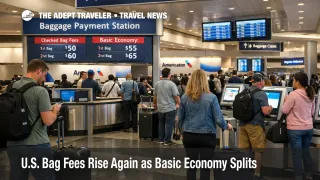
U.S. bag fee hikes widened again on April 9, 2026, and the more important shift is not only that American Airlines and Southwest Airlines now charge more. American also turned checked bags into a sharper fare class penalty by setting higher Basic Economy bag fees for tickets bought from May 18, 2026. That changes the booking math for travelers who still sort airlines by base fare first, especially on domestic, Caribbean, Mexico, Central America, and short haul international trips where a checked bag is often not optional.
U.S. Bag Fee Hikes: What Changed
American said that for tickets booked on or after April 9, 2026, standard checked bag fees on domestic and short haul international flying rose to $50 for a first bag and $60 for a second bag at the airport, with a $5 online or app prepay discount that brings those to $45 and $55. For domestic Basic Economy tickets purchased on or after May 18, 2026, those fees rise another $5, to $55 and $65 at the airport, or $50 and $60 when prepaid. American also said that from May 18, 2026, all Basic Economy customers, including elites, will have to pay to select seats and will lose eligibility for complimentary and systemwide upgrades on those fares.
Southwest's new fee table shows that for mainland U.S. travel booked, ticketed, or changed on or after April 9, 2026, Basic, Choice, and Choice Preferred fares now pay $45 for a first checked bag and $55 for a second, while Choice Extra still includes two free checked bags. A List Preferred members continue to get two free checked bags, and A List members or Rapid Rewards credit cardholders still receive a first bag benefit.
This is no longer a one carrier or two carrier story. Reuters reported this week that Delta and Southwest raised checked bag fees, and that the moves followed similar increases by United and JetBlue. American and Alaska then joined that push on April 9. The result for travelers is a broader U.S. airline pricing shift in which carriers are trying to protect headline fare competitiveness while recovering higher operating costs through baggage and other optional products.
Which Travelers Will Pay More First
The travelers most exposed are the ones whose trip type makes a checked bag hard to avoid. Families, cruise passengers, longer stay leisure travelers, snowbird style travelers, destination wedding guests, and people mixing business and leisure are more likely to feel the increase as a real fare change rather than a minor add on. A roundtrip traveler who checks one bag each way on Southwest now pays $90. On American, that same traveler pays $90 if the bag is prepaid, or $100 if it is added at the airport, and a Basic Economy traveler buying after May 18 would pay $100 prepaid or $110 at the airport.
American's extra Basic Economy layer matters more than the raw $5 difference suggests. It widens the gap between the ticket travelers see first and the trip they actually pay for once bags and seat choice are added back in. That makes Basic Economy less of a stripped down fare and more of a penalty fare for anyone who needs normal trip features. It also makes comparison shopping messier, because two airlines can look close on the fare screen while the real trip cost diverges once baggage, seat assignment, and upgrade access are considered.
In an earlier Adept Traveler article, JetBlue Bag Fee Increase Hits U.S. and Caribbean Trips showed the same pressure moving into leisure heavy markets. In another earlier Adept Traveler article, United Bag Fee Hike Raises Trip Costs Across the Americas mapped how bag pricing was already becoming a cleaner airline lever than openly rebuilding every base fare at once.
What Travelers Should Do Before Booking
Travelers who know they will check a bag should stop treating baggage as a late stage purchase. Price the full trip at booking with one or two checked bags, seat selection, and any fare bundle differences already included. On some routes, a slightly higher Main Cabin or Choice Extra ticket can now beat a cheaper base fare once bag fees are added back in. That is especially true on American after May 18, 2026, when Basic Economy loses more of the flexibility and comfort travelers often assume still comes with elite status.
The next decision threshold is whether you can avoid airport day pricing. American's $5 prepay discount now matters more because the underlying fees are higher, while Southwest's structure makes fare choice matter more than it did when the carrier included bags across most of its product line. Travelers with a co branded card, status, or a premium fare should verify those baggage benefits before checking out, because the benefits remain one of the few clean ways to escape the new fee wave.
For the next 24 to 72 hours, monitor whether airlines keep the pressure in baggage alone or start widening it into seat fees, fare fences, schedule trims, or fewer low fare seats. U.S. Airfare Hikes Spread as Fuel Costs Double and Travel Bankruptcy Risk Rises if Fuel Stress Lasts Into Summer are useful internal context because the same fuel shock is already hitting fares, schedules, and carrier margins at the same time.
Why Airlines Are Using Bag Fees, And What Happens Next
The mechanism is straightforward. Reuters reported that carriers are passing through higher jet fuel costs tied to Middle East tensions and disruption in the Strait of Hormuz, with global jet fuel rising from about $85 to $90 per barrel in February to roughly $209 per barrel. In that environment, baggage is an easier lever than reworking every base fare in every market at once. It preserves the appearance of fare competitiveness while still lifting the total spend from travelers who use optional services.
What happens next depends less on one more bag fee announcement and more on duration. If fuel pressure eases quickly, travelers may mostly see higher ancillary costs and a few fare increases. If it lasts, the second order effects are larger, fewer schedule backups, weaker rebooking options, more pressure on budget fares, and a wider split between travelers with loyalty or premium access and everyone else. American's Basic Economy move points to that broader direction already. The industry is no longer only charging more for bags. It is refining who pays, when they pay, and how much of the trip experience remains outside the cheapest fare.
Sources
- American Airlines Updates Bag Fees and Basic Economy Fares
- Optional Travel Charges, Southwest Airlines
- American Airlines, Alaska Air hike checked baggage fees amid soaring fuel prices
- Delta Air, Southwest Airlines hike checked baggage fees as jet fuel prices soar
- JetBlue Bag Fee Increase Hits U.S. and Caribbean Trips
- United Bag Fee Hike Raises Trip Costs Across the Americas
- U.S. Airfare Hikes Spread as Fuel Costs Double
- Travel Bankruptcy Risk Rises if Fuel Stress Lasts Into Summer