

Bahrain Exit Planning Shifts to Flights vs Causeway
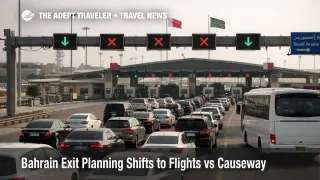
Bahrain exit planning is now a live departure problem, not just a shelter in place story. On April 10, the U.K. Foreign, Commonwealth & Development Office said Bahrain's airspace had reopened on April 8, but only limited commercial flights were available from Bahrain International Airport, disruptions could return at short notice, and the King Fahd Causeway to Saudi Arabia could also close without much warning. For travelers already in Bahrain, that shifts the decision from waiting for headlines to choosing which exit path can actually hold long enough to use.
Bahrain Exit Planning: What Changed
The advisory changed the math by pairing two messages that do not sit comfortably together. The first is that commercial departures have resumed. The second is that neither the airport route nor the land route should be treated as stable. The FCDO now says travelers whose presence in Bahrain is not essential may wish to consider departing if they judge they can do so safely, while also warning that further air restrictions and causeway closures remain possible at short notice.
That makes this a meaningful itinerary risk, not minor friction. A confirmed Bahrain International Airport (BAH) flight is still the cleaner exit because it avoids a second border crossing and avoids Saudi entry screening altogether. But the airport option depends on limited seat supply and a flight actually operating when you reach check in. The causeway option gives some travelers more control over timing, but it adds border processing, vehicle rules, Saudi entry requirements, and the possibility that the crossing itself becomes unavailable after you have already committed to the move.
Which Bahrain Departures Are Most Exposed
The travelers most exposed are people trying to improvise a road escape without clean Saudi paperwork. The Bahrain advisory says road travelers should read Saudi Arabia entry requirements, warns they may be denied entry without the correct paperwork, and adds a hard operational filter for drivers: if traveling by car, the vehicle must be wholly owned and registered in the traveler's name. That sharply weakens causeway plans built around rental cars, company cars, borrowed vehicles, or family vehicles registered to someone else.
Passport validity is another obvious trap. Saudi Arabia's entry requirements say that for normal entry, passports generally need at least six months of validity remaining on arrival, and the Bahrain advisory separately says British nationals trying to leave via Saudi Arabia on emergency travel documents, emergency passports, or passports with less than six months remaining should contact British officials for advice. In practice, that means a traveler who can still board a direct flight out of Bahrain may be in a much stronger position than one trying to solve a land exit through Saudi Arabia with weak document validity.
Visa mechanics are the other failure point. Saudi guidance says travelers need an eVisa or electronic visa waiver either before travel or on arrival at Saudi international airports. Because that on arrival pathway is tied to airports, travelers should not assume it solves a King Fahd Causeway crossing. For road departures, the safer assumption is that Saudi permission needs to be sorted before you start driving. That is an inference from the official visa language, but it is the prudent one.
What Travelers Should Do Now
Travelers with a realistic ticket out of Bahrain should usually preserve that air option first. Check the operating status directly with the carrier, confirm that the reservation is still active, and move only when you can absorb a same day delay or cancellation. The main buffer is time, not miles. For an airport attempt, a flexible same day schedule and at least one extra hotel night in Bahrain is the safer baseline while flights remain limited and subject to renewed restrictions.
A road move makes more sense only when the Bahrain flight path has already degraded, your Saudi documents are already in order, and your onward travel from Saudi Arabia is real rather than theoretical. That means checking passport validity, visa status, vehicle ownership documents, medication supply, and the status of the causeway before departure. Bahrain's national portal says the King Fahd Causeway offers live services including broadcasts, road services, and guidance on best travel times, which makes it useful as a final pre departure check, not a guarantee.
The practical buffer for a causeway exit should be larger than most travelers want to hear. Anyone attempting it should plan for border delay, a rejected entry attempt, or an overnight in Saudi Arabia before onward departure. Tight same day chains, for example drive to Saudi Arabia, catch a flight, and connect onward the same day, are the kind of plan most likely to break first if closures, queues, or document questions flare up again.
Why the Math Changed, and What Happens Next
The mechanism is straightforward. Bahrain is no longer dealing with a single binary closure. It now has a partially reopened air route, a road route that still exists but can close quickly, and a regional security backdrop that keeps both under pressure. That creates a two leg decision where each leg has a different failure mode. Flights fail on capacity and operating restrictions. The causeway fails on access, border control, and document compliance. When one path weakens, pressure does not disappear, it spills into the other path and raises the cost of waiting too long.
What happens next depends less on broad Gulf headlines than on specific operating signals. Watch for any new FCDO wording on departures, any change in Bahrain airport flight availability, and any renewed disruption affecting the causeway. In an earlier Adept Traveler article, Bahrain Road Exit Planning Gets Real for Travelers captured the earlier road exit phase. More recently, Saudi Arabia Airports Open, but Flights Stay Fragile showed why Saudi onward assumptions are still brittle. For now, Bahrain exit planning is best treated as a buffer problem: whichever route you choose, leave enough margin that one broken leg does not strand you in the middle of the move.