

Bahrain Road Exit Planning Gets Real for Travelers
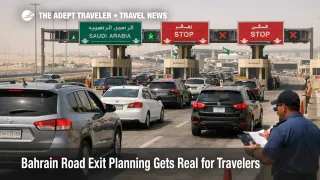
Bahrain is no longer just a Gulf watch item for travelers. The U.K. Foreign, Commonwealth & Development Office, or FCDO, now advises against all but essential travel to Bahrain, says some embassy staff and dependents were temporarily withdrawn, and tells travelers thinking about a road departure to Saudi Arabia to make sure their paperwork is correct before they move. The practical change is that Bahrain has shifted from a wait for flight updates story into an exit planning problem with a real land route decision. Travelers already in country now need to choose between sheltering in place, waiting for commercial air updates, or preparing a road exit only if their documents, vehicle status, and onward plan are already in order.
This Bahrain road exit planning shift matters because the advisory is more than a general regional warning. The updated FCDO page explicitly says road travelers should read Saudi Arabia travel advice for entry requirements, warns they may be denied entry without the correct paperwork, and adds a stricter operational detail, if traveling by car, the vehicle must be wholly owned and registered in the traveler's name. That is the kind of instruction that turns a theoretical border option into a checklist with real failure points.
Bahrain Road Exit Planning: What Changed
What changed since earlier Gulf disruption coverage is the level of specificity. The FCDO page for Bahrain is current as of March 6, 2026, was updated on March 4, 2026, and now pairs the higher advisory level with three concrete instructions, register your presence, review the Saudi Arabia entry rules before any road move, and keep travel documents up to date, including visas needed for onward travel. It also says travel within or out of Bahrain is at your own risk. That is a different traveler signal from a generic security reminder, because it frames departure as something you prepare carefully, not something you improvise after traffic starts building at the border.
For travelers holding airline tickets, that means the default move is not automatically "drive now." It means you should preserve optionality. If your flight is still operating, waiting for airline instructions may be cleaner than trying to solve border formalities, Saudi entry rules, and a second departure from another country at the same time. If your flight is canceled or repeatedly slipping, the road option becomes more relevant, but only after the paperwork is clean and the onward booking from Saudi Arabia is realistic.
Which Travelers Can Actually Use the Road Option
The travelers most likely to make a Bahrain road exit work are people with a clear legal path into Saudi Arabia and a vehicle setup that satisfies the new FCDO language. The article's most important filter is ownership. The U.K. advice now says that if you are driving, the vehicle must be wholly owned and registered in your name. That creates an obvious failure risk for rental cars, company cars, borrowed vehicles, or cars registered to a spouse or another relative. Even before any visa or border control issue, those cases can break the road plan at the document check stage.
The second filter is onward viability. Saudi Arabia's own FCDO page tells travelers using commercial departure options to check airline updates, local authority instructions, and the status of border crossings before moving, while keeping emergency supplies and essential medication with them. In plain language, that means crossing the border is only half the problem. You still need a usable air or ground departure from the Saudi side, plus enough cash, battery, medication, and hotel flexibility to absorb delays if the crossing or your onward flight does not line up cleanly.
Travelers who are least suited to the road option include anyone with unclear Saudi entry rights, weak onward plans, children or medical needs that make long waits harder, or a flight from Bahrain that still has a plausible chance of operating. Those travelers may be safer staying put and monitoring updates rather than turning one disruption into several. For broader regional context, Adept readers can compare State Dept Depart Now Alert Hits Gulf Hub Connections and Middle East Airspace Reopens, Closures Stay Fluid.
What Travelers Should Do Now
Start with a hard document check before you pack the car. Confirm your passport validity, Saudi entry eligibility, any onward visas you might need, and whether the vehicle is actually wholly owned and registered in your name. If any one of those pieces is weak, the road option is not "backup," it is a trap that can leave you stranded between decisions.
Next, judge the trip by timing risk, not just distance. A road exit makes more sense when your Bahrain flight has already collapsed, you have confirmed onward transport from Saudi Arabia, and you can tolerate the possibility of border delay and a hotel night after crossing. Waiting makes more sense when you still hold a realistic commercial departure from Bahrain, your group would struggle with uncertainty on the road, or your documentation is anything less than airtight. This is one of those cases where moving early can save the itinerary, but moving badly can make it worse.
Over the next 24 to 72 hours, monitor three things in parallel, airline status from Bahrain, any further advisory changes, and causeway operating conditions. The King Fahd Causeway Authority maintains live transit time and camera tools, which are useful for spotting whether the crossing is functioning normally before you commit. Travelers who do stay should also use the FCDO's Bahrain registration channel, because direct official updates matter more now than generic regional headlines.
Why the Disruption Spreads Beyond the Border
The mechanism here is straightforward. Once an advisory hardens and a named road exit enters official guidance, traveler behavior changes immediately. Some people stop waiting for a normal flight recovery and begin solving for the Saudi side instead. That pushes pressure onto the Bahrain to Saudi Arabia crossing, then onto Saudi hotels, airport ticket counters, transfer supply, and rebooking desks. First order, more people consider leaving by road. Second order, documentation mismatches, car ownership problems, and border queues turn into missed flights and extra nights on the far side.
That is why Bahrain road exit planning should be treated as an operational choice, not an emotional one. The route itself exists, via the King Fahd Causeway, but access to a road is not the same thing as a workable exit. A workable exit means the border will admit you, your vehicle setup meets the rule, your onward booking is real, and your buffer is large enough to absorb delays. Travelers who are not there yet are usually better off monitoring commercial air updates and keeping a stable shelter plan. Readers who need destination context beyond the disruption can also use Bahrain - Travel News and Guides from The Adept Traveler.