

Chicago Flight Delays Lead Broad U.S. Weather Day
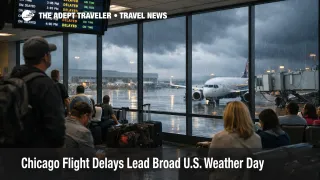
Chicago flight delays are setting the tone for a wider U.S. weather disruption on Tuesday, April 14, after the Federal Aviation Administration warned that wind could slow flights in the New York area, Denver, and Las Vegas, while thunderstorms could delay Detroit and both Chicago airports. By midafternoon, Chicago O'Hare International Airport (ORD) had already moved beyond forecast risk into live operational delay, with FAA status showing departure gate holds and taxi delays of 31 to 45 minutes and increasing. That makes Chicago the clearest early pressure point for domestic travelers trying to hold same day connections. Passengers with afternoon and evening trips should leave more buffer, avoid tight onward plans, and expect late aircraft arrivals to ripple deeper into the day.
Chicago Flight Delays: What Changed
The FAA's April 14 daily air traffic report flagged a multi city weather exposure pattern rather than a single isolated hub problem. Wind was the main concern for New York, Denver, and Las Vegas, while thunderstorms were the concern for Detroit Metropolitan Wayne County Airport (DTW), O'Hare, and Chicago Midway Airport (MDW). The difference in Chicago is that the risk had already become a live delay event, with O'Hare reporting longer departure delays than the other named airports when the FAA status page was last updated. Midway, Detroit, Denver, Las Vegas, and John F. Kennedy International Airport (JFK) were each still showing shorter general gate hold and taxi delays of 15 minutes or less in the latest available FAA status snapshots.
FAA planning notes show why this could become a broader afternoon and evening problem. The agency's current operations advisory listed terminal constraints tied to wind at New York area airspace, Denver, and Las Vegas, plus thunderstorm constraints at O'Hare and Midway. It also showed an active O'Hare ground delay program, possible ground stop or delay programs later in the day at Denver and JFK, and possible later programs at both Chicago airports. In the same advisory, the FAA said route restrictions into O'Hare from both the Northeast and Southeast had been extended because of ongoing en route thunderstorm impacts.
Which Travelers Face the Most Disruption
The most exposed travelers are domestic passengers connecting through Chicago in the late afternoon and evening, especially those trying to bridge short layovers between Midwest, Northeast, and West Coast flights. O'Hare is not just another airport on the list. It is a major hub where a weather slowdown can trap inbound aircraft, delay outbound crews, and compress later departure banks. Once that happens, the disruption spreads from one airport's surface delays into missed onward flights in cities that never see a thunderstorm themselves.
New York, Denver, and Las Vegas travelers also face real risk, but the mechanism is a little different so far. At those airports, the FAA's day of operations view was still more cautionary than severe in the latest public status snapshots, with shorter delay ranges still showing. That means travelers there should treat the afternoon as fragile rather than already broken. Detroit sits in a similar middle ground. The daily FAA report specifically named thunderstorms there, but the latest public airport status still showed only shorter general delays. That can change quickly if storm timing lines up with the heavier departure banks.
What Travelers Should Do Now
Travelers departing through Chicago on April 14 should assume that a legal connection is not the same thing as a resilient connection. Anyone with an afternoon or evening same day domestic connection through O'Hare should build a wider buffer now, not after the first inbound delay posts. If there is a choice between a later nonstop and a tighter Chicago connection, the nonstop is usually the safer operational choice on a day like this. Travelers with important evening events, cruises, tours, or long surface transfers after arrival should also start thinking about the cost of arriving late, not just the cost of changing flights.
For passengers routed through New York, Denver, Las Vegas, Detroit, or Midway, the main decision threshold is whether the itinerary still has room to absorb a moderate delay. If the trip depends on a short layover, a last train, or a fixed arrival deadline on Tuesday night, it is worth checking for earlier departures, longer connection options, or nearby airport alternatives before the system gets tighter. If the itinerary has slack and the current flight is still operating normally, waiting can still make sense, but only with close monitoring of FAA airport status and airline specific notifications. The daily FAA report itself says it is a planning tool, not a flight specific guarantee.
The next operational checkpoint is the evening push. The FAA advisory shows possible later ground stop or delay programs at Denver, JFK, O'Hare, and Midway, which means the day could widen from a Chicago led problem into a broader network management problem if forecast conditions verify. Travelers should watch whether O'Hare departure delays keep lengthening, whether Midway moves beyond minor delay territory, and whether New York or Denver shift from forecast concern into formal traffic management programs. Those are the signals that the recovery window is narrowing.
How the Disruption Spreads Through Travel
Weather delay days become more serious when they cluster across multiple hubs with different failure modes at the same time. In this case, Chicago is already dealing with live thunderstorm related departure friction, while the FAA is separately managing wind risk in the New York region, Denver, and Las Vegas. That matters because crews, aircraft, and spare seats move around the same national network. A late aircraft into Chicago can miss its next segment. A wind constrained departure bank in Denver or New York can then leave fewer recovery options for rebooked passengers. The result is that what starts as a local weather issue turns into a national reaccommodation and connection problem by evening.
The near term outlook is not yet a full system wide meltdown, but it is more than routine daily noise. The FAA daily report named six major pressure points, Chicago already showed a materially longer live delay range than the other cited airports, and the operations plan was already forecasting the possibility of additional formal traffic management actions later on April 14. For travelers, that means the seriousness is best described as meaningful disruption with room to worsen, especially for hub dependent itineraries and late day domestic connections.
Sources
- FAA Daily Air Traffic Report, April 14, 2026
- FAA Chicago O'Hare International Airport Real-time Status
- FAA Current Operations Plan Advisory, April 14, 2026
- FAA Chicago Midway Airport Real-time Status
- FAA Detroit Metropolitan Wayne County Airport Real-time Status
- FAA John F. Kennedy International Airport Real-time Status
- FAA Denver International Airport Real-time Status
- FAA Harry Reid International Airport Real-time Status