

Europe EES Border Delays Hit First Schengen Entry
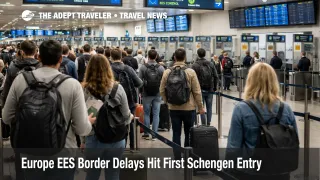
Europe EES border delays are now a live border control problem, not a rollout warning. The European Commission says the Entry, Exit System, or EES, became fully operational across all Schengen countries on April 10, 2026, replacing passport stamps with digital entry and exit records for non EU short stay travelers. Airport groups say that shift is already producing peak waits of 2 to 3 hours at some airport border posts, missed flights, and operational disruption even where border authorities are already using partial suspension measures. For travelers, the practical change is simple. The first Schengen entry on a trip now needs more slack, especially if that arrival feeds a same day flight, rail leg, cruise embarkation, hotel transfer, or tour pickup.
Europe EES Border Delays: What Changed
The key change is that April 10 ended the phased rollout. During the transition period, EES was operating progressively from October 12, 2025, with passport stamping still used in parallel at some crossings. As of April 10, the system is fully operational across the Schengen area's participating external borders, and first time eligible travelers must now go through biometric enrollment as part of normal border processing. That means facial image capture, fingerprint capture, and travel document data recording are no longer an edge case at selected points, they are the standard process at first entry.
That change matters most for non EU nationals entering for short stays of up to 90 days in any 180 day period. The system applies whether the traveler is visa exempt or traveling on a short stay visa. It does not apply to EU nationals, or to travelers who remain outside Schengen border control in pure international transit. The first trip after rollout is the slowest touchpoint, because later crossings are meant to rely more on verification than full enrollment once the biometric file already exists.
The live disruption claim is no longer speculative. ACI EUROPE and Airlines for Europe said on April 10 that airports and airlines were already seeing 2 to 3 hour border waits during peak periods, missed flights, and delays to departures, including examples of flights leaving with large numbers of passengers still stuck in the queue. The groups also said those delays were happening despite extensive use of partial suspension measures, which allow biometrics not to be captured in some cases.
Which Travelers and Itineraries Face the Most Risk
The most exposed traveler is the non EU visitor whose first Schengen entry is tied to another timed product later the same day. That includes U.S., U.K., Canadian, Australian, and other non EU short stay visitors landing at a Schengen airport and then continuing on a separate ticket, a nonrefundable rail booking, a cruise embarkation, or a prebooked transfer. The queue itself is only the first order problem. The second order problem is that border delay happens before the onward itinerary starts, so one slow control point can unravel the rest of the day.
The pressure point also changes by mode. At most Schengen airports, the problem hits on arrival at the first Schengen passport control point. At juxtaposed controls such as Dover, Folkestone, and London St Pancras, the pressure can hit before departure because the border process happens before boarding. In an earlier Adept Traveler article, Europe EES Border Queue Risk Hardens Before April 10., the core warning was that queue pressure was becoming an Easter planning issue. That has now shifted into a verified live processing bottleneck.
Airport flows are the biggest immediate concern, but cross channel and rail flows are structurally exposed for the same reason. When the border step happens before train closure, ferry check in cutoff, or a same day onward departure, EES delay can turn a legal trip into a missed departure even if the traveler arrived on time for the operator's old processing assumptions. In an earlier Adept Traveler article, Schengen EES Goes Fully Live on April 10, the main warning was that first entry processing would become the standard problem after full rollout. That is now what airports are reporting in practice.
What Travelers Should Do Now
Travelers should stop treating first Schengen entry as a routine passport stamp and start treating it as a variable length processing step. For a simple arrival with no timed onward leg, adding at least 2 extra hours of expectation at the first border point is now the prudent baseline, because that matches the upper end of the long waits airports are publicly reporting. For any itinerary that stacks a first Schengen entry onto a same day cruise embarkation, separate ticket flight, Eurostar leg, or a fixed tour pickup, the safer move is materially more slack or an overnight buffer in the entry city.
The rebook versus wait decision depends on what breaks if the border line runs long. Keep the current plan if the onward segment is protected on one ticket, the only timed event is the border itself, or a late arrival is acceptable. Rework the trip now if a single missed cutoff would trigger lost cruise boarding, a no show rail fare, an unprotected domestic flight, or a hotel transfer that is difficult to replace late in the day. Europe EES border delays are most dangerous when one queue sits between an international arrival and a nonrefundable second booking.
Over the next 24 to 72 hours, the most important signals are not broad political messaging, but operator advice at the exact airport, station, or port being used. Watch for carrier emails, airport guidance on arrival banks, Eurostar and ferry operator check in advice, and any notice that border authorities are using temporary flexibility. Travelers should also separate EES from ETIAS. EES is the live border control system now. ETIAS is the later pre travel authorization program, and the EU has not yet launched it.
Why The Delays Are Showing Up Now, And What Happens Next
The mechanism is straightforward. EES is meant to replace manual passport stamping with a digital record that tracks entries, exits, overstays, refusals of entry, and biometric identity checks. On paper, that should improve enforcement and eventually make later crossings more efficient. In practice, the first wave after full rollout is slower because first time travelers have to be enrolled, infrastructure varies by crossing, and busy arrival banks compress many new registrations into the same short window.
That is why airport groups are pressing for more flexibility even though they support the system itself. ACI EUROPE and A4E want border authorities to be allowed to fully suspend EES processing when waits become excessive, arguing that partial suspension has not been enough during peak flows. The immediate outlook is not a rollback of EES, but an operational fight over how much flexibility member states can use during peak summer traffic. That means some crossings may stabilize faster than others, while airports with heavy non EU demand at concentrated arrival banks remain exposed.
For travelers, the next phase is likely to be uneven rather than universally bad. Some later trips will move faster once biometrics are already on file, and some operators will adapt staffing and pre travel advice. But the broad travel planning rule has changed now. First Schengen entry is a higher risk timing point than it was before April 10, and that risk spreads beyond the airport whenever the rest of the itinerary depends on a tight same day sequence.
Sources
- Entry/Exit System (EES) is fully operational
- How the entry/exit system works
- Entry Exit System disruptions on first day of full operations affirm yet again the immediate need for flexibility
- Europe EES Border Queue Risk Hardens Before April 10.
- Schengen EES Goes Fully Live on April 10
- EU Entry/Exit System guidance