

China Seattle Entry Warning Hits U.S. Gateway Choice
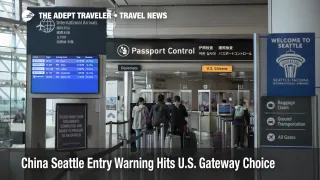
China's Seattle U.S. entry warning turns Seattle-Tacoma International Airport (SEA) into a live gateway decision point on April 16, 2026, not just another diplomatic headline. Reuters reports China's foreign ministry told its citizens to avoid entering the United States through Seattle after saying about 20 Chinese scholars with valid U.S. visas were questioned there and denied entry. For Chinese nationals, universities, corporate travel managers, and anyone ticketed on short onward connections after a U.S. arrival, the practical shift is immediate, gateway choice now matters more, and the safe assumption is that extra screening time at first entry can break the rest of the itinerary.
Seattle U.S. Entry Warning: What Changed
What changed is unusually specific. China did not issue only a broad caution about U.S. travel. It named Seattle as an airport to avoid, said the warning followed repeated questioning and harassment of Chinese scholars there, and told travelers to strengthen safety awareness, avoid entering through that airport, and prepare before departure. Reuters says the ministry tied the alert to a recent case involving about 20 scholars headed to an academic conference who were denied entry after questioning by U.S. Customs and Border Protection officers at Seattle.
That airport specific language matters operationally because U.S. inspection happens at the port of entry, not after a domestic onward leg. CBP says all persons arriving at a U.S. port of entry are subject to inspection, which means any extra questioning risk is concentrated at the first U.S. gateway and can cascade into missed domestic flights, rebooked meetings, lost hotel nights, and broken same day ground transfers.
SEA is not a trivial waypoint in that equation. The airport's official site shows it remains a major international gateway with dedicated international travel and federal immigration enforcement functions, so a warning aimed at Seattle can influence actual routing choices rather than symbolic ones.
Which Travelers Face the Most Exposure
The most exposed group is Chinese nationals whose trip purpose already attracts closer documentary scrutiny, especially scholars, students, researchers, conference attendees, and business travelers carrying institution linked materials or traveling on tight schedules. The warning itself was framed around scholars, but the broader risk for travelers is not limited to academia if itineraries rely on quick passage through first entry inspection.
A second exposure band is anyone using Seattle as a gateway to somewhere else in the United States. A traveler with a two hour domestic connection can absorb only so much variance before the trip fails, and inspection delay is harder to recover from than an ordinary late arrival because baggage, recheck timing, and terminal transfers may all sit downstream of passport control. That makes short separate ticket itineraries especially fragile. This is the same basic U.S. entry math Adept has already covered in U.S. Entry Restrictions Jan 2026: Country List, Visas and Global Entry Paused, TSA PreCheck Stays On in Shutdown, where border processing time, not just flight time, decides whether a plan holds.
Travel managers should also treat this as a routing and duty of care issue. If a China based employee or invited speaker can reach the same destination through Los Angeles, San Francisco, Vancouver, British Columbia, Canada, or a nonstop alternative that reduces U.S. connection complexity, that may now be worth higher fare or longer elapsed time. That is an inference from the warning and from how U.S. first entry inspection works, but it is the practical direction the risk points.
What Travelers Should Do Now
The immediate move is to review gateway choice before departure. If Seattle is only one of several workable entry points, shifting away from SEA lowers exposure to the exact airport China singled out. If Seattle is already ticketed and the trip cannot move, carry the full document set in hand, not only in checked baggage or cloud storage, including passport, visa, invitation letters, conference or meeting proof, return or onward itinerary, accommodation details, and employer or university contact information.
Connection buffers should be rebuilt conservatively. Travelers arriving from abroad into Seattle and continuing within the United States should avoid tight onward schedules, last flight of the night domestic segments, and any same day commitment that fails if inspection runs long. The decision threshold is straightforward, if a missed onward flight would collapse the purpose of the trip, pay for time now rather than gambling on standard connection logic.
Organizations sending travelers from China to the United States should also brief them on conduct at inspection. China's notice told citizens to respond calmly and rationally if questioned. Separately, CBP's public guidance makes clear that all arriving travelers are subject to inspection, so the practical goal is not to debate the process at the counter. It is to arrive prepared, keep answers consistent with the visa class and trip purpose, and reduce downstream schedule fragility if the inspection takes longer than planned.
Why Seattle Became the Flashpoint, and What Happens Next
The confirmed fact is narrow but consequential. China says Seattle was the site of repeated questioning incidents involving Chinese scholars, and it translated that concern into a named airport warning. What is not yet confirmed publicly is whether this remains tightly tied to a recent set of scholar cases or expands into a broader pattern affecting more traveler categories. Until that becomes clearer, the safest reading is operational, Seattle has become a higher uncertainty gateway for the traveler segment China addressed.
The next thing to watch is whether the warning changes actual booking and arrival behavior. If universities, conference planners, or managed travel programs start steering travelers away from Seattle, demand can shift toward other West Coast and transborder gateways, which may alter fares, seat availability, and domestic connection patterns even without any formal U.S. policy change. That second order effect is plausible, not yet measured, but it follows directly from an airport specific warning aimed at a major port of entry.
For now, the clean traveler takeaway is not that every Chinese national should cancel a U.S. trip. It is that the Seattle U.S. entry warning changes the risk map. Gateway selection, document readiness, and connection padding now matter more than they did a day earlier, especially for travelers whose trip purpose could draw extra questioning at first entry.