

Global Entry Paused, TSA PreCheck Stays On in Shutdown
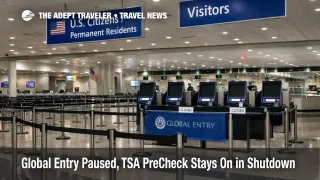
The Department of Homeland Security shutdown has produced a clearer operational split that matters for trip timing now. TSA PreCheck is still operating, after DHS briefly signaled it would be suspended, but Global Entry remains paused, which pushes vetted international return travelers back into standard primary inspection lines. TSA's public guidance also leaves room for airport by airport adjustments if staffing constraints tighten, so travelers should treat PreCheck as helpful but not guaranteed, and treat Global Entry as unavailable until an official restart notice is issued.
Global Entry Paused Shutdown: What Changed for Travelers
The new decision relevant fact is not the shutdown itself, it is the confirmed operating posture travelers will encounter at the airport. TSA has stated that TSA PreCheck "remains operational," with adjustments evaluated case by case as staffing constraints arise. In contrast, reporting across multiple outlets has been consistent that Global Entry remains suspended during the shutdown, meaning Global Entry members should expect to use standard processing on arrival.
For travelers, that changes where to spend buffer minutes. Outbound departures may feel mostly normal at many airports if PreCheck lanes remain open, but inbound international arrivals are the predictable choke point because Global Entry kiosks and the dedicated flow are not available, and time lost at passport control is time you cannot recover for a domestic connection.
Which Itineraries Face the Most Disruption
The highest exposure is international trips returning to the United States that rely on tight onward domestic connections, especially at hubs with heavy arrival banks where multiple widebody flights land close together. If you normally budget a short connection because Global Entry made passport control nearly deterministic, that assumption is now broken, and the variance is what causes missed flights, not just the average wait.
A second exposure band is travelers with same day commitments that assume "airport to curb" timing is stable, for example timed pickups, rental car counters near closing, and hotel check in windows after late arrivals. When Global Entry is paused, a 20 minute plan can become a 60 minute reality, and the downstream costs stack quickly if the next available flight is not until morning.
For travelers tracking this as part of the broader peak demand picture, the same shutdown driven split is already being treated as a throughput risk heading into the March and April travel surge. See US Spring Break Flights Set Record as Shutdown Hits for the volume context, and Global Entry Paused, Plan Longer U.S. Passport Lines for the deeper return trip mechanics.
What Travelers Should Do Now
Plan your international return like Global Entry will not be available. The cleanest operational move is to buy time in your itinerary, which means choosing longer scheduled connections on international to domestic transfers, and avoiding last flight of the night onward legs where a misconnect defaults into an overnight.
If your itinerary is already ticketed with a short connection, set a decision threshold before you depart. If missing the connection would create a cascading failure, for example a cruise embarkation, a nonrefundable tour, or a critical event, then proactively shifting to an earlier arrival or a later onward flight is often cheaper than dealing with same day reaccommodation when seats are thin.
For eligible travelers, Mobile Passport Control (MPC) can reduce friction at participating airports and can be set up before you land. CBP's MPC guidance allows submission up to four hours before landing, or immediately after landing, which means you can pre stage the workflow before you hit the queue. It is not Global Entry, but it is a practical fallback when Global Entry is offline.
Finally, keep TSA PreCheck, but treat it as probabilistic time savings, not a promise. TSA's public language is explicitly case by case when staffing constraints arise, so your best defense is simply arriving with a buffer that survives a lane consolidation surprise.
Why This Shutdown Creates Airport Bottlenecks
Trusted Traveler programs are throughput tools. When Global Entry is active, it segments low risk travelers into faster processing, which reduces load on standard primary inspection lines and can improve overall hall flow. When it is paused, the same volume is forced through fewer effective processing channels, and queues become more sensitive to arrival banks, staffing, and secondary screening spillover.
The first order effect is straightforward, longer and less predictable passport control lines for returning international travelers. The second order ripple is where trips break, missed domestic connections, more customers needing same day rebooking, higher call center load, later hotel arrivals, and more overnight stays when reaccommodation inventory drains. That is why this is not just an inconvenience story, it is an itinerary math story during a high demand period.
The extra twist is that the system is carrying uncertainty on the outbound side too. Even though PreCheck is operating, the stated posture allows airport by airport adjustments, which means a traveler can see "normal" at one checkpoint and "reconfigured" at another, with little warning. Until DHS funding is restored and Global Entry is explicitly restarted, the rational traveler posture is conservative buffers on returns, and slightly padded arrivals for departures.
Sources
- At this time, TSA PreCheck remains operational with no change for the traveling public (TSA on X)
- Department of Homeland Security suspends Global Entry as the partial government shutdown drags on (Associated Press)
- Reversing course, US will keep TSA PreCheck program operational (Reuters)
- US travel group, lawmakers urge Trump to resume use of Global Entry program (Reuters)
- Mobile Passport Control (MPC) (U.S. Customs and Border Protection)
- Mobile Passport Control app (MPC) (CBP Help Center)