

Europe EES Airport Delays Split Brussels, Operators
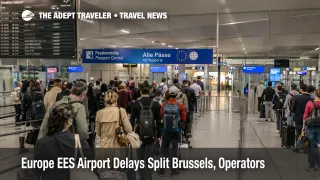
Europe EES airport delays are no longer just an airline complaint. Six days after the European Commission declared the Entry/Exit System, or EES, fully operational across Schengen on April 10, airport operators are publicly challenging Brussels' picture of normal performance and warning that real peak processing remains much slower on the ground. For non-EU travelers, the practical consequence is unchanged from the first rollout shock, but clearer now, the first Schengen entry still needs extra slack, and any same-day onward plan remains more fragile than pre-EES timing assumptions allowed.
Europe EES Airport Delays: What Changed
The new development is not the rule itself. The Commission says EES became fully operational across all Schengen countries on April 10, replacing passport stamping with digital entry and exit records for non-EU short-stay travelers and recording facial images, fingerprints, and travel-document data. Since the system's introduction, the Commission says it has already logged more than 52 million entries and exits, more than 27,000 refusals of entry, and identified more than 700 people seen as security risks.
What changed this week is the source of the backlash. In an earlier Adept Traveler article, Europe EES Border Delays Push Airlines To Seek Pause, the operational warning came mainly from airlines and missed-flight fallout. Airport operators are now making the same argument from the border-control side. ACI EUROPE said on April 10 that the Commission was citing an average registration time of 70 seconds when EES is functioning at full capacity, but airports and airlines were already seeing peak waits of two to three hours, missed departures, and disruption even where border authorities were already using partial suspension measures that skip some biometric capture.
That makes the disagreement more serious than a normal rollout complaint. Brussels is still describing a system that is broadly working, with only limited technical issues in a few member states. Airport bodies are describing a system that may work in the abstract but still breaks real passenger flows during peak banks, which is the condition travelers actually experience. The gap matters because airport staffing, gate management, and departure integrity are built around real queue times, not theoretical averages.
Which Schengen Arrivals Face the Most Risk
The most exposed traveler is still the non-EU visitor making a first Schengen entry at a large airport and then trying to keep a same-day chain intact. That includes U.S., U.K., Canadian, Australian, and other short-stay visitors whose trip continues to a separate-ticket flight, a rail departure, a cruise embarkation, a timed transfer, or a late hotel arrival. The first order effect is the border queue itself. The second order effect is that the queue now consumes the margin that used to protect everything after it.
The operator pushback is broad enough that travelers should stop treating this as a problem isolated to one airport or one country. Reporting on the dispute says airport complaints are coming from countries including France, Germany, Belgium, Italy, Spain, and Greece, and that ACI argues actual registration can take up to five minutes rather than the 70-second benchmark highlighted by the Commission. That does not mean every arrival will face multi-hour delays, but it does mean major first-entry gateways across western and southern Europe remain exposed when arrival peaks stack too many first-time enrollments into the same window.
Large hubs with heavy long-haul inbound banks are the weakest fit for tight onward planning right now. The main problem is not just volume, but volume mixed with first-time biometric capture. Once a traveler is already enrolled, later crossings may move faster because the system shifts more toward verification than full registration. The timing risk is therefore highest on the first Schengen touchpoint, not necessarily on every later border interaction in the same trip. In an earlier Adept Traveler article, Schengen EES Goes Fully Live on April 10, the main warning was that April 10 would turn first-entry timing into a live planning issue. Airport operators are now confirming that problem in practice.
What Travelers Should Do Now
For now, travelers should budget EES delay at the first Schengen entry as a live planning variable, not a one-off launch-week anomaly. If the arrival only leads to a simple transfer into the city, a later hotel check-in, or a flexible ground plan, extra patience may be enough. If that arrival feeds a separate booking with a hard cutoff, the safer move is materially more slack, and in many cases an overnight buffer in the entry city. The core rule is simple, do not build a same-day itinerary around pre-April border assumptions.
The rebook-versus-wait threshold depends on what breaks if the queue runs long. Keep the current plan if the onward segment is protected on one ticket, the next step is flexible, or a missed timing window would be inconvenient but recoverable. Change the plan now if a border delay could trigger a missed cruise boarding, a nonrefundable rail leg, an unprotected short-haul connection, or a costly late-night transfer problem. Travelers landing at the first Schengen point late in the day should be especially conservative, because a border overrun at the start of the evening is harder to repair than one in the morning.
The most useful signals over the next 24 to 72 hours will come from airports, border authorities, and carriers at the exact gateway being used. Watch for airport advice about peak arrival banks, carrier warnings for long-haul inbound passengers, and any notice that authorities are expanding flexibility measures when waits become excessive. The Commission has shown no sign of rolling EES back. The likelier near-term path is uneven local adaptation, more political pressure from airports and airlines, and a continued mismatch between system-level messaging and airport-level experience until traffic rises further toward summer.
Why Airport Operators Are Pushing Back Now
The mechanism is straightforward. EES is designed to replace a quick stamp with a digital border record tied to biometric enrollment and automated overstay tracking. That gives Brussels a strong security and migration-management case, and the Commission is leaning on those benefits in its public defense of the system. But airports are dealing with a different metric, whether the processing step fits inside the arrival waves and staffing patterns that keep terminals moving. Those are not the same question, and right now they are producing different answers.
That is why the argument has shifted from airlines to airport operators. Airlines feel the missed passengers and delayed departures at the end of the chain. Airports feel the queue formation, lane pressure, staffing mismatch, and passenger spillback earlier in the chain. When both sides are now saying the same thing, that peak processing is materially slower than Brussels' public baseline, the issue starts to look less like lobbying noise and more like a structural summer risk if traffic grows before procedures or flex rules improve.
What happens next will likely turn on flexibility, not repeal. ACI EUROPE and Airlines for Europe are pressing for broader powers to suspend or relax EES processing when waits become excessive, while the Commission is still arguing that member states must ensure proper ground implementation. That means the next traveler-facing shift will probably be local, more staffing, more tactical suspensions, more airport-specific warnings, and a continued need for larger buffers on first Schengen entry until peak summer performance shows whether the system can settle down under heavier volumes.
Sources
- Entry/Exit System (EES) Is Fully Operational, European Commission
- Entry Exit System Disruptions on First Day of Full Operations Affirm Yet Again the Immediate Need for Flexibility, ACI EUROPE
- New EU Entry-Exit System Causing Up to Three-Hour Delays, Say Airports, The Guardian
- Europe EES Border Delays Push Airlines To Seek Pause, Adept Traveler
- Schengen EES Goes Fully Live on April 10, Adept Traveler