

Eurostar Amsterdam Delays Expose Border Check Weak Point
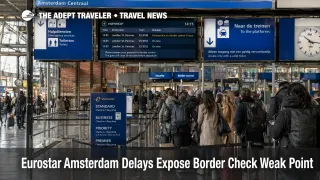
Eurostar Amsterdam delays became a live border processing problem on Thursday, April 16, 2026, after the operator said trains at Amsterdam Centraal were delayed because of an IT problem at border control. For travelers leaving the Netherlands for London, the issue matters before the train even moves, because passport and security checks for direct Amsterdam to London services happen before boarding. Eurostar was also warning of heavy station conditions elsewhere on its network, including Paris Gare du Nord, which means travelers should treat same day rail handoffs more cautiously than a normal timetable might suggest.
Eurostar Amsterdam Delays: What Changed
The disruption is not a general caution. It is tied to named Amsterdam departures on April 16. Eurostar's live updates showed ES 9115 from Amsterdam Centraal to London St Pancras International delayed, ES 9133 delayed from its scheduled 1040 a.m. departure, and ES 9147 delayed from 240 p.m. to about 310 p.m., with the scheduled 605 p.m. arrival pushed to about 635 p.m. Eurostar's wider disruption page was also still carrying a same day notice that Amsterdam trains were delayed because of the border control IT problem, with the page updated at 1256 p.m. local time.
That makes this more operationally serious than an ordinary rolling stock or line delay. When the choke point sits inside the departure funnel, travelers can lose time before they ever reach the platform. The train may be available, but the station process becomes the limiting factor. For business travelers, airport rail connections, evening hotel arrivals, and same day London meetings, that shifts the failure point earlier in the itinerary. A London arrival that slips by 20 or 30 minutes can be manageable on its own. It becomes more damaging when it breaks a prepaid transfer, a final regional rail leg, or a fixed check in deadline.
Which Travelers Face the Most Exposure
The highest exposure sits with passengers on direct Amsterdam to London trains, not those traveling within the continental part of the Eurostar network. Eurostar says travelers taking a direct train from Amsterdam or Rotterdam to London go through passport and security checks before departure, and at Amsterdam Centraal passports are checked first by Dutch authorities and then by UK Border Force. That means a border control IT issue in Amsterdam can delay the departure process even when the train itself is ready to run.
The risk is highest for travelers who built London around a tight onward chain. That includes rail passengers connecting to Heathrow or Gatwick by train, travelers heading straight to evening flights, and anyone using Eurostar as the first leg in a multi city work trip. Benelux passengers with Brussels or Paris connections are less directly exposed to the Amsterdam border control problem if they are not on a London bound departure, but the operator's separate notices about heavy conditions at Paris Gare du Nord and other network disruptions still argue for more slack across the corridor on April 16.
In an earlier Adept Traveler article, Europe EES Boarding Checks Tighten on April 10, the main warning was that border timing pressure could move upstream into check in and boarding. In an earlier Adept Traveler article, Europe EES Border Delays Hit First Schengen Entry, the focus was airport side first entry friction. Amsterdam now shows that rail can hit the same structural problem when border formalities sit inside the station departure process.
What Travelers Should Do Now
For April 16 departures from Amsterdam to London, the practical move is to arrive earlier than your normal comfort margin and to treat the station process, not the published running time, as the main risk. Eurostar's standard guidance for assisted travel from Amsterdam is 60 minutes before departure for London bound services, and its station guidance makes clear that these trips require both security and passport control before boarding. On a day with an active border IT failure, a larger buffer than the normal minimum is the safer assumption.
Travelers with a low margin plan should make a hard call before leaving for the station. If a London arrival delay of 30 minutes would break the rest of the day, the better move is to rework the onward segment now rather than hope the queue clears in time. That is especially true for separate ticket air connections, final departures of the day, or nonrefundable timed bookings in London.
Watch Eurostar's live disruption page, not just station boards or third party apps. The threshold to change plans is simple. If your Amsterdam departure is already listed as delayed and your onward plan has no recovery room, assume the border funnel is still unstable. If the service notice clears and your onward booking has some slack, the trip may still work, but it is no longer a day for razor thin transfers.
Why This Failure Point Matters Beyond Amsterdam
The bigger lesson is that cross Channel rail has a border processing weak point that behaves more like an airport than a domestic train departure. Eurostar's Amsterdam and Rotterdam to London services require security and passport checks before boarding, so the station becomes a controlled international exit point rather than a simple walk up rail platform. When that system fails, trains can be delayed by process friction even if the track, train, and crew are all available.
That mechanism has become more important since the EU Entry, Exit System, or EES, became fully operational across Schengen countries on April 10, 2026, replacing passport stamps with digital entry and exit records for non EU short stay travelers. Amsterdam's April 16 issue is officially tied to an IT problem at border control, not explicitly to EES. But the wider environment now has less slack for border side disruption, because more processing complexity is sitting at the control point itself. Until Eurostar says the problem is fully resolved, travelers should assume Amsterdam to London remains vulnerable to late clearing of formalities, even where delays stay modest on paper.
Sources
- Disruptions, Eurostar live travel updates
- Delays at Amsterdam Centraal on 16/04/2026, ES 9115 and ES 9147
- Delays at Amsterdam Centraal on 16/04/2026, ES 9133
- Do I need to go through security and passport control to travel from the Netherlands to the UK?
- Amsterdam Centraal station: practical info
- Entry/Exit System (EES) is fully operational