

EU Jet Fuel Plan Raises Summer Flight Risk
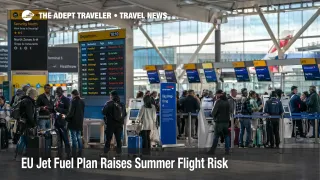
Travelers booking Europe flights for late spring and summer now have a clearer warning that the fuel problem is shifting from airline complaints to contingency planning. Reuters reported on April 16 that the European Union is drafting measures to map refinery capacity, push existing plants to maximum use, and develop additional jet fuel actions for publication on April 22, while the International Energy Agency has warned shortages could begin by June if Europe replaces only part of the fuel it usually gets from the Middle East. For passengers, that raises the odds of fare pressure first, then selective schedule cuts and weaker recovery options if the disruption lasts.
EU Jet Fuel Plan: What Changed
What changed is the level of response. In an earlier Adept Traveler article, Europe Jet Fuel Risk Moves Into Emergency Planning, the story was still about airlines and airports asking Brussels for help. On April 16, Reuters reported that the Commission is now drafting specific measures that would begin EU wide mapping of refining capacity next month and require action to keep existing refining capacity fully used and maintained, while separate jet fuel measures are still being finalized for the April 22 release window.
That is a more serious signal than a carrier saying fuel is expensive. Europe is more dependent on Middle East jet fuel imports than on any other transport fuel, Reuters reported, and many airports do not hold large stocks on site. The IEA's April Oil Market Report also says global crude throughputs are struggling because disrupted feedstock supplies and infrastructure damage are tightening product markets, with April crude runs cut sharply across Asia and the Middle East. When the physical system tightens at the refinery and import level, the traveler problem moves from ticket price pain to whether airlines can keep marginal frequencies and same day backup capacity intact.
Which Europe Trips Face the Most Exposure
The exposure is uneven, and that matters more than the headline. Reuters reported that Spain, with eight refineries, is a net exporter of jet fuel, while imports cover more than 60 percent of British demand. Britain is outside the EU plan itself, but it is still inside the wider European air system, so travelers originating in or connecting through London face a market with less domestic cushion if disruption persists. That also lines up with another recent Adept Traveler report, Virgin Atlantic Fuel Pressure Keeps U.K. Fares High, which showed a major Heathrow based carrier already talking in weeks, not months, about clear fuel visibility.
The most exposed itineraries are the ones with the least slack. Once daily flights, thin leisure routes, island links, and self connections are all more vulnerable than high frequency trunk routes through the biggest hubs. First order, airlines can protect their strongest departures and raise prices on the rest. Second order, reduced slack spreads into aircraft positioning, crew rotations, missed onward rail or cruise connections, and extra hotel nights when one broken sector no longer has an easy same day replacement. Reuters also reported on April 10 that Europe's airport industry group had warned of a systemic jet fuel shortage within three weeks unless Strait of Hormuz flows recovered, which shows how quickly airport level stress could outpace fare signals alone.
What Travelers Should Do Now
Travelers should book for resilience, not just price. On major city pairs with several daily flights, waiting can still be reasonable if fares are high and your dates are flexible. On secondary routes, cruise or tour linked itineraries, and long haul trips built around one critical connection, the better move is usually to pay for schedule depth, better change terms, and longer buffers now rather than hope the market stays loose.
The decision threshold is simple. Rebook or upgrade to a more flexible itinerary if your trip depends on the last flight of the day, a self transfer, or a nonrefundable land arrangement that breaks if one air segment slips. Wait only if you are on a dense route with multiple same day alternatives and you can absorb a longer connection or an overnight if conditions worsen. Travelers flying from the United Kingdom should be stricter on that threshold because Britain's import dependence leaves less room for complacency than markets with stronger refinery cover.
The signals to watch over the next several days are specific. Watch for the April 22 Commission release, airline language shifting from fuel prices to fuel availability, airport advisories about supply constraints, and quiet reductions on weaker frequencies rather than headline network cuts. Those are the signs that pricing pain is crossing into operational cuts. If they broaden through late April and May, the summer problem will be less about whether Europe can fly, and more about which routes and airports lose resilience first.
Why the Summer Risk Could Spread Fast
The mechanism is structural. Europe can still refine much of its own jet fuel, and the EU also requires member states to hold 90 days of emergency oil reserves, but Reuters reported that there is no specific jet fuel stock requirement and that commercial supply is highly uneven around the region. That means the backup exists in aggregate oil terms, not necessarily in the right product, at the right airport, at the right time. The Commission's draft response appears aimed at exactly that weak point, matching refinery output and maintenance decisions more closely to a distorted supply map before peak season demand gets heavier.
What happens next depends on whether replacement barrels from the United States and Africa can close enough of the gap. Reuters reported on April 15 that Europe is seeing record April jet inflows from the United States, but also said those extra shipments are unlikely to fully replace lost Middle East supply. The IEA has separately warned that many European refiners are already operating at maximum capacity for jet fuel production. So the likely near term path is not an immediate continent wide grounding. It is a narrower market with higher fares, weaker reaccommodation, and a greater chance that localized airport or route level fuel stress appears before the broader system formally runs short.
Sources
- EU working on jet fuel plan as Iran crisis threatens air travel, Reuters
- Europe could face jet fuel crunch within weeks, airports body warns, Reuters
- Europe sees record jet inflows from US in April, Reuters
- Oil Market Report, International Energy Agency
- Europe has 'maybe 6 weeks of jet fuel left,' energy agency head tells the AP, Associated Press