

Smartraveller Widens Middle East Transit Risk
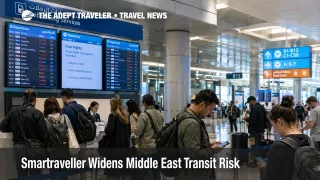
Middle East transit risk widened on April 15, 2026, when Australia's Smartraveller said the conflict is causing global fuel supply challenges and can disrupt trips even when the destination is outside the region. The advisory says travelers may face delays or cancellations to flights and local transport, venue closures, and changes in the availability of food, water, medicines, and essential services. That shifts the traveler problem from a region specific airspace warning to a wider network risk that can break itineraries through a transit point, a missed connection, or a destination level service squeeze.
In an earlier Adept Traveler article, EU Jet Fuel Plan Raises Summer Flight Risk, the pressure was still framed mainly through Europe's fuel planning response. In an earlier Adept Traveler article, Europe Jet Fuel Warning Raises June Flight Risk, the issue had already moved closer to actual schedule consequences. Smartraveller now makes the next step explicit, your trip can be affected even if the Middle East is only a layover, or not on the ticket at all, because fuel preservation measures and security disruption can spill into the wider travel system.
Middle East Transit Risk: What Changed
What changed is the scope of the warning. Smartraveller's April 15 update says the conflict has caused global fuel supply challenges, and that overseas travel plans may be hit by flight and local transport delays, service disruptions, venue closures, and short notice measures. The same advisory says "Do not travel" guidance applies to transit and layovers, not only destination stays.
That matters operationally because many travelers still treat Gulf hubs as neutral connection points when they are not actually entering the region. Smartraveller is telling them not to make that assumption. Its Middle East conflict page says travelers should not travel to, or transit through, Bahrain, Iran, Iraq, Israel, Kuwait, Lebanon, Palestine, Qatar, Syria, the United Arab Emirates, or Yemen. It also says embassies and consulates in Israel and the UAE are closed, with limited consular capacity elsewhere in the region.
Which Travelers and Itineraries Are Exposed
The most exposed travelers are people whose trip looks indirect on paper but fragile in practice. That includes Europe, Africa, and Asia itineraries that connect through Gulf hubs, cruise trips that rely on a same day flight into an embarkation city, and multi country journeys that need one late arriving long haul sector to line up with hotels, rail, tours, or onward short haul flights. Smartraveller's advisory is broad enough that the risk is no longer only an airspace closure. It is also the knock on effect of fuel controls, local transport disruption, and weaker essential services at the destination or transit point.
Insurance is part of that exposure, and the warning here is blunt. Smartraveller says travelers should check their policy for cover related to delays, cancellations, and changes to travel advice levels. Its guidance on travel advice levels also says standard policies are unlikely to cover Level 4 "Do not travel" destinations, and its formal Level 4 explanation says most standard policies will not cover those destinations at all and that the policy might be void.
That does not mean every disrupted trip becomes uninsured. It means travelers have to separate two questions before departure. First, is any transit point on the itinerary under "Do not travel" advice. Second, does the policy cover trip delay, missed connection, extra accommodation, or rerouting if the problem is transport disruption rather than a direct strike on the destination. Travelers who skip that check may discover too late that the airline offers only a credit, while the insurance policy excludes the transit exposure that triggered the loss.
What Travelers Should Do Before Departure
Start with the routing, not the fare. Read the travel advice for your destination and every transit point, exactly as Smartraveller instructs. If any layover touches a Level 4 location, ask the airline or travel advisor for a reroute before you cancel on your own. Smartraveller explicitly says to contact the airline or agent about alternative routes, rebooking, or refunds, and not to cancel flights until you get professional advice.
The next decision point is itinerary protection. Rebook sooner if your plan depends on a same day cruise embarkation, a final flight of the day, a short self connection, or a destination where a fuel or service squeeze would leave you with poor backup options. Wait longer only if your trip has built in slack, no Level 4 transit point, and multiple daily alternatives on the same carrier group. Travelers who want a broader framework for mapping knock on effects can also review How Air Travel Disruptions Cause Ripple Effects Across Regions.
Then check the insurance wording while the trip is still fixable. Smartraveller says call centers are under pressure, so do not leave this until the day of departure. Travelers who do not already understand their trip delay, cancellation, and advice level clauses should review the policy now, and compare that with the carrier's own rebooking and refund rules. Adept Traveler's Essential Travel Insurance: Protect Against Flight Cancellations is a useful companion on the cost side of delay and cancellation exposure.
How the Disruption Spreads Beyond the Region
The mechanism is broader than airspace. Smartraveller says countries are introducing fuel restrictions and other local measures to preserve supplies, and warns that essential services can be affected. That means disruption can spread through three layers at once, transport capacity, destination operations, and traveler support. First order, flights or local transfers run late, get cut, or become harder to confirm. Second order, hotel nights, cruise check in windows, tour timing, and onward recovery options all tighten.
The wider fuel story also supports that reading. Reuters reported on April 16 and April 17 that Europe is preparing jet fuel contingency measures and that IATA sees a risk of cancellations from late May if supply disruption persists. Smartraveller's update does not claim every region will see the same outcome, but it does tell travelers to stop treating the crisis as a narrow Middle East problem. For the next 24 to 72 hours, watch whether travel advice levels change, whether carriers begin pushing more reroutes around Level 4 transit points, and whether fuel conservation measures appear at destinations that are not themselves in the conflict zone. That is where Middle East transit risk now becomes a practical trip planning problem, not just a headline.
Sources
- Global travel impacts of conflict in the Middle East, Smartraveller
- Middle East conflict, Smartraveller
- Travel advice explained, Smartraveller
- Travel advice levels are changing, Smartraveller
- EU working on jet fuel plan as Iran crisis threatens air travel, Reuters
- Europe faces summer flight cancellations from jet fuel shortage, IATA says, Reuters