

Strait of Hormuz Reopening Leaves Fuel Risk in Place
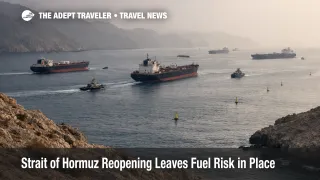
Strait of Hormuz reopening became official on April 17, 2026, when Iran said commercial vessels could pass during the 10 day ceasefire tied to the Israel, Lebanon track. That is a real operational shift, but not a return to normal. Travelers facing fuel driven airfare pressure, Europe summer flight risk, or Gulf connection uncertainty should treat this as the start of a slow supply repair, not the end of the shortage story. The immediate headline is better than a blocked chokepoint, but the traveler consequence remains live because ships, insurers, refiners, and airlines still have to decide when they trust the route again.
Strait of Hormuz Reopening: What Changed
What changed on April 17 is political permission, not full commercial normalization. Iranian Foreign Minister Abbas Araqchi said passage for all commercial vessels through the Strait of Hormuz was completely open for the remaining ceasefire period and said vessels would use a coordinated route set by Iran's Ports and Maritime Organisation. Reuters also reported that the reopening is explicitly linked to the Lebanon ceasefire, which means the shipping picture is still tied to a short, fragile diplomatic window rather than a settled maritime regime. At the same time, President Donald Trump said the U.S. naval blockade of Iranian shipping would stay in place, which leaves a major legal and operational caveat hanging over the headline reopening.
That distinction matters for travelers because the fuel system does not restart the second a minister posts that a chokepoint is open. Crude has to be loaded, tankers have to accept the voyage, underwriters have to price the trip, and refined products like jet fuel then have to move through refinery and airport supply chains before airlines feel real relief. In an earlier Adept Traveler article, Europe Jet Fuel Warning Raises June Flight Risk, the focus was the shrinking stock window in Europe. The reopening improves the direction of travel, but it does not erase that warning overnight.
Which Travelers Still Face Fuel and Flight Risk
The most exposed travelers are not only people sailing in the Gulf. They are also passengers holding Europe flights for late April, May, and early summer, because IATA said on April 17 that Europe could start seeing cancellations from the end of May if jet fuel shortages persist. Reuters reported that Europe relies on imports for a large share of its jet fuel, with about 75 percent of supply coming from the Middle East. Even with Hormuz nominally open, the European Union said on April 17 that it is still preparing for possible jet fuel shortages and could coordinate a release of jet fuel stocks if disruption continues.
There is also a difference between proving passage is possible and proving trade is ready to trust the route again. The U.S. military said on April 11 that two warships sailed through the strait to set conditions for mine clearing. That is an important signal. It suggests the present barrier is not simply that nothing can move through Hormuz. The harder problem is whether commercial operators believe the route is predictable enough to risk crews, cargoes, and schedules. In an earlier Adept Traveler article, Iran Blockade Raises Gulf Port Rerouting Risk, that confidence problem was already visible before today's reopening announcement.
What Travelers Should Do Before Booking or Rebooking
Travelers should resist reading the Strait of Hormuz reopening as a same day fare or schedule fix. If your trip depends on a late spring Europe flight, a Gulf connection, or a cruise and air chain that can be broken by one delayed segment, keep extra buffer in place. The better planning assumption is that airlines may get some pricing relief before they get supply certainty. Those are not the same thing.
Rebook earlier rather than later if your itinerary depends on a thin route, one daily frequency, or a same day onward connection that cannot absorb a missed flight. Wait longer only if your trip has schedule flexibility and your airport has multiple daily alternatives on major carriers. The next useful signals are not speeches. They are whether major container and tanker operators actually resume Hormuz transits, whether underwriters loosen terms, and whether EU officials next week sound less defensive about reserve releases and refinery optimization.
Why Tankers, Insurance, and Jet Fuel Will Lag
The biggest reason for caution is that the shipping industry still does not think the risk picture is clean. Reuters reported on April 17 that shipowners want clarification on mines, Iranian conditions, and practical implementation before moving vessels. A U.S. Navy advisory said the mine threat in parts of the Traffic Separation Scheme is not fully understood and that avoidance should be considered. That does not prove the strait is fully mined. It does show that mariners still lack enough certainty to treat the corridor as routine.
There is also growing evidence that Iran did not need to seal Hormuz in a classic all or nothing way to shut down trade. Reuters reported earlier this month that analysts and intelligence sources saw Iran using attacks, mines, and threats to make passage too dangerous or effectively uninsurable. A Reuters analysis described the surprise more bluntly, Iran appears to have shown that selective disruption, not a perfect physical seal, can be enough to keep most commercial traffic away. That is why today's reopening does not automatically mean a flood of tankers tomorrow. Operators still have to believe that selective coercion has actually stopped.
Insurance will slow the recovery too, though not in the simple way many headlines imply. Lloyd's Market Association said war cover remains available, but it also said reduced traffic was being driven by safety concerns, not a total absence of insurance. Reuters reported this week that war risk cover is still being reviewed every 48 hours and still adds hundreds of thousands of dollars in weekly cost. Hapag Lloyd said today that insurance coverage, exact sea corridor orders, and ship sequencing all still need to be cleared. Beazley's decision to launch a new $1 billion marine war consortium for Hormuz transits is another sign that the market is building special capacity for an abnormal route, not declaring business as usual.
For travelers, the practical conclusion is simple. Strait of Hormuz reopening is necessary, but it is not sufficient. Even if crude starts moving more freely now, refined products will take longer to show up where they are needed, especially jet fuel in import dependent markets. IATA said on April 8 that jet fuel supply could take months to normalize even after reopening because refining capacity has also been damaged and disrupted. That keeps the Strait of Hormuz reopening in the category of early relief, not restored normality.
Sources
- Iran's foreign minister says passage of vessels via Hormuz Strait is open during ceasefire | Reuters
- Shipping firms seek clarifications before crossing Hormuz | Reuters
- Mine threat in parts of Hormuz not fully understood, US navy advisory says | Reuters
- US military says two of its ships crossed through Strait of Hormuz | Reuters
- Europe faces summer flight cancellations from jet fuel shortage, IATA says | Reuters
- EU could release jet fuel stocks if Hormuz disruption persists | Reuters
- Airline and travel industries see no immediate relief from Iran ceasefire | Reuters
- Safety concerns, not insurance availability, driving reduced vessel traffic in the Strait of Hormuz | Lloyd's Market Association
- Beazley announces intent to launch a Marine War consortium | Beazley