

Iran Blockade Raises Gulf Port Rerouting Risk
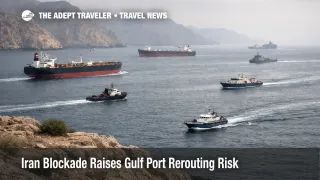
A Gulf port rerouting risk is now the sharper traveler problem on April 14, 2026. Reuters reported that the U.S. military is blocking shipping traffic in and out of Iranian ports, while also making clear that neutral transit through the Strait of Hormuz to non Iranian destinations is still allowed. That distinction matters, because the immediate shutdown is port specific, not a blanket closure of all Gulf shipping. Travelers using Gulf gateways, cruises, ferries, or coastal self rescue options should now plan for spillover into neighboring ports, longer reroutes, and faster changes in ground and hotel logistics if retaliation threats turn into local security controls or temporary access restrictions.
Gulf Port Rerouting Risk: What Changed
What changed since Monday is not only that the blockade is now active, but that the operating picture is clearer. Reuters reported on April 14 that nearly 24 hours into the U.S. action there were still no reports of Washington directly stopping neutral shipping that was not going to or from Iran, and separate Reuters shipping data showed Iran linked tankers still transiting the strait when their voyages were tied to non Iranian ports. That narrows the confirmed rule set. Iranian port traffic is the target. Neutral movement to other Gulf destinations is still legally and operationally distinct, at least for now.
That makes the traveler risk more specific, and in one sense more dangerous. The first version of the story was whether Iranian linked maritime access would be choked off. The April 14 version is that Tehran has threatened retaliation not only against naval vessels in the strait, but also against Gulf neighbours' ports. In an earlier Adept Traveler article, Iran Port Blockade Raises Gulf Travel Risk, the practical question was whether the blockade would become real and whether neutral traffic could still move. That threshold has now been crossed. The next pressure point is whether neighboring Gulf hubs start tightening security, altering port access, or becoming less reliable as fallback options.
Which Gulf Travel Flows Are Most Exposed
The most exposed travelers are not ordinary air passengers connecting far from the coast. The sharper exposure sits with people whose plans depend on maritime infrastructure or on coastal exit flexibility. That includes Gulf cruise passengers with embarkation, disembarkation, or port call exposure in the wider region, ferry users where maritime confidence matters, and travelers in countries such as Bahrain who may be counting on a sequence of airport, road, and port options instead of one clean exit path.
The risk also rises for travelers building self rescue plans around a nearby Gulf state rather than their current location. If Iran cannot use its own ports and begins threatening neighboring maritime infrastructure, second order pressure can spread into hotel demand near alternative departure points, tighter private transfer supply, and more conservative operating decisions by cruise lines and transport providers. In an earlier Adept Traveler article, Bahrain Exit Planning Shifts to Flights vs Causeway, the main logic was already narrowing to fragile air and road departure choices. A wider Gulf port risk does not automatically close those routes, but it reduces the margin for error when travelers assume they can improvise later.
A second layer sits with air travelers who think this is only a shipping story. It is not. Maritime disruption in the Strait of Hormuz and the Gulf of Oman can tighten jet fuel and operating costs even where flights still run. Adept has already tracked that pressure in Middle East Oil Shock Lifts Summer Airfare Risk. The first order effect is on ships and ports. The second order effect can still land at airports through fuel, schedules, and weaker fallback options if coastal hubs harden security.
What Travelers Should Do Now
Travelers with Gulf cruises, ferry links, or coastal transfers should stop treating nearby ports as interchangeable. Confirm the exact embarkation port, tender port, or transfer point your itinerary depends on, and match that against your hotel and airport plan. A cruise or ferry that still appears to be operating can become much less useful if port access roads, terminal security, or onward ground transport change faster than the booking system updates.
Travelers already in the Gulf should build a buffer around any departure plan that relies on same day improvisation. Keep one additional overnight option priced and ready near your intended exit point. Maintain enough cash, phone charge, medications, and document access to switch from one coastal or airport exit to another without returning to a hotel first. This is most important for travelers in higher risk Gulf locations where official advice already frames departure as a live planning issue.
The main decision threshold over the next 24 to 72 hours is whether threats against neighboring ports turn into operational measures. Rebook earlier, or move closer to your planned exit point, if you see any of the following: official notices restricting port access, cruise lines dropping Gulf calls, ferry operators suspending sailings, embassies telling citizens to reduce movement options, or airport and road advisories starting to mention coastal security cordons. Wait only if your route is inland, your carrier or operator is still reaffirming service, and you can absorb a delay without losing your whole itinerary.
Why the Risk Is Spreading Beyond Iran
The mechanism is straightforward. The blockade itself is port targeted, not a total maritime stop across the strait. Reuters reported that CENTCOM said the measure applies to vessels entering or leaving Iranian ports in the Gulf and Gulf of Oman, while neutral transit to non Iranian destinations remains allowed. That leaves a large middle zone where shipping can still move, but confidence can deteriorate quickly if military threats widen or operators fear inspection, misidentification, or localized retaliation.
That is why the Gulf port rerouting risk has become more important than the original headline shock. A traveler does not need every Gulf port to close for plans to fail. They need only one port to tighten access, one cruise line to skip a call, one ferry operator to pause sailings, or one state to issue a stronger advisory that pushes demand into fewer safe exits. U.S. MARAD has already said risks of Iranian attacks against commercial shipping remain high in the Persian Gulf, the Strait of Hormuz, and the Gulf of Oman, and Britain's Bahrain advice still says limited flights and short notice closure risk remain part of the picture. What happens next depends less on whether neutral shipping is still legally permitted, and more on whether regional operators and governments decide the security margin has become too thin to keep normal port access in place.
Sources
- US, Iran may resume talks this week despite port blockade, Reuters, April 14, 2026
- Tankers pass Strait of Hormuz on first day of U.S. blockade, data shows, Reuters, April 14, 2026
- U.S. military says it will start blockade of all ships going to and from Iran on Monday, Reuters, April 12, 2026
- Bahrain travel advice, GOV.UK
- 2026-004 Persian Gulf, Strait of Hormuz, and Gulf of Oman, Iranian Attacks on Commercial Vessels, U.S. Maritime Administration