

Metro Manila Protests Raise NAIA Transfer Risk
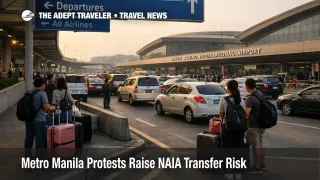
NAIA transfer risk in Metro Manila has risen again after the U.K. Foreign, Commonwealth & Development Office said on April 1, 2026 that large scale demonstrations are expected over the coming weeks in Metro Manila and elsewhere in the Philippines, may disrupt travel, and require extra time for journeys. For travelers, the immediate problem is not an airport shutdown. It is less predictable road access to Ninoy Aquino International Airport (MNL), slower hotel to terminal transfers, and a smaller margin for error once curbside traffic, check in, and immigration queues start stacking on the same day.
NAIA Transfer Risk: What Changed
What changed is the wording and the time horizon. The FCDO is not describing a single march or one dated protest window. It says large scale demonstrations are expected over the coming weeks in Metro Manila and elsewhere in the Philippines, that they may lead to travel disruption, and that travelers should allow extra time for journeys and monitor local media. That turns a background security note into a practical transport warning for anyone relying on timed road movement in Manila.
The first order effect is slower, less reliable surface access. A traveler can lose an otherwise workable itinerary without ever entering a rally site if police controls, crowd management, or rolling diversions change how long the airport run takes. The second order effect comes later in the chain. Once a delayed car trip reaches NAIA late, the remaining buffer has to absorb bag drop, airline deadlines, and immigration processing that the Bureau of Immigration is already telling travelers to plan around by arriving at least three hours before departure.
Which Travelers in Manila Are Most Exposed
The most exposed travelers are the ones with a fixed hour on the far side of Metro Manila. That includes international passengers leaving NAIA, travelers making same day domestic connections after an international arrival, visitors moving between bayfront or central hotel districts and the airport, and anyone trying to combine sightseeing, a hotel change, and a flight on the same day. NAIA remains the main airport gateway for the capital region, and its terminals and access flows still depend heavily on road timing before the airport process even begins.
In practical terms, corridor risk matters more than map distance. Travelers staying around Manila Bay, Ermita, Malate, Makati, Bonifacio Global City, Ortigas, or Quezon City may all face the same outcome if a protest or diversion hits one of the main cross city approaches. In an earlier Adept Traveler article, Manila Protest Risk Slows April Airport Transfers explained how airport runs can fail even when flights are still operating, because road controls and terminal pressure combine into one tighter deadline. In another earlier Adept Traveler article, Metro Manila Protests Raise Airport Timing Risk documented the same pattern as a rolling mobility problem rather than a one day disruption.
What Travelers Should Do Now
For NAIA departures over the next several weeks, the conservative move is to stop using normal Manila timing on any day with announced demonstrations, visible police buildup, or reports of route controls. The Bureau of Immigration says travelers should arrive at the airport at least three hours before departure. For anyone starting across town, checking bags, traveling as a family, or moving during a protest exposed period, that should be treated as the airport arrival floor, not the moment to leave the hotel.
The next decision point is route choice and trip design. Travelers should confirm their terminal before departure, ask their hotel or driver what route they plan to use, and avoid stacking a fixed time tour, meeting, or lunch onto the same day as a flight unless there is enough slack to survive a slow cross city transfer. New NAIA's official passenger information shows the airport's terminal structure and transport guidance, which makes terminal mistakes more avoidable than road delay itself.
For arrivals, the safer play is to keep the first evening flexible. A late airport pickup is inconvenient, but a rigid same night plan is what turns delay into a broken itinerary. Travelers with only one night in Manila should think harder about staying near the airport or dropping nonessential cross city moves. The tradeoff is simple, a less ambitious city plan can protect the flight, while a tight schedule leaves almost no room once Metro Manila traffic and protest controls begin to interact.
Why Metro Manila Delays Can Break a Full Itinerary
The mechanism is straightforward. Demonstrations do not need to close the airport to create NAIA transfer risk. They only need to disrupt the roads and junctions that feed the airport, hotel districts, and business areas across a dense capital region. Once traffic is rerouted or metered, travelers arrive at the terminal later, and that lost time cannot easily be recovered because airline processing and immigration still have hard cutoffs.
That is why this advisory deserves more weight than a generic protest warning. The FCDO's current text is forward looking, not retrospective, and it explicitly links demonstrations to transport disruption over the coming weeks. The likely next phase is not a single citywide shutdown, but recurring days when road movements become unreliable with little notice. Travelers who treat NAIA transfer risk as a timing problem instead of only a protest avoidance problem will make better decisions, especially on departure day and on any itinerary that depends on crossing Metro Manila at a fixed hour.
Sources
- Philippines travel advice, GOV.UK
- BI reminds Holy Week travelers to arrive early, secure documents ahead of travel
- BI on full force for Holy Week exodus; warns vs. fake eTravel sites
- New NAIA - Rewriting NAIA history into the future
- Transport | New NAIA - Rewriting NAIA history into the future
- Manila Protest Risk Slows April Airport Transfers
- Metro Manila Protests Raise Airport Timing Risk