

Nigeria Flight Shutdown Reprieve Leaves Risks in Place
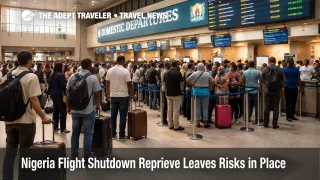
Nigeria flight shutdown reprieve has kept domestic service running on April 20, 2026, but the operational risk inside Nigeria has not gone away. The Airline Operators of Nigeria, which had warned it could halt flights from April 20, said over the weekend that it was only pausing the action after government intervention and ahead of talks in Abuja on April 22. For travelers, that removes the immediate grounding threat, but not the underlying pressure from Jet A1 costs, weak schedule resilience, or short notice airline changes if negotiations fail.
In an earlier Adept Traveler article, Nigeria Domestic Flight Shutdown Risk for April 20, the main traveler problem was a narrow window between the threatened shutdown date and a government meeting that came later. That window has changed. Flights are still operating, but only under what AON described as a conditional suspension of the stoppage plan, which means the system is functioning on a temporary political and commercial truce, not a settled fix.
Nigeria Flight Shutdown Reprieve: What Changed
What changed is not the fuel dispute itself, but the timing of the risk. Reuters reported on April 20 that Nigerian airlines temporarily suspended the planned nationwide shutdown after an appeal from Aviation Minister Festus Keyamo, with the pause tied directly to an April 22 meeting for the relevant parties. Reuters had already reported on April 16 and April 17 that carriers were threatening to stop domestic flying from April 20 and that the government was trying to head off both a shutdown and fare increases.
That is a real improvement for passengers booked this week, but it is not stabilization. AON's own position, as reported by Reuters and Nigerian media, is that the shutdown was called off only temporarily and only pending the outcome of the Abuja talks. The practical reading for travelers is simple: the hard stop threat has eased, but the market is still under cost stress and could shift quickly into higher fares, selective trimming, or another shutdown warning if the talks do not produce relief.
Which Nigeria Travelers Still Face the Most Exposure
The most exposed travelers are still those building bigger itineraries on top of a domestic Nigeria segment. That includes passengers feeding into long haul departures from Lagos, Nigeria, and Abuja, Nigeria, corporate travelers moving on fixed schedules, and anyone with same day domestic to international connections. A temporary reprieve helps only if the flight actually operates on time and leaves enough recovery room when something slips.
The exposure is broad because AON represents around a dozen mainly domestic carriers, not a single weak airline. Reuters described the group that way on both April 16 and April 20, which means the risk is system wide across Nigeria's domestic network rather than isolated to one operator. Daily Trust reported in late 2025 that Nigeria had 15 operating domestic airlines, including Air Peace, Arik Air, Aero Contractors, Max Air, United Nigeria, ValueJet, Ibom Air, Rano Air, Overland Airways, Green Africa, Xejet, and Umza Air. That does not prove each one is equally vulnerable, and current reporting does not support a ranked list of the most exposed carriers. The cleaner conclusion is that airlines most dependent on domestic flying and most sensitive to daily fuel and foreign exchange pressure remain under strain, but no authoritative source has published a carrier by carrier fragility table for this week.
First order, passengers avoid an immediate blanket grounding. Second order, misconnect risk, hotel timing, corporate travel churn, and tour joins remain fragile because a network under cost pressure has less slack when irregular operations hit. In an earlier Adept Traveler article, Africa Jet Fuel Shortage Hits Flight Planning, the pressure point was the broader fuel system. Nigeria now shows how that wider fuel stress can turn into a domestic mobility problem even without a formal fuel shortage declaration.
What Travelers Should Do Before the April 22 Talks
Travelers inside Nigeria this week should stop treating a confirmed booking as a fully stable itinerary. The safer move is to reconfirm flights directly with the airline, avoid the last domestic departure of the day when a missed segment would break the trip, and widen buffers around any onward international departure, cruise join, conference start, or prepaid ground arrangement. The reprieve lowers the odds of an immediate collapse, but it does not restore normal recovery options if a schedule is cut or repriced on short notice.
For travelers deciding whether to rebook now or wait, the threshold is whether a failure of the domestic leg would damage the rest of the itinerary. If the trip depends on a same day long haul connection, a major event, or nonrefundable lodging, protecting the itinerary matters more than squeezing a little more certainty out of the April 22 meeting. If the trip is point to point within Nigeria and timing is flexible, waiting for the meeting result may be reasonable, but only with close monitoring of fare changes and airline notices. Reuters reported that the minister also urged airlines to avoid immediate fare hikes, which suggests pricing pressure is still live even while flights continue.
The clearest signs of true stabilization would be a published outcome from the Abuja meeting, a visible softening in fare pressure, or airline statements confirming continued service without conditions. The warning signs would be fresh public complaints from AON, abrupt fare jumps, removed frequencies, or a return to shutdown language after April 22. Until one side publishes a concrete solution, Nigeria flight shutdown reprieve is still best understood as temporary breathing room, not a solved aviation fuel crisis.
Why the System Is Still Fragile After Flights Kept Running
The mechanism is straightforward. Reuters reported on April 16 that AON said jet fuel prices had risen about 270 percent since late February, while airlines argued that revenues were no longer enough to cover fuel alone. Reuters also reported that fuel often accounts for more than a third of airline expenses in Nigeria, and that carriers blame both supply constraints and foreign exchange pressure for the surge. That means a temporary political intervention can delay a shutdown, but it does not by itself repair the cost base that pushed airlines toward that threat.
There is also a difference between price stress and physical shortage. Nigerian regulators and officials pushed back against the idea of an outright fuel scarcity, and Reuters earlier reported that the local market dynamics include supply, pricing, and distribution questions, not only global crude moves. The main traveler consequence is that flights can keep operating while still becoming less reliable or less affordable. When that happens, the system often breaks first through thinner schedules, pricier last minute tickets, and weaker reaccommodation after a disruption, rather than through a clean one day shutdown.
What happens next depends on whether the April 22 meeting produces something tangible, such as pricing relief, payment flexibility, or another formal commitment to keep flights operating while talks continue. Until then, the most honest reading is that Nigeria's domestic network has stepped back from the edge, but it is still standing close to it.
Sources
- Nigerian airlines pause flight suspension as minister urges talks on fuel costs, Reuters
- Nigeria urges airlines to hold off flight suspensions over jet fuel price spike, Reuters
- Nigerian airlines threaten to halt flights over soaring jet fuel prices, Reuters
- Domestic airlines bow to pressure, shelve planned flight suspension, The Guardian Nigeria
- Jet Fuel Price Surge Sparks Calls for FG To Suspend Aviation Charges, THISDAYLIVE
- Nigeria Domestic Flight Shutdown Risk for April 20, Adept Traveler
- Africa Jet Fuel Shortage Hits Flight Planning, Adept Traveler