

Peru Gas Shortage Slows Lima and Callao Transfers
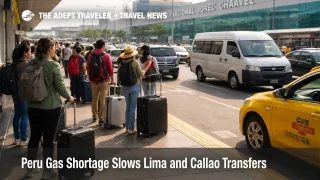
Peru gas shortage transfers remain a real planning issue in Lima, Peru, and Callao, Peru, because the U.K. Foreign, Commonwealth and Development Office, or FCDO, still says emergency measures are in place after the Camisea pipeline rupture and warns travelers to expect shortages of natural gas for vehicles. The immediate travel problem is not a confirmed shutdown at Jorge Chávez International Airport (LIM). It is a weaker urban transport system around the capital, where road movements can become slower, less predictable, and harder to recover when a pickup, hotel car, or intercity handoff slips. Travelers with flights, long distance buses, or fixed tour start times should build extra time into every road segment linked to the capital.
In an earlier Adept Traveler article, Peru GNV Shortage Hits Lima Ground Transport, the main warning was that Peru's fuel stress had become a ground transport problem. What is different now is that the official FCDO page is still current on April 20, 2026, and still points travelers to Lima and Callao emergency measures tied directly to the gas shortage rather than treating the disruption as a short lived March event.
Peru Gas Shortage Transfers: What Changed
The change that matters for travelers is operational, not symbolic. FCDO says Peru remains under a state of emergency, and its latest Peru update specifically says emergency measures affecting Lima and Callao were declared in response to the natural gas shortage, with disruption to gas for vehicles still part of the warning. That keeps the risk centered on everyday city movement, where taxis, ride hail supply, hotel transfers, and other road based links may not fail outright, but can lose reliability at the exact moment travelers need precision.
That warning fits the mechanics of the March crisis. Reuters reported that the Camisea pipeline rupture triggered Peru's worst energy crisis in two decades, that the government declared a 14 day emergency for the national pipeline network, and that the supply cut was severe enough to force rationing and remote work measures in Lima. Reuters also reported that about one million vehicles in Peru run on natural gas or LPG, which helps explain why a pipeline failure can spill quickly from the energy sector into road transport and timed traveler movements.
Which Lima and Callao Journeys Are Most Exposed
The most exposed travelers are the ones who need the city to run on time. That includes passengers heading to Jorge Chávez International Airport (LIM), late arriving visitors expecting a routine hotel pickup, travelers connecting from hotels to intercity bus terminals, and anyone trying to stack a flight, a road transfer, and a same day tour or onward booking into one chain. Lima and Callao matter most because that metro area contains Peru's main international gateway, so even a modest decline in vehicle availability or pickup timing can break an itinerary without any airport closure at all.
The second order effects are broader than the airport. When a large share of vehicles depend on constrained fuel supply, backup cars are harder to source, queues can build at fueling points, and transport companies may protect core routes first. For travelers, that can mean slower hotel to station runs, weaker margin for guided day tours, and more fragile handoffs into domestic flights or long distance bus departures. Reuters described the shortage as hitting transport alongside electricity and factories, which supports treating this as a citywide movement problem rather than a narrow airport story.
What Travelers Should Do Now
Build buffer into every road segment in Lima and Callao that connects to something you cannot easily replace. For airport runs, a prearranged hotel car or vetted transfer remains safer than assuming normal app based supply and normal pickup times. Travelers arriving after dark should land with a confirmed pickup plan, working mobile data, and enough flexibility for a longer wait or a more expensive transfer than expected.
The decision threshold is straightforward. If a delayed transfer would only cost convenience, extra buffer is probably enough. If a delayed transfer would break a nonrefundable domestic flight, a bus departure, a cruise embarkation, or a tightly timed Machu Picchu sequence, the safer move is to shift earlier, stay nearer the departure point, or split the itinerary so one late car does not collapse the whole day. For broader planning context when advisories and disruptions start affecting rebooking logic, Current Travel Advisories 2025: What U.S. Travelers Must Know is still a useful reference.
Over the next 24 to 72 hours, watch four things. First, any change to the FCDO Peru page. Second, whether local transport providers start adding explicit delay warnings or surcharge language. Third, whether your hotel or airline begins steering travelers toward earlier departures for Jorge Chávez transfers. Fourth, any sign that the Lima and Callao emergency measures are being narrowed or formally lifted. Until those signals improve, the prudent assumption is friction, not normality.
Why the Shortage Still Changes City Movement
The mechanism is simple. A pipeline rupture cut into a fuel system that matters well beyond power generation. Reuters reported that the damaged line is part of the backbone that supports a large share of Peru's electricity and most of its LPG supply, and the resulting shortage forced the government to prioritize households, essential services, and emergency response. Once that happens, lower priority road movements become the adjustment layer, and traveler transport is part of that layer.
What happens next depends less on headlines and more on whether the transport system regains slack. Peru did restart distribution in mid March, according to Reuters, but the current FCDO page still treats Lima and Callao emergency measures tied to the shortage as an active traveler issue on April 20, 2026. That combination suggests the main risk is not dramatic collapse. It is a capital region transport network that remains less tolerant of tight plans, thin buffers, and last minute improvisation. For travelers, that is serious enough to justify earlier departures, stronger transfer planning, and more caution around same day airport and intercity links.