

Porto Vigo Rail Break Forces Celta Bus Transfer
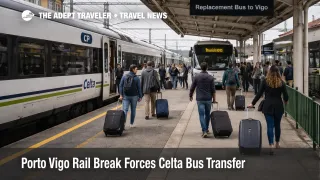
Porto Vigo rail transfer risk now runs through April 7, 2027, after CP replaced part of the Celta with a road segment between Valença do Minho, Portugal, and Vigo-Guixar, Spain. For travelers, that turns one of Iberia's simplest cross-border rail trips into a transfer itinerary with more exposure to road traffic, baggage friction, and missed same-day plans. The change matters most for leisure travelers building multi-stop loops through northern Portugal and Galicia, Spain, and for anyone trying to connect the train to a hotel check-in, a flight, or a timed tour on the same day. The safest assumption is that the journey still works, but it no longer behaves like a clean end-to-end rail product.
Porto Vigo Rail Transfer: What Changed
CP says engineering works in Spain affect Celta trains 420, 421, 422, and 423 from April 6, 2026, through April 7, 2027, requiring a replacement bus on part of the route. The replacement section runs between Vigo-Guixar and Valença do Minho with no intermediate stops, while the published train times remain in force even though actual arrival time can vary with road conditions. In practical terms, the rail journey still exists on paper, but the Spanish side now behaves more like a rail and coach connection than a through train.
That distinction matters because the Celta's appeal has always been simplicity. The service links Porto-Campanhã with Vigo-Guixar and normally serves a leisure-friendly corridor used for short city breaks, regional touring, and onward connections into Galicia. Once a road segment is inserted, the weak point shifts from track reliability to transfer handling, road traffic, curbside boarding, and whether passengers can move comfortably with what they are carrying. Reporting based on CP's notice says the bus segment also creates extra limits for some travelers, including no pets on the replacement coach, no wheelchair carriage on that bus segment, and bikes or scooters only if packed within specified dimensions.
Which Travelers Face the Most Friction
The most exposed travelers are not necessarily those taking the longest trip. They are the ones depending on precision. If you planned Porto to Vigo as a smooth mid-trip transfer before a same-day hotel arrival, winery visit, rental car pickup, or onward Renfe connection, the added coach segment reduces the margin for error. A train delay is one kind of problem. A bus transfer layered on top of a train is another, because it adds boarding friction, luggage handling, and traffic risk that rail travelers often did not price into the day.
This change is especially awkward for travelers carrying large bags, folded strollers, bike cases, or mobility aids, and for visitors who chose rail specifically to avoid driving or cross-border coach travel. It also hits touring logic on both sides of the border. Porto stays paired with Santiago de Compostela, Rías Baixas coast loops, and Galicia road trips become less fluid when the cleanest rail spine turns into a mixed-mode connection. For travelers building Portugal and Spain into one compact itinerary, the first order effect is a slower, less seamless transfer. The second order effect is that every later reservation, hotel arrival window, and onward connection becomes more fragile.
In an earlier Adept Traveler article, Portugal General Strike December 11 Hits Transport showed how quickly cross-border Iberian plans weaken when surface transport becomes transfer-dependent instead of direct. The same planning logic applies here, even though this is a scheduled works project rather than a strike. And in an earlier Adept Traveler article, Sweden Rail Works Break Stockholm Narvik Night Train, the core traveler problem was similar: a headline rail journey still existed, but the forced interchange changed baggage handling, timing tolerance, and missed-connection risk.
What Travelers Should Do Now
Travelers should treat the Celta as usable, but not as a tight-connection product. For Porto departures, that means resisting the temptation to stack this trip against a same-day flight out of Vigo or a rigid timed entry soon after arrival. For Vigo departures, it means assuming the road section can widen the real journey time even if the timetable itself has not changed. If this rail leg is the hinge between two expensive commitments, a bigger buffer is no longer optional.
The decision threshold is simple. Keep the train if your day can absorb slippage and you still want the lower-stress, no-car option for most of the journey. Rebuild the itinerary if you are carrying awkward luggage, need guaranteed accessibility on the transfer segment, are traveling with pets, or are connecting onward to something that will not wait. For some travelers, especially those moving in a group or trying to cover multiple Galicia stops in one day, a direct car hire or an all-road plan may now be the cleaner choice even if rail looked better before the works began.
If you are still choosing where to base yourself, Galicia, Spain is a useful place to reset the itinerary around what you actually want to do on the Spanish side, instead of treating Vigo as a simple rail handoff. Over the next 24 to 72 hours before travel, monitor CP for any operating refinements, then check whether your hotel, tour, or onward ticket can tolerate a later arrival than the old all-rail version of the trip suggested.
Why the Celta Break Matters Beyond One Train
This is more than a one-off inconvenience because the disruption window is long. A one-year-plus works period, running from April 6, 2026, to April 7, 2027, catches multiple leisure seasons and removes the assumption that travelers can simply "wait a few weeks" for the route to normalize. It also affects all four Celta services named by CP, which means the disruption is structural for the route during the works period, not just a weekend pattern or a low-frequency maintenance window.
The broader mechanism is straightforward. Cross-border rail sells confidence as much as transport. When the through journey breaks, the route can still operate, but it behaves differently in ways travelers feel immediately: more handoffs, more mode changes, more uncertainty about real arrival time, and more exclusions for edge-case needs. That is why a works notice on one corridor can spill into hotel timing, airport access logic, and whether travelers keep a two-country itinerary compact or split it into longer stays. For northern Portugal and Galicia travel through spring 2027, the headline is not that rail disappeared. It is that the cleanest version of the rail journey did.