

Flight Delays and Airport Impacts: April 21
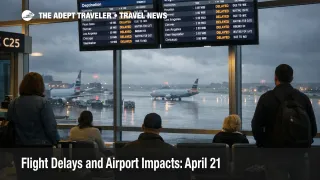
April 21 flight delays are shaping up first as a Texas weather problem, then potentially as a wider late day hub issue if delays spread into Chicago and the national network. The Federal Aviation Administration said on Tuesday, April 21, 2026, that low clouds and thunderstorms may slow flights in Dallas Love Field (DAL) and Dallas Fort Worth International Airport (DFW), with additional low cloud risk in Houston, Austin, and San Antonio, while the FAA operations plan also flagged San Francisco International Airport (SFO) for gusty winds and low clouds. Travelers connecting through Texas, heading to Northern California, or relying on late day hub connections should treat the afternoon and evening banks as exposed and build margin now.
April 21 Flight Delays: What Changed
The immediate shift on April 21 is that the FAA's public daily report is centered on Texas and San Francisco, not a broad East Coast weather pattern. The agency's daily air traffic report specifically pointed to Dallas Fort Worth, Dallas Love Field, Houston, Austin, San Antonio, and San Francisco, while the command center's operations plan went further by warning of a possible DFW ground stop through 1000 a.m. CDT and possible San Francisco ground stop or ground delay action after 500 p.m. CDT.
The command center plan also shows this may not stay confined to those first pressure points. It flagged possible ground stop or delay action for Houston's major airports after 200 p.m. CDT and possible ground stops at Chicago O'Hare International Airport (ORD) and Chicago Midway International Airport (MDW) after 200 p.m. CDT, with possible Chicago route management later in the day. That does not mean all of those programs will fully materialize, but it does show where the FAA expects the system to tighten if forecast conditions verify.
Which Travelers Face the Most Disruption
The most exposed travelers are the ones connecting through Texas during the morning and midday push, then through Chicago or San Francisco later in the day. Texas thunderstorm delays matter beyond the local airports because Dallas and Houston sit on major east west and north south flows. When weather slows arrivals there, the first hit is departure sequencing and inbound holding, but the second hit is later aircraft rotations, thinner rebooking options, and weaker connection reliability well outside Texas.
San Francisco carries a different kind of risk. Wind and low ceilings reduce arrival efficiency fast at SFO, and the FAA has already signaled possible control programs later in the day. Chicago is the key multiplier to watch after that. Even modest Chicago restrictions can spread nationally because ORD touches so many domestic networks, and that risk now sits on top of a broader FAA summer effort to reduce chronic O'Hare congestion through temporary flight caps starting May 17. On April 21, that means any ORD slowdown deserves more respect than a routine local weather delay.
What Travelers Should Do Now
The practical move is to protect the itinerary before formal delay programs stack up. Check your airline app early, not just the airport board, and treat connections under about 90 minutes through Dallas, Houston, San Francisco, and Chicago as exposed today. If your trip depends on a same day cruise embarkation, an international departure, a hard evening event, or a nonrefundable hotel move, earlier departures and longer layovers are stronger than waiting for a formal ground stop. The FAA itself says travelers should check with their carrier for flight specific delay information.
The next decision point is whether your delay risk sits at the origin, the connection, or the final hub. Travelers departing Texas this morning should assume weather may slow the first leg. Travelers flying into San Francisco or Chicago later should assume the bigger risk may be a compressed evening recovery window. In an earlier Adept Traveler article, Flight Delays and Airport Impacts: April 20, the same system pattern appeared in a different geography, a few constrained hubs can do outsized damage once the day loses slack. Readers who want the structural version of that problem can also read U.S. Air Traffic Control Privatization: Reality Check.
For travelers already committed to flying today, watch for three signals. First, whether Texas weather forces longer control programs than the FAA currently projects. Second, whether SFO moves into afternoon ground delay or ground stop action. Third, whether ORD and MDW pick up actual controls later in the day. If those stack in sequence, April 21 can shift from a regional disruption day into a broader evening recovery problem.
How April 21 Flight Delays Could Spread Next
The mechanism is straightforward. Weather cuts the number of arrivals an airport can safely handle, then air traffic control meters flights into that reduced capacity. At a place like Dallas or Houston, that starts as a local flow problem. At San Francisco or Chicago, it can become a network problem because the airports are large connection and aircraft rotation points. The first order effect is arrival and departure delay. The second order effect is late inbound aircraft, broken crew timing, missed onward connections, and fewer same day recovery options.
What happens next depends on how long the Texas weather lingers and whether the late day forecast windows at San Francisco and Chicago verify. The FAA's public daily report is still narrower than the command center's deeper planning document, which is a useful reminder that the wider risk map is still conditional, not fully realized. For now, the right read is not national meltdown. It is a protect the itinerary day for travelers touching Texas, San Francisco, and later Chicago, especially if the trip depends on tight timing and limited fallback options.